
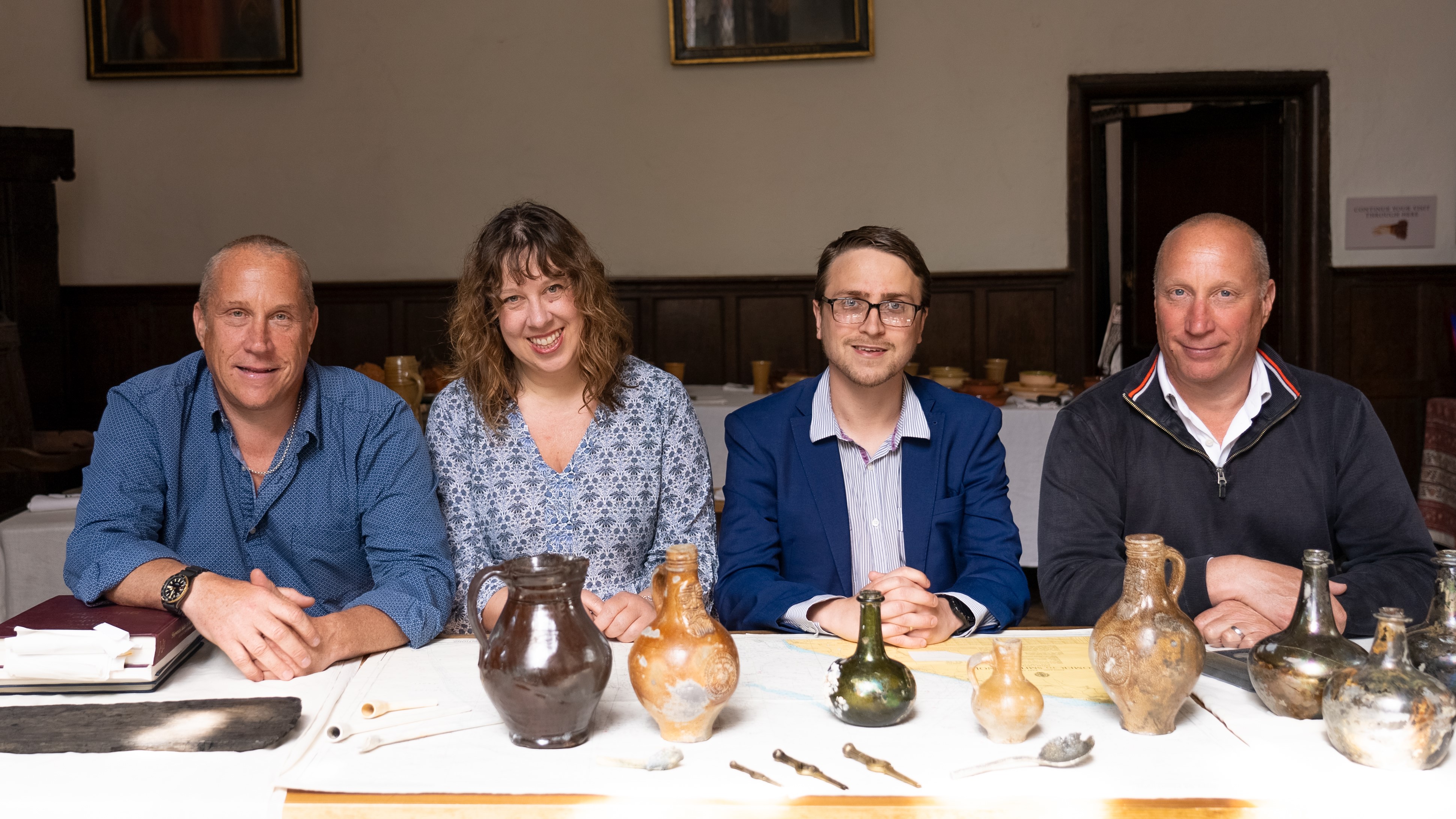
Last June, UEA announced the discovery of the shipwreck of The Gloucester, a 17th century warship which sank in 1682, off the coast near Great Yarmouth. Following the opening of an exhibition focused on the discovery at Norwich Castle, I spoke to Claire Jowitt, Professor of English and History at UEA, who is acting as Principal Investigator on the project as well as being one of the curators of the exhibition, and the diving brothers who discovered the wreck, Lincoln and Julian Barnwell.
The Gloucester is a particularly significant discovery because of its royal passenger, James, Duke of York (later James II). Claire told me how a period of succession crisis around whether James, a Catholic, should be able to take the English throne was somewhat subsiding by 1682, and James had returned to court from Scotland where he had been based. This voyage then, in May 1682, was heading back to Scotland, to bring James’ family to join him in England, when they met, according to Claire, “quite a difficult passage around the North Norfolk coast.” Following disagreements over the best course to take, at 5:30 the next morning the boat hit a sandbank and sunk. There were evacuations, but as Claire described, James was hesitant to abandon the ship and “royalty have to leave first… and actually the ship’s underwater really quickly… and that means that an awful lot of people lose their lives.”
Despite the royal connection, it’s the other passengers, numbering a maximum of around 400, who are forming a substantial amount of the research Claire and Dr Benjamin Redding, Senior Research Associate in the School of History, are conducting. There were many nobles accompanying James, but one of the aims of the project is to look outside of the traditional ‘Great Men’ of history, stories Claire says “our historical record is full of,” and instead uncover the lives of those lower down the social scale. One example Claire draws on is of James Littledale, servant of the Earl of Roxborough, who drowned alongside his master who couldn’t swim whilst trying to save him. Claire and Ben are looking at stories from across the social spectrum, but as Claire emphasised, “we’re always really pleased when we’re not just dealing with a noble.”
Fast forward 325 years, and in 2007 brothers Lincoln and Julian Barnwell were looking for a new diving project. As Lincoln told me, “We’ve been diving Second World War wrecks for many years and we soon learnt that wooden wrecks were really interesting… so I flipped through the [British Isles Index of Shipwrecks by Richard and Bridget Larn, on display in the exhibition] to the oldest date I could get to, suddenly saw 1682, the Gloucester, the Duke was on board and then there’s that magic word: ‘cannon’! It might be a boyhood thing, but I used to love cannons and that’s what really got me, and that night I rang up my brother to see if he’s up for a new adventure, I knew what he’d say and he was, so off we went!”

Lincoln went on to describe the first dive on the project, recalling that, “The first dive was any diver’s dream really, I’ll never forget that. We got to the seabed and I just knelt there and I took… it must have been like 10 minutes just looking at the view, I didn’t want to move anywhere, just wanted to really enjoy the moment, to remember it, absorb it, and just surrounded by these 9 foot cannons.” Claire also told me how the discovery of a brick without a frog (“a little dent on one side”) in it, which can be seen at the start of the exhibition, first identified the wreck as being early modern, rather than 19th or 20th century.
Since that moment the project has been ongoing, with the discovery of the ship’s bell in 2012 (“the diver’s mission,” according to Lincoln) confirming the wreck as being The Gloucester. UEA entered the project in 2019 at the request of Steve Miller, director of the Norfolk Museums Service, and the current exhibition has been co-curated by Claire, Ben and Ruth Battersby Tooke and Dr Francesca Vanke of Norfolk Museums. Lincoln said that he hopes the exhibition “Might inspire someone to start diving, take an interest in shipwrecks – they are fantastic – or dive some lovely coral reefs, and then maybe even do a course, become an underwater archaeological specialist in the 17th century,” whilst Julian highlighted his delight at the engagement with younger visitors.

The exhibition features a range of items both from the wreck and loaned from other institutions like the National Maritime Museum, and is split into two parts, one focusing on the 17th century history of the ship, and the other on its new life in the 21st century. One of the key finds, of which there are some at the exhibition, were 149 wine bottles (a substantial proportion of the 4-500 artefacts that have been recovered). Claire suggested these show James was “in a party mood,” and she was particularly excited by the 29 still with their full contents, including “ullage, which is the little bit of air between the liquid and the cork. So in those bottles there is 17th century pre-industrial air which has been kind of captured down there.”
Also on display are the contents of two chests which were found, which Julian described as “quite cool, because you’ve got so many objects [from a] range of social classes.” These include a pair of glasses with their original case, items of clothing and ink from an inkwell! Claire also highlighted “a little leather purse that’s got crown symbols on it… the only item rescued to date that screams royalty with the St Edward’s Crown on it” (the same crown which will be used in Charles III’s coronation in May), as well as a urine specimen jar which may have been used by James. UEA students may also be interested to see an animation telling the story of the shipwreck in the exhibition, which was written by Steve Waters, UEA Professor of Scriptwriting, and voiced by current and former UEA drama students.

Claire spoke about the importance of the discovery to UEA, as it is “a story that’s important for Norfolk and we are an anchor institution within Norfolk… Ideally what UEA would love is for there to be a permanent home for these artefacts… a Norfolk Mary Rose, and UEA as an anchor institution would do all it could to support those kinds of ambitions.” The Barnwell brothers also talked about the value of the exhibition for Norfolk’s tourism industry with Julian discussing the potential for a permanent museum with “immersion technology… a digital museum as well as objects.” He hopes people “realise this is just the first chapter of the modern 21st century story of The Gloucester, and help us turn it into what she deserves to be.”
For now, Claire and Ben are continuing to work on their book, “a cradle to grave history of the Gloucester,” whilst the exhibition at Norwich Castle, The Last Voyage of the Gloucester: Norfolk’s Royal Shipwreck, 1682, runs until September. Entry is free for UEA students.
Featured Image: L to R: Lincoln Barnwell, Prof. Clare Jowitt, Dr Benjamin Redding, Julian Barnwell (UEA)



Leave a Reply