
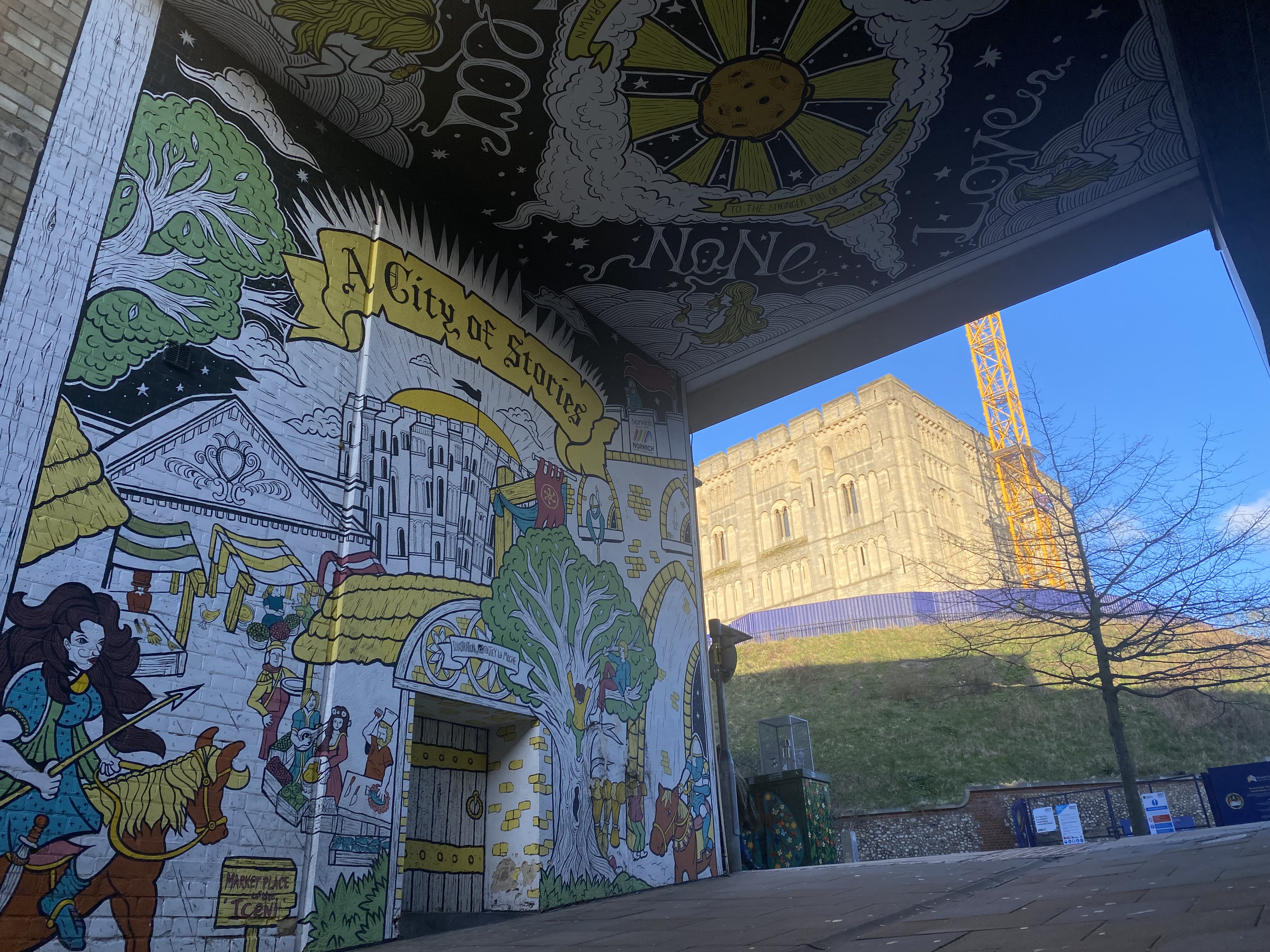
Since 2012, Norwich has had the distinction of being the first UNESCO City of Literature in England. Perhaps the best way to understand why is to take a walk around the city.
In the small church of St. Julian’s, that stands on Rouen Road, the earliest surviving book authored by a woman in English, Revelations of Divine Love, was written in 1395 by Julian of Norwich. Julian lived secluded in a cell attached to the church, praying and meditating. She is one of the most incredible medieval mystics. Her visions of Christ-as-loving-mother communicated in the Revelations still move hearts today, religious or not, with their hopes that ‘all shall be well.’ No stay in Norwich is complete without a visit to her small cell, where a mass is still held most days. There is a sense of tranquillity there; I once spoke with a woman who had travelled from Somerset to do nothing but spend three days there in meditative silence.
Just outside is one of Norwich’s eight Book Benches. These sitable stone sculptures feature the titles of books with connections to Norfolk, some famous, some esoteric.
A short distance from St Julian’s church is another literary landmark, the National Centre for Writing. It led Norwich’s bid to become a UNESCO City of Literature, so its impact should not be overlooked.
It organises scores of literary workshops, programs, and events throughout the year, which are undoubtedly worth checking out.
Closely partnered with the National Centre for Writing is the British Centre for Literary Translation, founded in 1989 by W.G. Sebald (best known for The Rings of Saturn). It is highly regarded, being the leading translation institution in the UK. Head to the Forum at the heart of the city, to find the church of St. Peter Mancroft, which houses the tomb of renowned 1600s polymath and bibliophile, Thomas Browne. His influence on literary style cannot be underestimated, and his private collection of books became the foundation of The British Library.
Opposite that church is the impressive Millennium Library; the busiest library in the UK from 2007-2014, remaining a bustling hub of activity. In 1850, Norwich was the first municipality to enact the Public Libraries Act, pointing to a long precedent of the importance of culture to the city. Today, Norwich spends more on culture, per capita, than any other in the UK.
If you would like to empty your wallet for the sake of this statistic, I would recommend The Book Hive for new books. It tends to stock more pleasantly unexpected offerings than Waterstones, including indie-press publishings. For second-hand books, head to Tombland for the appropriately-named Tombland Bookshop, with its antiquarian (pleasingly antediluvian?) atmosphere.
Clearly, Norwich’s literary merit would be greatly diminished without UEA. Our famed Creative Writing Course, established in 1970, was the first of its kind in the UK. Notable alumni include Ian McEwan, Naomi Alderman, and the Nobel Prize Laureate, Kazuo Ishiguro.
And finally, perhaps most importantly, UEA is the home of Concrete, of course.
Image: Sophie Handyside




Leave a Reply