
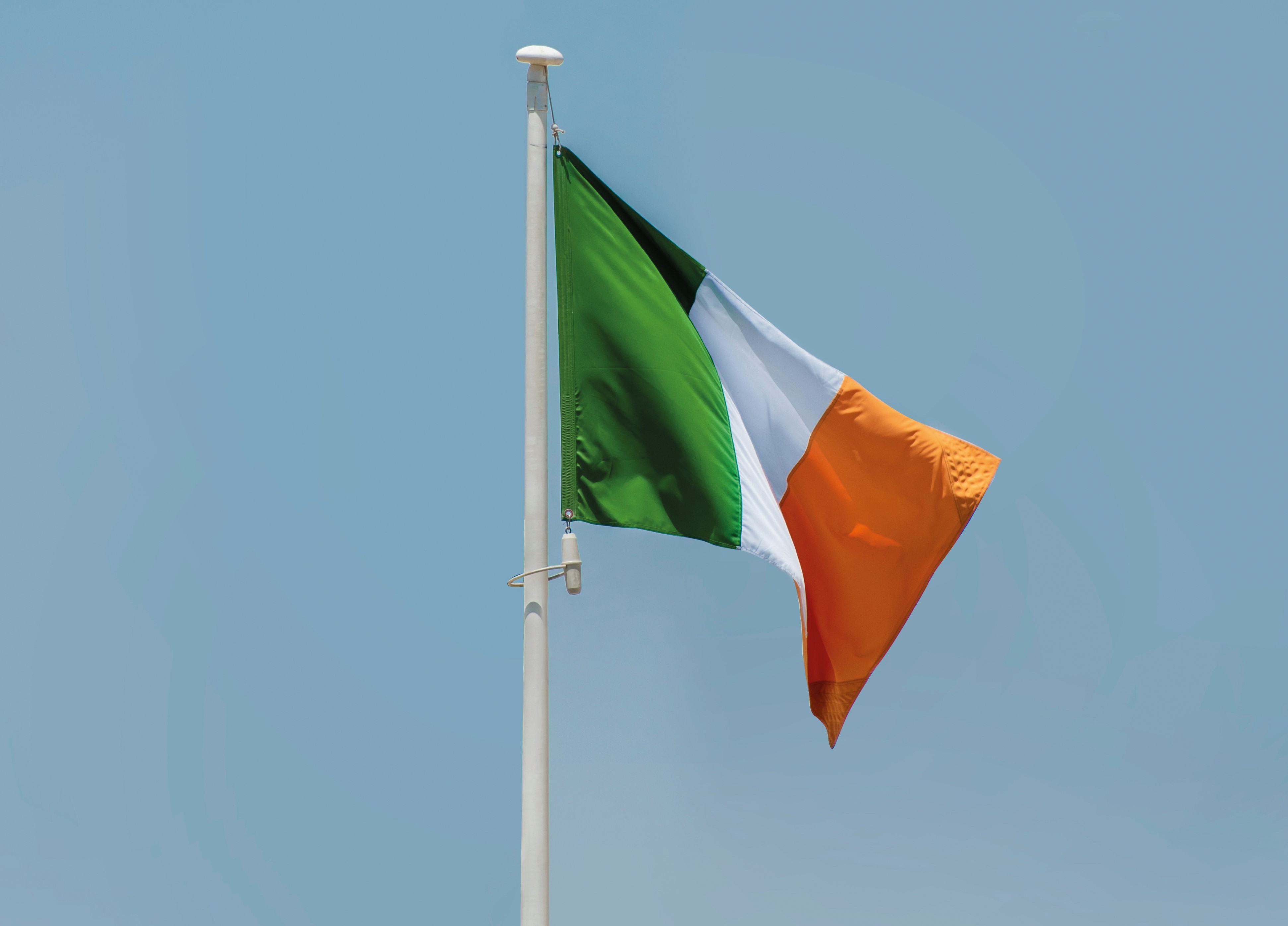
O People of the UK: you are in despair over the state of your country’s politics, and I don’t blame you! The only consolation I can offer is to assure you that Irish politics is just as much of a mess.
Since the establishment in 1922 of what was then the Irish Free State (now Republic of Ireland), only two parties have ever produced the taoiseach (head of government, like your prime minister): Fine Gael (previously Cumann na nGaedheal) and Fianna Fáil. This could potentially make some sort of sense if they could be seen as equivalent to Labour and the Conservatives, or even to Republicans and Democrats in the USA: one party (broadly speaking) on the right and one (broadly speaking) on the left. But Ireland doesn’t have this.
Two parties have dominated our politics for over a century, and they are both centre-right; they are practically identical ideologically. In an exit poll after our 2016 general election, voters were asked to place themselves on a scale from 0 (very left-wing) to 10 (very right-wing). Voters who put Fine Gael (FG) as their first choice averaged 5·84, and those who put Fianna Fáil (FF) as their first choice averaged 5·7. It is pertinent to note that for context, the average Irish voter overall was at 4·98. Furthermore, in 1999 it was found that 39% of Fine Gael members saw no major policy difference between the two parties.
So, if both the political parties are generally the same on economic issues (which they are), and on social issues (which they are), and on issues of Europe (which they are — both comfortably pro-EU), why are these two separate parties? In fact, they used not to be. They both started as splinter groups away from yet another political party, with Cumann na nGaedheal splitting off in 1923 and Fianna Fáil in 1926. The dividing issue was whether to accept the 1921 Anglo-Irish Treaty. To summarise, the Treaty did many things, amongst them the creation of the border between Northern Ireland and what is now the Republic. It was a disagreement over whether to accept this treaty and slowly push for more or abstain from the governing of the newly created Irish Free State on the principle that the border was not legitimate and only a full 32-county republic would be accepted. Cumann na nGaedheal really dominated Irish politics in the early years, being the only non-abstentionist major party in existence as there were other parties, but they were not as influential. When it became certain that the glorious fight for Irish independence and unity was not resuming for the foreseeable future, Fianna Fáil abandoned their abstentionism and splintered away, starting to take their seats in the Dáil (Parliament).
Given all of this, you would be forgiven for assuming that Fine Gael and Fianna Fáil are the two biggest parties in the Dáil, but they are not. Of 160 TDs (MPs), 38 belong to Fianna Fáil (FF) and 35 to Fine Gael (FG) — but 37 are from Sinn Féin (SF). If you have heard of any Irish political party, it is probably this one; they are currently the largest political party in Northern Ireland. They were that radical nationalist, abstentionist party that both FF and FG split away from in the ’20s, and they are still abstentionist to this day in the UK. They take their seats in Stormont, but not in Westminster.
It is worth mentioning that this is why the number of MPs needed for a majority changes slightly each time: the number of MPs actually going to Parliament depends on how many seats Sinn Féin get!
The Republic of Ireland is currently run by a three-party coalition — largely as a result of our electoral system, PR-STV (proportional representation by means of the single transferrable vote); you rank your choices, there is not an option for a tactical vote or a safe seat, and the resulting divided parliament accurately represents the divided opinions of the nation. Small parties not only exist but flourish and thrive too. Outright majorities are rare, and coalitions are common — which I personally think is a good thing as it means a true collaboration between the range of views belonging to the public. But it can get a bit ridiculous, as the 1948 – 1951 government of Ireland was a six-party coalition. The coalition at the moment is of Fianna Fáil, Fine Gael, and the Greens. Prior to 2020, FF and FG refused to go into coalition with each other, and most governments were one of the two, usually propped up by the Labour Party (unrelated to UK Labour) or the Progressive Democrats. But in 2020, the number of Sinn Féin seats were enough to disrupt this. The only sensible coalition was to take two of the biggest three parties — SF, FF, FG — and add one or two smaller parties, and as much as cooperation between Fianna Fáil and Fine Gael can be difficult, nobody will go into coalition with Sinn Féin, for a variety of reasons including ties to the IRA.
We have referendums semi-frequently in Ireland, including a divorce one in 1995 which passed at 50·28% “yes” — closer than Brexit (and frequently put down to a storm that stopped many rural, conservative people from getting out and voting)! Two in Mar 2024 failed at 67·69% “no” and 73·93% “no”; this was due to very few people voting except the protest voters who used a “no” vote to show disdain for the government.
Sinn Féin are on the rise on both sides of the border being the largest party in Northern Ireland and comfortably highest in polls in the Republic, there are more Catholics than Protestants in Northern Ireland, and things might be looking up for those in favour of a united Ireland. But the Dáil is only 22·5% women and far-right anti-immigration views are also flaring up in Ireland, so what kind of united Ireland might we be left with if that did happen? And will a border poll ever be called in the first place, with the recent DUP-placating Safeguarding the Union command paper declaring that “the [UK] Government sees no realistic prospect of a border poll leading to a united Ireland”? The requirement for a border poll is in the Good Friday Agreement, but since when do Westminster respect that?
Image: Unsplash



Leave a Reply