
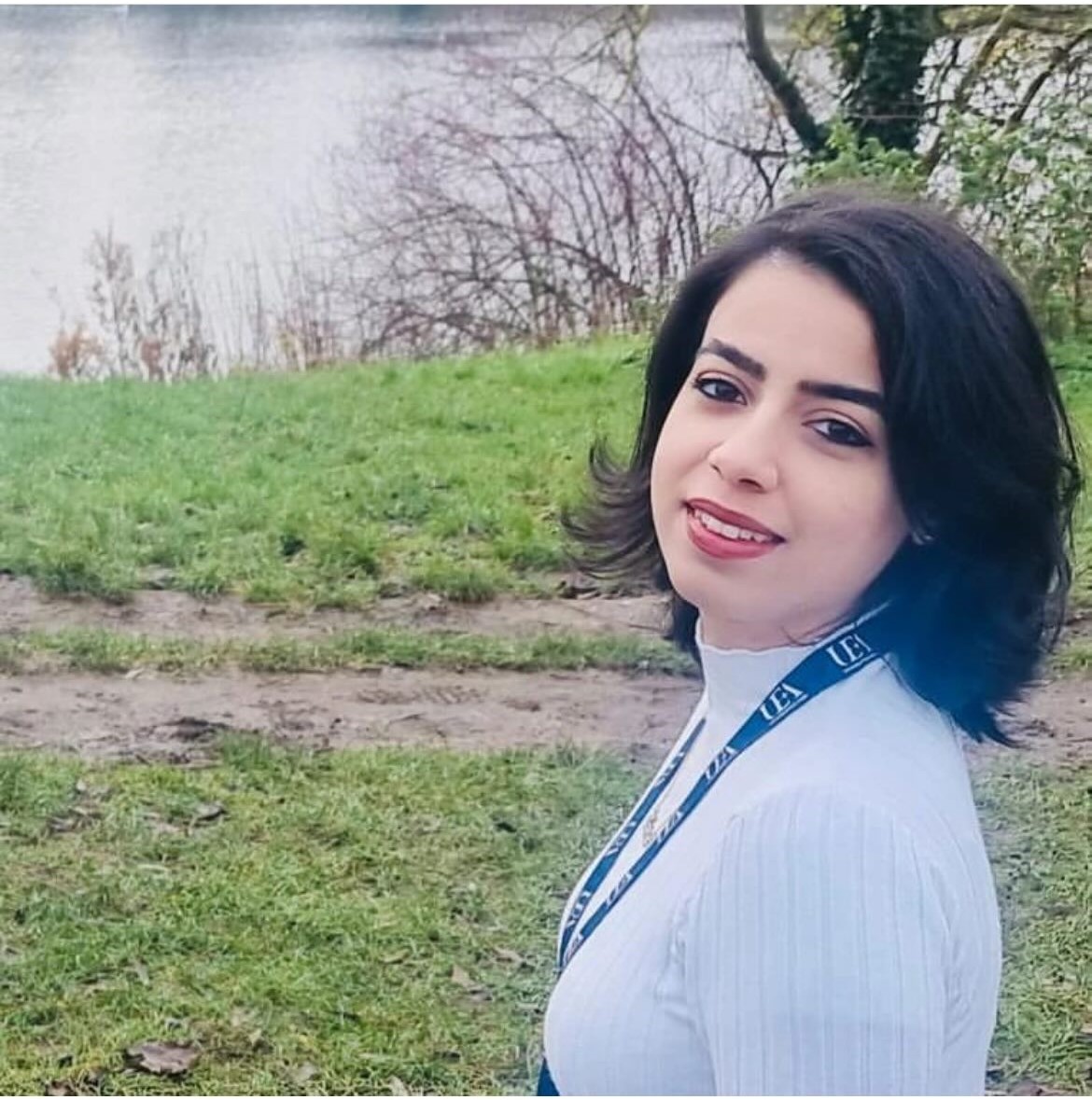
Image: UEA graduate Alaa Shatila (28) by UEA Lake in 2022. Credit: Alaa Shatila.
Content warning: Serious violence. Distressing images.
This article retells multiple and extensive conversations with Alaa Shatila. All reported facts, figures, photos, and identities have been independently verified.
In the days leading up to October 7th, 2023, Alaa Shatila—a 28-year-old UEA graduate from Palestine—attended a humanitarian conference in Jordan. She was representing ActionAid, an international charity working with impoverished women and girls for whom she had worked in Gaza for the past year. Travelling back from the conference to her homeland on the night of October 6th, Alaa had to pass through the Egyptian border at Rafah (until recently, the only reasonably safe crossing point into and out of Gaza). As she lay down to try and get a few hours of sleep, she looked forward to reuniting with her family at their home in central Gaza the next day. But tragically, this was not to be. Awakening the next morning, Alaa checked her phone. What she saw would change the course of her and her family’s life forever. Hamas – a group described as terrorists by the UK government – had launched an armed attack on Southern Israel, killing an estimated 1,143 people and taking around 200 people hostage.
What did this mean for Alaa, an ordinary young Palestinian woman? In her own words, she was “shocked, horrified, confused…and terrified for my family.” Twenty-four hours later, the Israeli government formally declared war on Hamas in retaliation for the incursion, with tanks amassing on the Israeli border with the Gaza Strip.

Image: Alaa’s family celebrating Mother’s Day together before the war – from left to right: mother, Maha (56), Alaa (28), brother, Mohammed (12), sister, Aya (29) sister, Asil (26) and sister, Nour (20). Her father, Marwan (58), is taking the photo. Credit: Alaa Shalita.
In the following days, Alaa remained held against her will at the Egyptian border, unsure of the fate of her family, mother Maha, father Marwan, and siblings Aya, Heba, Nour and Mohammed. Alaa’s anxiety was exacerbated by internet and phone signals repeatedly being cut off for extended periods. Her sister Asil – with whom she was in contact – was studying for a PhD in London. As days of angst turned into weeks, feeling “confused and distraught”, Alaa tried to settle herself into the Egyptian capital of Cairo, where she had been relocated.
Meanwhile, across the border in the Gaza Strip, the Shatila family fled south to a relative’s home in the border town of Rafah, seeking shelter from the immediate danger of central Gaza, where a full-scale offensive attack was now being carried out by the Israeli Defence Force (IDF). However, on 17th October, the worst happened. The home in which they were sheltering was bombed. Alaa’s father, Marwan, can be seen in the photo below looking on in horror at the collapsed house – at this moment in time, unaware of his family’s fate.

Images: 1. Alaa’s father, Marwan, emerges from the rubble in search of his family. Credit: The Shatila family.
Thankfully, they all survived, but Alaa’s sisters, Heba and Nour, were crushed by a falling wall, resulting in serious injury. Alaa’s brother, Mohammed and eldest sister, Aya, both received head injuries. Marwan received minor head injuries, and Alaa’s mother, Maha, emerged unharmed.
The family were admitted to the European Gaza Hospital in Khan Younis later that day, where they would remain until January 2024 as the only means of shelter available to them. In the new year, the Shatilas were forced to vacate the hospital grounds, with staff telling them that they needed to prioritise people with more severe injuries due to dangerous levels of overcrowding. Alaa comments, “My sisters did not shower for three months because there was no clean water in the hospital. It was dirty; there wasn’t enough medication; the floors were covered in blood…Everything was horrible – these were the conditions they were living in”.
To make matters worse, the Shatilas received yet more devastating news during their stay. Marwan’s shop in central Gaza had been bombed (pictured below). Alaa explained she was on the phone with her sister, Aya, and asked for her father. “Dad can’t talk now”, Aya responded. Asking why, she explained that his shop – the family’s sole source of income – had just been destroyed by an IDF missile.


Image: Alaa’s father’s shop – before the bombing (left) and after (right). Credit: The Shatila family.
“I was so worried about my father”, Alaa describes. “He loved his shop and had spent years devoted to it – building it up from a small stall to a well-established local shop…Our family’s livelihood depended on it, and it had been taken away from us just like that.”, she adds.
As the rainy winter season progressed in Gaza, large areas of the Shatila’s neighbourhood back in central Gaza were destroyed, and tens of thousands more citizens were displaced or killed.
A couple of weeks later, the shells landed at the Shatila’s front door. Their family home in central Gaza was destroyed. Luckily, nobody was inside the property at the time, with the family still sheltering in the hospital.


Images: Palestine Square – (left) the neighbourhood where Satila’s family home once stood the day after the shelling. (right) the neighbourhood as it was being bombed. Credit: Screenshots by Alaa Shatila of an official IDF video widely shared on X (formally Twitter).
As part of a strategically planned offensive, the IDF targeted a central residential neighbourhood in Gaza City called Palestine Square, beneath which they claimed were a network of Hamas tunnels. In Alaa’s words, “They flattened it – there was, there is nothing left”.
Forced to vacate the relative shelter of the European Gaza Hospital, the family had no choice but to take refuge in a “tiny” room in another relative’s home in Rafah. Alaa describes how her two parents and four siblings were each forced to sleep in a space of one square metre during this period.
As the IDF increased its military assault in the north and central belt of the Gaza Strip, around 1.5 million other Palestinian citizens were now forced to flee south to Rafah. For Alaa’s family, it was increasingly hard to access clean drinking water, food, medicines and other essential services. Desperate to aid her suffering family, Alaa attempted to contact her uncle in the USA. They discussed the possibility of gaining a visitor visa permit with the US Embassy in Cairo. But the Shatila’s application was refused by a US embassy official stating, “Only close relatives such as parents or children can apply”.
With no other alternative to bring her family into relative safety, Alaa was forced to pay the Egyptian government US$5000 per person (US$30,000 total) to get each family member across the border at Rafah – wiping out all of her remaining life savings. On February 14th, Alaa was reunited with her family after five painful months as they crossed the border. “My heart was beating so fast”, Alaa describes. “I could not quite believe they were all still alive. I counted them as they came through – we were finally back together.”
To date, more than 35,000 people have been killed in Gaza, according to Palestinian health authorities – the majority of whom are civilians.
“We are completely exploited here” – life as a refugee in Egypt.
Since entering Egypt, Alaa and her family have done their best to navigate the harsh realities of being a refugee in a country that, as she described it, “treats us like second-class citizens.” Denied access to residency permits, the Shatilas cannot seek formal employment. Alaa has been making embroidery products “day and night” and selling them to a local merchant to support herself and her family. What makes this situation even more challenging, she explains, is that Palestinian refugees face vastly inflated rents.
The family are currently renting a small flat in Cairo, previously marketed to native Egyptians at US$200 per month; they are paying US$450 for the same property. “Every month that goes by, my father does not know how he will pay the rent”, Alaa explains, and adds, “He has a heart condition, and my sisters are still suffering from their injuries…but we can neither afford nor have access to healthcare – the situation here is still desperate”. Her 12-year-old brother, Mohammed, is not permitted to attend school, and her 20-year-old sister, Nour, is missing out on her second year of university. The family have also been advised to attend therapy sessions for PTSD symptoms, which cost US$70 per person, but they are unable to afford to do so. Alaa concludes her story, “We cannot go on like this. We have lost everything. We are suffering – we just want to survive and access life’s most basic needs. We need help”.


Images: 1. Alaa reading on the second floor of UEA library in 2021. 2. Alaa (far left) enjoys an end-of-year BBQ with other Chevening Scholars by UEA Lake in 2022. Credit: Alaa Shatila.
Alaa Shatila gained a Chevening Scholarship to study International Social Development at UEA in 2021 (pictured above). She describes her time at UEA: “It was fantastic. I got so much support from the UEA and the [International Development] School. The lecturers were very supportive, especially my thesis supervisor, Dr Anthony Pickles, with whom I am still in contact. I will never forget my wonderful year in Norwich at UEA. It is a bright memory in my otherwise dark world”.
Alaa and her family are trying to raise £15,000 to move to a safer and more accessible country. In a direct message to students and staff members at UEA, Alaa says, “As I graduated from UEA, I realised I had become a better version of myself – empowered to communicate, lead, debate, and network. The conditions of the current war in Gaza are undermining my ability to build on these skills to become the leader I dream of and to work towards my vision of empowering other vulnerable groups globally. I cannot do that without the security of my most basic needs. Your support will help me and my family with these and help me continue my journey as a UEA scholar with a positive social impact”.
As members of the UEA student community, we stand together with all of those suffering as a result of the Israel-Hamas war.
Visit Alaa’s GoFundMe page to donate and read more about her story.




Leave a Reply