
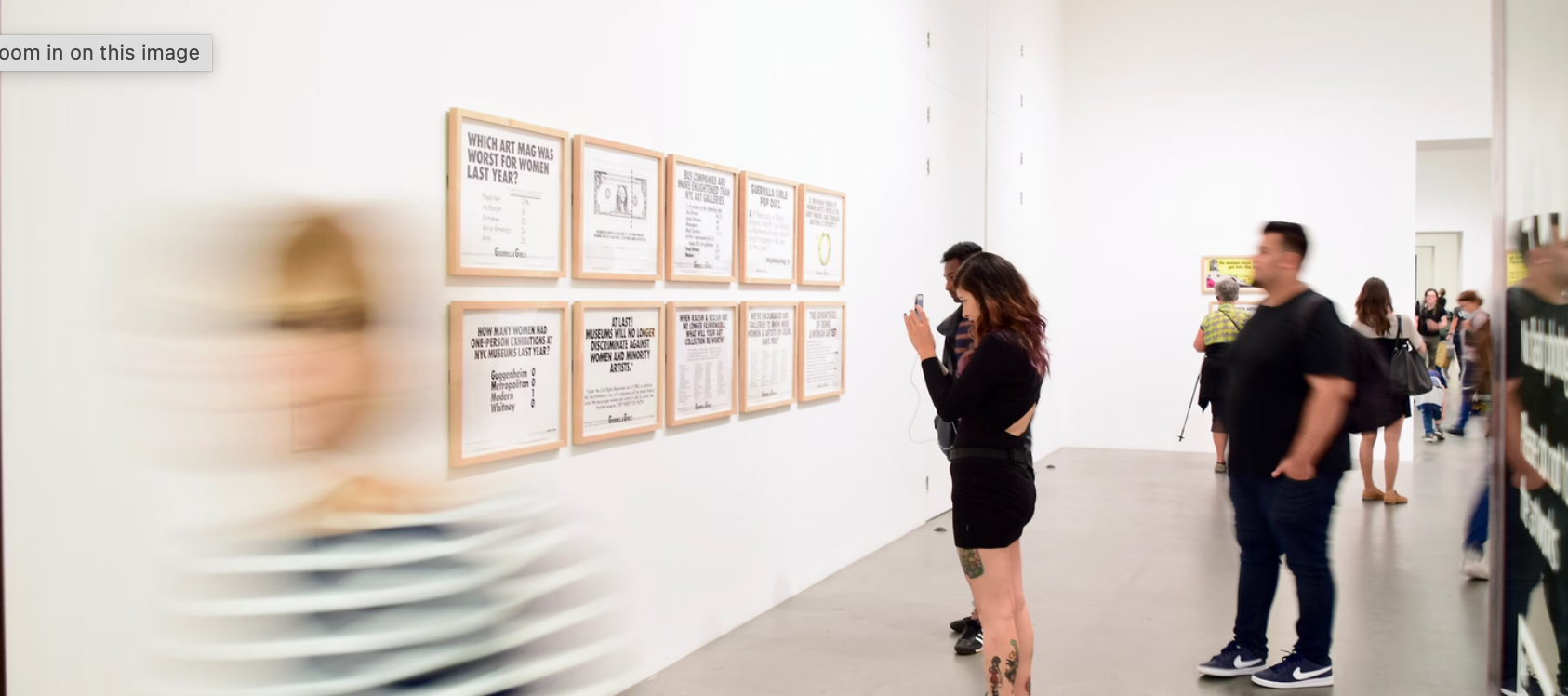
I would argue that the cause for the creation of art comes down to one singular thing, emotion. It is the attempt to validate each of our own induvial, equivocal experiences as a self, surrounded by other individual selves. Art is a hope, often a lifeline that strives to connect induvial to individual, experience to experience, emotion to emotion. In a world where we are all so trapped inside our own heads, we turn to paint, to clay and the canvas, to strive to fill in the whiteness that separates our own human experience.
But this has not aways been the case within the art world, where wealth and money has fuelled the production and eventual capitation of art. The art world has long been regarded as an exclusive domain, a realm of gallery openings, auction houses, and biennales that seems distant from the everyday lives of many people. I’m sure as university students of all backgrounds there have been times when we have all experienced such limitations, from cost and availability to education and access. In an age where walls are ripped down to make a profit out of Banksy and galleries like the Gagosian or David Zwirner have a hold over the art market, controlling the visibility and pricing of contemporary artists. The autonomy and personhood of artists themselves is lost in a name and branding.
Yet, as societal awareness grows around issues of equity and inclusion, the question of accessibility in the arts has become a crucial topic of discussion. As a university community that fosters creativity and innovation, we have the voice and power to examine how accessible the art world is, and more importantly, how it can become more inclusive.
The University of Coventry have launched a new scheme, entitled “Inclusive Immersive,” to create an immersive art experience working closely with young people with learning disabilities. Receiving £50,000 in funding from the Arts Council England’s National Lottery Project Grants, this has enabled the University to reach new steps in the art world as the project aims to lead to new guidance for the arts organisations relating to immersive art exhibitions. Researchers will work with Coventry based Open Theatre along with new technologies to produce installations and performances in venues across Coventry in spring 2025, ending with workshops and symposiums to share their findings and progress.
For much of history the art world has been shaped by wealth, with money controlling access to artistic recognition, funding, and opportunities. This system naturally favoured artists from privileged backgrounds who had the time, resources, and connections to pursue formal training, showcase their work, and enter prestigious institutions. The result was a glaring lack of diversity in terms of gender, race, and socioeconomic background. Marginalized artists often found their work sidelined or tokenized, while people from lower-income backgrounds were largely excluded as both creators and consumers. The cost of materials, the burden of student loans, and the high cost of living all become factors excluding the creation of art and thus losing the true reason for art as a creative expression.
However, the University of Coventry’s new steps is not the only way that the modern world is striving to reshape the art world, bringing art back to its true nature as a creative expression for all people. In recent years there have been significant efforts to address the accessibility gap within the world of art, with technology, social movements, and shifting attitudes toward inclusivity all playing key roles in creating a more equitable space for artistic expression. The rise of digital platforms and social media, such as Instagram and TikTok, as well as online marketplaces like Etsy and Saatchi Art have enabled artists to showcase their work directly to a global audience, reducing financial barriers. Even the horrors of Covid-19 have brought access limitation into the light as the pandemic accelerated the adoption of virtual exhibitions, making art more accessible to people who may not have been able to attend physical galleries or museums due to geographic or financial constraints. Movements to decolonize the art world have challenged the Eurocentric narratives that have historically dominated major art institutions. Museums, galleries, and academic programs are increasingly being held accountable for their lack of representation of artists from a multitude of cultures and backgrounds. Efforts to diversify collections, programming, and curatorial teams are becoming more visible.
Although, this is not to say there is not still work to be done. Creating a truly accessible art world will require a multi-faceted approach that involves institutions, policymakers, and individuals. We, making up the face of universities, hold a crucial power through fostering diverse talent and providing opportunities for students to engage with art in inclusive ways. By doing so, we can bring art back to its truly powerful essence of creating solidary though creativity, as not just a way of life but as a way of love.
Photo Credit: Unsplash



Leave a Reply