
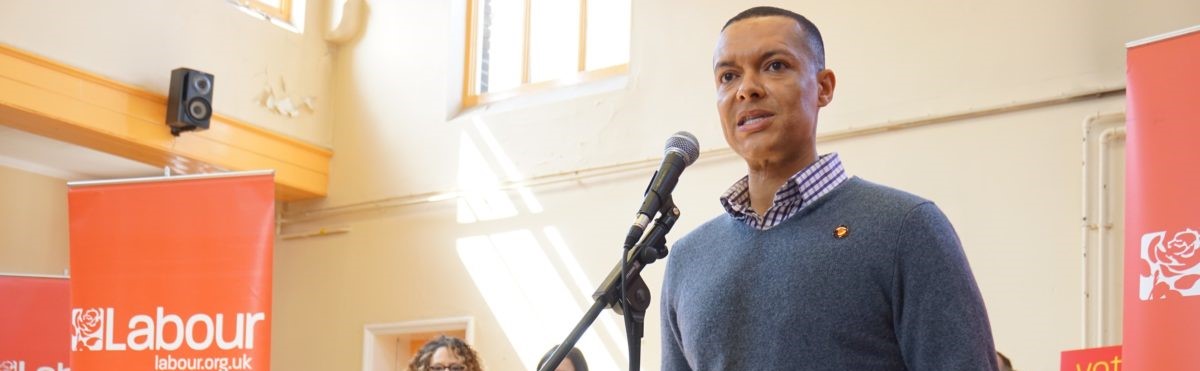
Black History Month brings with it a wave of reflections and celebrations, but for Labour MP Clive Lewis, the annual observance sparks a deeper conversation about Britain’s uncomfortable relationship with race, identity, and history. “I have a mixed set of emotions on Black History Month,” Lewis says, leaning forward in his seat as he considers the role of this commemorative period. “Every month is Black History Month. The history of this country is Black history.”
Born in London in 1971 to a Black father from Grenada and a white mother, Clive Lewis has never shied away from discussions on race. His journey into politics—shaped by his experience as a mixed-race Brit navigating the intersections of class and race—gives him unique insights. A former BBC journalist and soldier, Lewis eventually found his calling in politics. Today, he is one of the most outspoken voices in Parliament on issues of racial equality, colonial legacies, and class politics. As Black History Month rolls around, Lewis offers a critical reflection on what it means for Black Britons today and, more importantly, what it should mean for the future.
Lewis acknowledges that Black History Month has its merits—it brings critical issues to the forefront of public discourse. “It comes up once a year, and in that sense, it’s good… sometimes I’m slightly offended by the fact that we have to have a Black History Month that’s kind of put aside… it can act as a tool for people to do very little, to jump through hoops and go through the motions.”
To Lewis, Black History Month too often feels like a symbolic gesture, with politicians and institutions performing their annual duties without real follow-through. He told us of an invitation to a reception at Number 10 but reflects sceptically on its significance. “I wonder, will Keir [Starmer] take the knee when we all walk into the room? I doubt it.” For Lewis, these events serve as surface-level commitments to racial equality, while the deeper structural inequalities remain largely unchallenged. To this end, he spoke of a “hierarchy of worth” where “if you are at one end of that hierarchy, your life is worth so much, and if you’re at the other end, it’s worth a lot less”.
A key theme of our discussion is the role of representation in British politics, and Lewis doesn’t hold back in his critique. “The problem for me is that I have seen Black people in government, and they’ve been used as useful idiots to push and promote” things white people in the Conservative government “could never get away with”. Lewis points to figures like Kemi Badenoch and James Cleverly, whose policies, he argues, have not only done little to uplift Black communities, but actually encouraged the riots seen in the summer.
“What are we saying about having Black people in politics? The missing dimension is class. There’s no point being a Black person in politics unless you’ve got the right class politics as well.” This, for Lewis, is the crux of the matter. Representation in itself is not enough; it needs to be coupled with a broader understanding of how race and class intersect in maintaining structural inequalities. “Kemi Badenoch, James Cleverly, and others represent the interests of a specific class—a class that wants racism to carry on and flourish.”
Lewis’s argument is that race politics cannot be separated from class politics. The true path toward equality, he insists, lies in dismantling the systems that oppress not just along racial lines but also along class lines. “There’s no point in having more Black people in politics unless they also have good class politics as well. That’s been my revelation from being in politics.”
One of Lewis’s most impassioned beliefs is the need for reparatory justice—not just as a means of addressing the wrongs of the past but as a way of confronting ongoing systems of exploitation. Reflecting on a recent visit to the Caribbean, Lewis shares a powerful exchange he had with the chair of the Grenadian Reparations Commission. When Lewis questioned how he could ask his constituents to pay money towards reparatory justice, the Chair added that “The story here is the people [who] have exploited them for centuries are the same people exploiting us now in terms of debt repayments.”
For Lewis, reparations are not merely about financial compensation but about dismantling the structures that allow for continued exploitation. The people who should be paying for reparatory justice are the corporations and the wealthy who have “benefitted and continue to benefit from all of us,” he argues.
This then led us to ask about his controversial views on the monarchy, and his belief that it should be abolished, but as discussed earlier, for Lewis, it’s not just about dismantling a symbol of British imperialism—it’s about challenging the entrenched class system that the monarchy represents. “The monarchy is a big flashing symbol” of inequality, he says matter-of-factly. It represents hereditary privilege, which “percolates down into the body politic[…] It basically says that rampant inequality, that handing down wealth and power to your descendants is OK, because the Head of State does it”.
His views on the monarchy is also about democratic accountability. “Why, in a democracy, have we never been given a choice or say as to what that [monarchy] looks like?” Lewis questions. He doesn’t advocate for a specific solution, but rather, for a national conversation on the issue. “It might be that it’s a scaled-down monarchy. It might be that there’s no monarchy. It might be that there’s more monarchy, but give people in democracy a chance to have that conversation.” Abolishing the monarchy, for Lewis, is not just about rejecting empire but about rejecting the institutionalised inequality that defines British society today.
The conversation turned to education, a subject that Lewis feels passionately about. He credits his own history teacher, Mrs Hadkins, for giving him a nuanced understanding of Britain’s colonial legacy. “We didn’t just talk about great white people setting Black people free… We actually looked at the horrors of the slave trade,” Lewis recalls.
However, while the current school curriculum is something he doesn’t know well, he imagines it does not provide the same depth of understanding for all students. “I imagine the curriculum has been through a lot of political iterations and changes since my time […] I would say it probably isn’t quite where I’d be happy with it.” For Lewis, the issue with how colonialism is taught—or rather, how it isn’t taught—reflects a broader reluctance to grapple with Britain’s imperial past. “One of the things that people say to me is, ‘Why don’t you just get over slavery and colonialism and empire?’ […] well you show me one multinational corporation that has an impact on your life today that has made its money[…] and is still making money from [the] exploitation […] of those countries […] and I’ll shut up”.
Lewis calls for a more honest approach to education, one that links the past with the present. “We need to show what neo-colonialism and neo-imperialism looks like… it’s happening all around us from the Middle East, across the African continent, the Caribbean.” On the other hand, he also added that students should hear the opposing arguments too, so that “students can come to a conclusion [themselves].”
As our conversation drew to a close, Lewis’s vision for the future of Britain came into sharp focus. “I love this country and I love what it could be,” he says earnestly. “But I know that it could be better”. For Lewis, confronting the myths that Britain tells itself about its history—whether in relation to empire, race, or class—is the first step to making the country “a stronger and better place, because a country that knows where it’s come from and has a real understanding of its own history is a country that can go forward confidently”.
This Black History Month, Clive Lewis’s message is clear: the fight for racial equality is far from over and it is not enough to celebrate Black achievement for one month of the year. The real work lies in dismantling the systems of power—racial, economic, and political—that continue to oppress. And that, as Lewis makes clear, is a fight worth fighting for, every day.
Photo Credit: Norwich Labour Party



Leave a Reply