
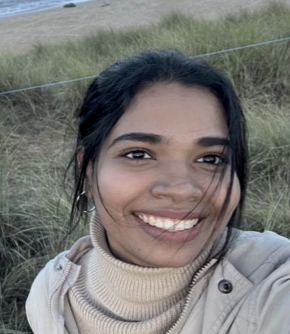
So, what’s your research about?
So, you know oceans? I study the oceans – specifically the Indian ocean… using weather models. It’s very interesting because the ocean is not like a singular entity – it’s so connected to the atmosphere. There are so many kinds of models such as an ocean only model, atmosphere only model – [I’m looking at] an ocean-atmosphere coupled model. There are a lot of pros to this but one con is that it introduces a lot of error. So, if I wanted to look at the heat content in the ocean, there’s a lot of processes that affect this. What I am doing is looking at each of the individual terms [in the model, such as mixing and advection], to see where the error is coming from.
What did your journey look into this role look like?
I’m coming from like a very different background in terms of academic culture. I did my undergraduate and master’s degrees in India and moved to the UK as part of my PhD scholarship. I feel like the UEA, especially the ENV school, is very diverse in terms of experiences. I feel like Norwich is such a great hub for activities to do. I’d say Norwich is a small space, but it has that community. A lot of people are interested in science. You have the science festival.
Oh, were you involved?
Yes! My then studentship director and some other PGRs applied for a grant from NERC to develop some games to encourage young people to pursue environmental sciences for further education, especially in low-income areas where the continuation to further education is quite low. We took to schools and the Norwich Science Festival. We got some really good feedback, and it’s been one of the best parts of my time here.
What keeps you motivated?
My stipend. MONEYYYYYY. Nah, I like doing research, I like being on campus. The atmosphere at the university is brilliant. As a PhD student, life can get so lonely. You have your supervisor, but your project is very personal. It gets exhausting, it can be too much, so making friends was the best thing I did…it’s great to have that supportive community. I also get to teach students which brings me a lot of joy. Doing outreach and teaching along with research exposes me to many different aspects of academia. Your role as a researcher doesn’t stop when you publish a paper or give a talk to people who already know the topic.
If you could change one thing about your field, what would it be?
I want to make it more interdisciplinary. My research means I don’t work with like biologists or chemists – I want to make it more collaborative, more interdisciplinary.
What implications to your research could there be?
If you look at the Indian Ocean like I’m looking at, there’s this thing called Indian Ocean dipole. Consider like a seesaw on the Indian ocean, and one end is on the eastern part (where the temperature is very high) and the western part (where the temperature is very low). [Because of this], in the east Indian ocean and adjacent countries there would be flood conditions due to the increased temperature, and, conversely, on the western side, like Africa, there are drought conditions. So, it’s the same ocean, but causing two completely different weather conditions in different places. It’s a massive driver of conditions.
The Indian Ocean has increased by 1 degree – the fastest of all the global oceans. Even though you might think 1 degree is tiny, such a change can cause floods and wildfires and affect the global weather patterns, with [the link between the ocean and atmosphere] transferring these changes globally. When we talk about climate change we always talk about deforestation, which is very important, but as an oceanographer, I think the ocean carries a bigger role in moderating the global temperature. Some facts:
The ocean is the no 1 carbon sink (it absorbs most of the CO2 in the atmosphere).
It’s the no 1 heat sink. It absorbs most of the heat in the atmosphere.
It produces 50-60% of all the oxygen in the atmosphere (because of the phytoplankton)
So, along with deforestation, there is a point where the ocean can not absorb any more heat or CO2, it can’t help anymore. It’s important but underrepresented in the climate change conversation.
Thanks again to Apurna for sharing her thoughts and research with us!




Leave a Reply