
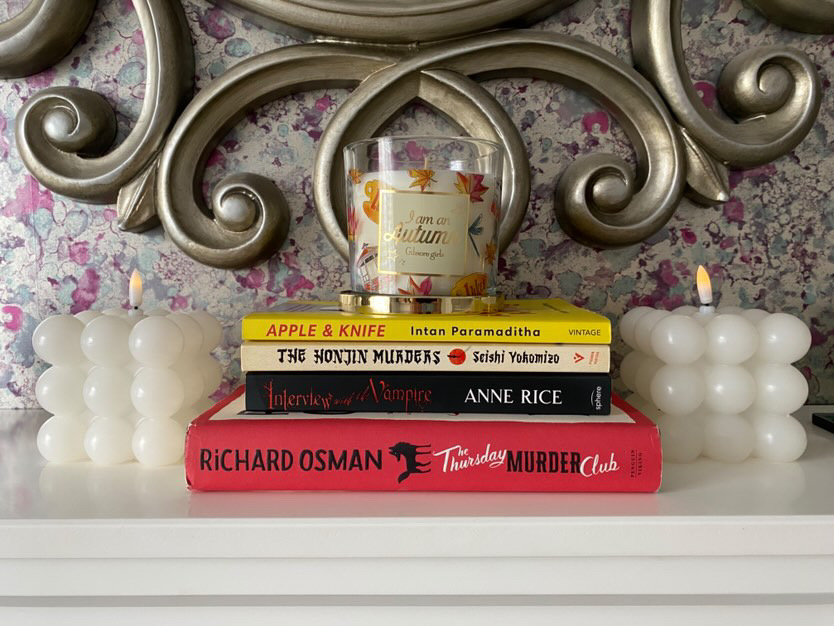
As the leaves are starting to fall, your Concrete team have been relaxing with their favourite autumnal reads. Let us know what books you have been reading in the comments below!
Warning: Some spoilers lie ahead!
Apple and Knife by Intan Paramaditha
Set in the everyday world of Indonesia, Paramaditha modernises and subverts fairytales and myth through a horror lens. Making the female body the centre of these stories, Paramaditha expresses the juxtaposing peril and power of having one in the modern day.
On one hand, you could be the subject of extreme violence, while on the other, you can use it to your advantage to gain control. ‘Vampire,’ one of the stories in the collection, is set up to seem like a female secretary will have an affair with her boss.
The evident power dynamic and the boss’ serial infidelity makes this seem inevitable. The secretary has no choice about what is going to happen to her, merely because of her position and her gender. And yet, at the end, this it turned on its head. It was not the secretary that was powerless, but the boss. Saras, the secretary, is a vampire and kills him.
On a metaphorical level, this is an interesting subversion – the boss is lured in, like prey, and used for his body, just as he intended to do to her. In this story then, the female body is a symbol of power. It allows for the assumption of inferiority to become the ultimate power.
With the monstrous and the taboo running rampant throughout the collection, it makes it the perfect book to pick up this October.
Lilia Colledge, Deputy Books Editor
H is for Hawk by Helen Macdonald
I approached Helen Macdonald’s H is for Hawk with minimal knowledge of nature writing, unsure of what to expect. To my surprise, it became one of my favourite books I have read this year.
The book recounts Macdonald’s experience of training a Eurasian goshawk, Mabel, after the sudden passing of her father. It is complexly beautiful, weaving fascinating facts about falconry with vivid descriptions of nature, with Macdonald’s grief encompassing it like a difficult, yet comforting, embrace.
I just wish I had read it sooner. After experiencing my own bereavements, I realise that having this book would have given me the language for feelings I could not name at the time.
Reading it 5 years later, Macdonald’s memoir serves as a reminder to admire the life I’ve lived since. (Admittedly though, I’m not as cool as her.) So, take this as your sign to read something out of your comfort zone; it might change your view on the world in ways you won’t expect.
Polly Dye, Books Editor
Frankenstein by Mary Shelley
The monster under the bed isn’t scary, just misunderstood.
Frankenstein is a gothic novel, a perfect read this time of year by the lake, watching the leaves fall. The protagonist, Victor Frankenstein, is a scientist who pushes the boundaries of what science can and should do, leading to his creation of The Monster. The Monster gets a bad reputation, but readers often diminish his suffering.
He is born into a strange place and immediately abandoned by his parental creator. He is left alone in a world that could never love him for who he is, causing him to become bestial. Frankenstein’s Monster embodies the nature-vs-nurture debate: the isolation Victor leaves him in forces him to become a monster that he isn’t at heart.
Consider The Monster as the victim of his creator instead of the oppressor. Does he deserve the harsh narrative pushed on him? Would he have been like us, if he was loved?
Avery Hewitt, Contributing Writer
Image Credit: Polly Dye

Leave a Reply