
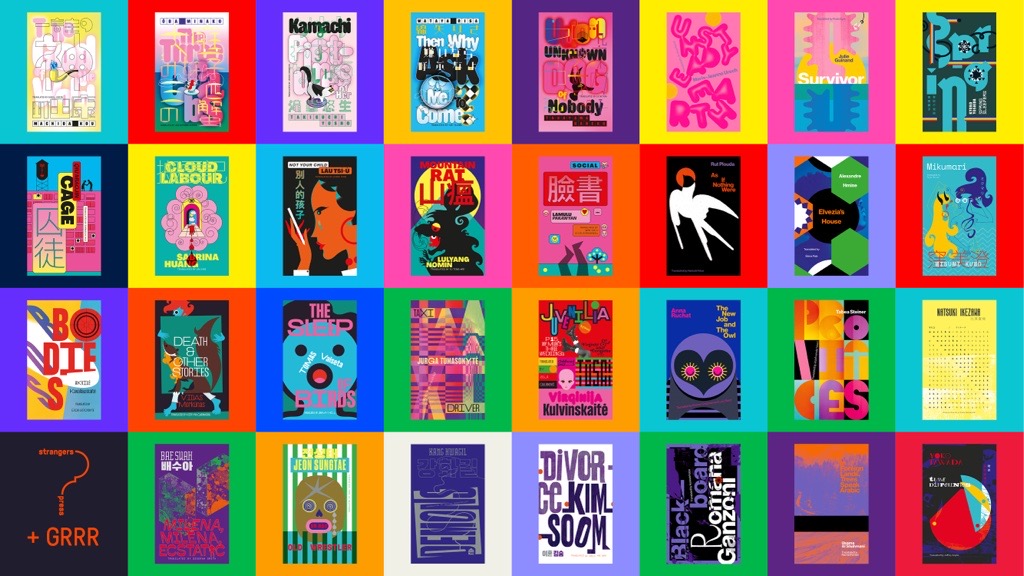
On October 30th, I was invited to listen to a talk given by Glen and Rebecca Robinson, who make up Studio GRRR, as part of Norwich Book Festival.
The talk was aptly named “Vibrant Book Covers at the Intersection of Art, Design, Translation”, exploring their relationship with art and looking at their recent work with KANATA, Strangers Press’ new Japanese fiction series.
While it is easy to think that translation is limited to language, Glen and Rebecca proved that this is not the case.
Much like their art, Studio GRRR believe that stories do not stay constant. They are dynamic.
At the heart of their craft is repurposing. Glen and Rebecca have an extensive collection of found materials and past art that they consistently return to for new ideas. A page in a sketchbook can be reused or recycled to fit new project ideas or aims.
Zines are also a significant part of their creation process.
They detail it as a form of collecting, putting together varying, seemingly unrelated, things to make them mean something else entirely. They are also particularly interested in layering and what messages this conveys in and of itself, creating a dialogue between images and objects, connecting them implicitly.

They also went into more detail about their beliefs around their art and how they distribute it.
Inevitably, they talked about AI and Large Language Models, and the impact this is having on creative practices. They proposed their own LLM, Living Language Memory, as an explanation for what they are doing with their art.
It is a living, changing thing.
A collation of past and present.
We can see this in their guerrilla placement of their art. They talked about how they make stickers of their art and put it in the streets, as well as hop on the back of other publications by slipping their zines into books.
This is not only a way of getting their work out there but also making their art part of a wider conversation. Another motto at the heart of what they do is empathy, intuition and imagination, which can certainly be seen in their nine years working with Strangers Press on cover design.
They are in agreement with Strangers Press’ ethos of “translation as a form of cultural change”.
They talked about how their work for Strangers Press is a collaboration at all levels. Sometimes it is local, but it can also become an international endeavour, especially when they are explaining their vision to the authors.
Glen and Rebecca talked about a specific encounter, when they had to talk to a translator about word spacing.
A concern was raised that the original layout was confusing for Japanese readers, as the words would not be separated that way in Japanese. This collaboration was necessary for reader accessibility as well as successfully translating their vision.
They also talked about translation being a conversion of one thing to another. We can see this in the written word and motifs being represented in their cover designs.
Specifically, on Udon: Unknown Dog of Nobody, a geometric egg substitutes the ‘O’ in Unknown, directly representing the translation of language into image.

Studio GRRR were very much focussed on this development of design being a journey, one which extended to the inside. Often, the inside is overlooked when cover design is done, but Glen and Rebecca felt it was a missed opportunity to not use the space.
They said it was especially fun trying to think of ways to link the front and inner cover designs.
Art as a visual language is extremely important to this idea of translation. We can see this clearly in the KANATA series, with the overlay of English and romanticised Japanese lettering, which directly addresses translation and how it is working in this series.
Glen and Rebecca also talked about how place affects translation.
For Udon: Unknown Dog of Nobody, they talked about how the translated work had gone via Japan, America and England, but the cover was translated via Carlisle, Amsterdam and Egypt, through street art in Amsterdam and the Egyptian god, Anubis.
This demonstrates that translation is happening everywhere, even when we do not expect it.
We can also see another form of translation happening on the back of Udon: Unknown Dog of Nobody. There is a gorilla pictured, representing an important image from the start of the story. Glen and Rebecca talked about the interesting way this was created. They used the typography of the title to create the gorilla, physically creating an image out of letters.
Clearly, Studio GRRR have proved that translation goes beyond the bounds of languae.
It is present in cover design, art, and even everyday life.
To see more from Studio GRRR, you can go to their website, https://www.glenandrebecca.com/, or follow them on Instagram @studio_grrr.
If you want to see their bold cover designs in-person, go to https://www.strangers.press/ to buy a copy of KANATA, or another of their fantastic translated series.
Image Credit: Studio GRRR (Glen and Rebecca Robinson)



Leave a Reply