
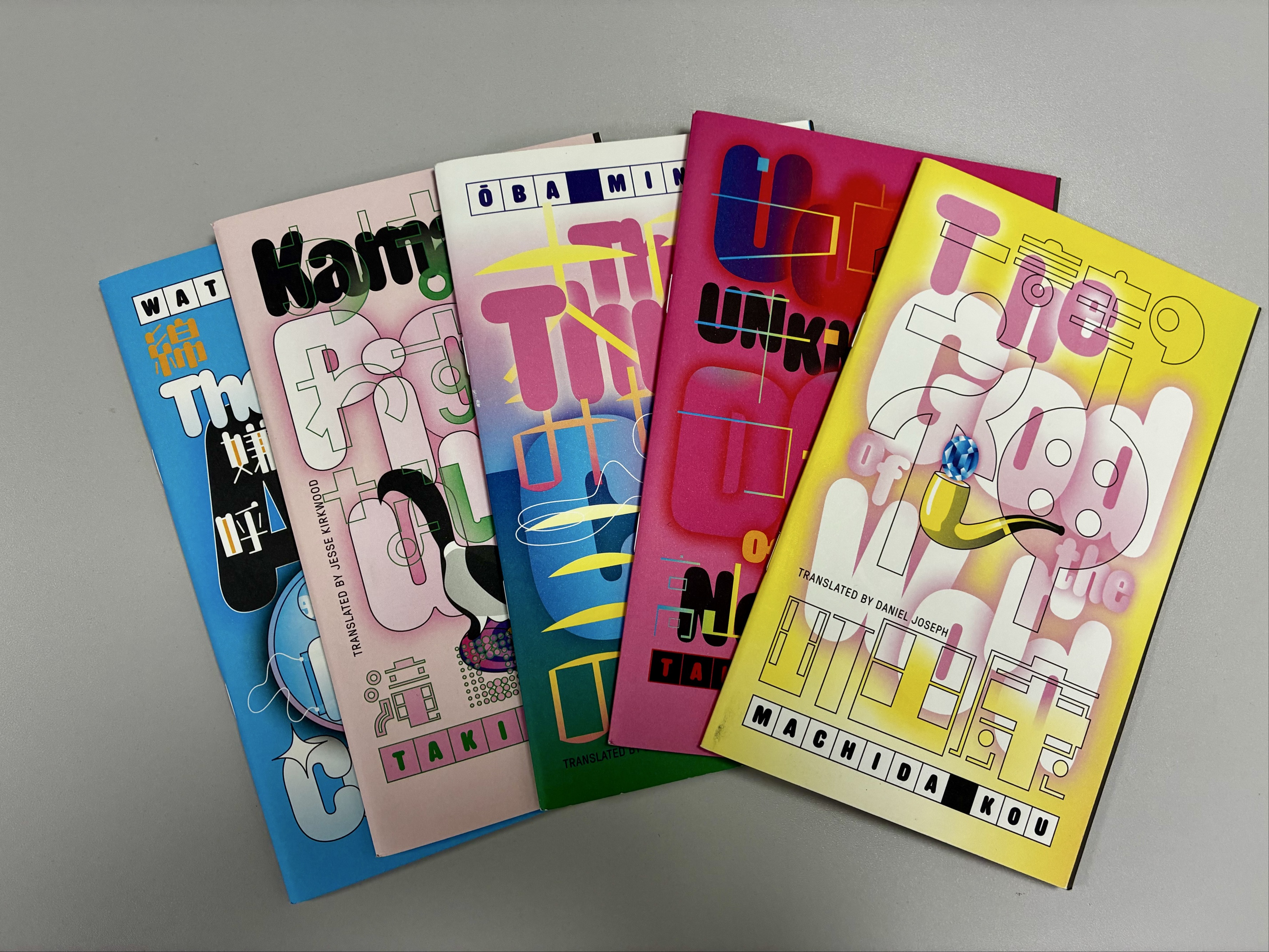
KANATA marks Strangers Press’ second foray into Japanese writing. Made up of five chapbooks from overlooked Japanese writers, KANATA explores what it means to go beyond, creating a collection that is both introspective and unique. Below, our writers share their thoughts on each chapbook in the series.
The Three Crabs by Oba Minako (translated by Lisa Hodmann-Kuroda)
The Three Crabs, written by Oba Minako and translated into English by Lisa Hodmann-Kuroda, is a peculiarly interesting book. It opens and ends with Yuri, our protagonist, staring at the neon sign for The Three Crabs. However, this is not the centre of the narrative, instead, we follow Yuri’s life, lying to her friends, lecturing her daughter and experiencing a failing marriage. Yet this character study is told in a beautifully lyrical way. You end up sympathising with Yuri despite her immoral actions, largely because of this. The lyricism also creates an unusual surrealist aura, where the narrative is grounded in reality, yet there are moments that feel separated from it. In all, this is a very interesting read, and something I feel I should reread to fully understand the messaging!
By Parker Job
Pictures of Her by Takiguchi Yusho (translated by Jesse Kirkwood)
This chapbook is a heartfelt meditation on the poetry of everyday life. It features two short stories, ‘Kamachi’ and ‘Pictures of Her,’ both eccentric yet deeply moving tales. In ‘Kamachi,’ a couple becomes fascinated by their neighbour, who performs her favourite memories through her open door, prompting us to debate the artistic merit of her life stories. ‘Pictures of Her’ shifts this theme of storytelling to a melancholic tone, as a man recounts a past trip with his now-divorced wife. This tender exploration of loss deviates from the whimsicality of ‘Kamachi,’ turning the collection into a kaleidoscope of multifaceted human memory.
However, the most stellar thing about these stories is their relatability. Yusho’s portrayals of odd neighbours and painful nostalgia transcend cultural boundaries, bridging communities through just forty pages. Pictures of Her ultimately transforms mundanity into magic, a reminder that the smallest moments often hold the most significance.
By Polly Dye
Udon: Unknown Dog of Nobody by Takayama Haneko (translated by LK Nithya)
This is a bizarrely fascinating story about the relationship between humans and animals. It begins with two of the three sisters, Kazue and Misa, finding an abandoned newborn dog. Upon discovery, they realise that they have no choice but to take it home. The rest of the story follows this feeling of no choice when it comes to caring for animals as the three sisters grow-up. Why do we feel a duty to care for animals? We see this questioned, with ruminations on what we get from these relationships. Animals, namely pets, will never be able to return this care, so why do we do it? The story ends cyclically, with Kazue and Yoko, the third sister, finding another Styrofoam box, like the one they found Udon in. Fox-like creatures emerge and it is at this exact moment that Kazue realises why we care for animals. The value of these relationships doesn’t come from what animals can give us in return, but what we get in loving and caring for them, making Udon: Unknown Dog of Nobody a strangely intimate exploration of human nature and our duty to animals.
By Lilia Colledge
Then Why Ask Me to Come by Wataya Risa (translated by Yuki Tejima)
Then Why Ask Me to Come, written by Wataya Risa and translated into English by Yuki Tejima is addictive. As soon as I picked it up it was difficult to stop. Our main character Kazuma Shimotsuki initially seems very normal, being dragged to a house party by his wife, and living through the Pandemic. That is, until he is trapped in a room where Kaede, his wife, and her best friend, Ham-Ham, along with others, confront him about his affair. Shimotsuki is not a good man, yet this narrative is told from his point of view. We are given his thoughts and reasonings, yet we still agree with Kaede. Risa manages to balance this effortlessly and create something that was infuriating to read, and yet I was unable to stop reading. In all, this book is witty, addictive and subverts expectations for a typical ‘cheating narrative’, making it a highly engaging read!
By Parker Job
The God of the Word by Machida Kou (translated by Daniel Joseph)
Machida Kou’s The God of the Word breathes new life into the Kojiki, the oldest extant literary work from Japan. Ohatsuse no Wakatakeru no Mikoto’s, violent rise is recounted through clear prose and snappy dialogue, as his temper drives him past a simple quest for revenge, to a merciless campaign of murder, creating a bloody trail all the way to the throne. Joseph’s translation relates the gory and complex affairs with fantastical twists and witty humour, in a similar vein to the childhood classic, Horrible Histories.
It is only after becoming emperor that Ohatsuse finally meets the titular ‘God of the Word,’ Hitokotonushi of Kazuraki. The mighty god creates things with a single word, bringing clogs, aromatherapy burners and even cream puffs to 5th century Japan, driving the dogmatic Ohatsuse to the brink of his sanity in a way that’s guaranteed to make you laugh.
By Lenny Senarath Arachchige
Image Credit: Polly Dye




Leave a Reply