
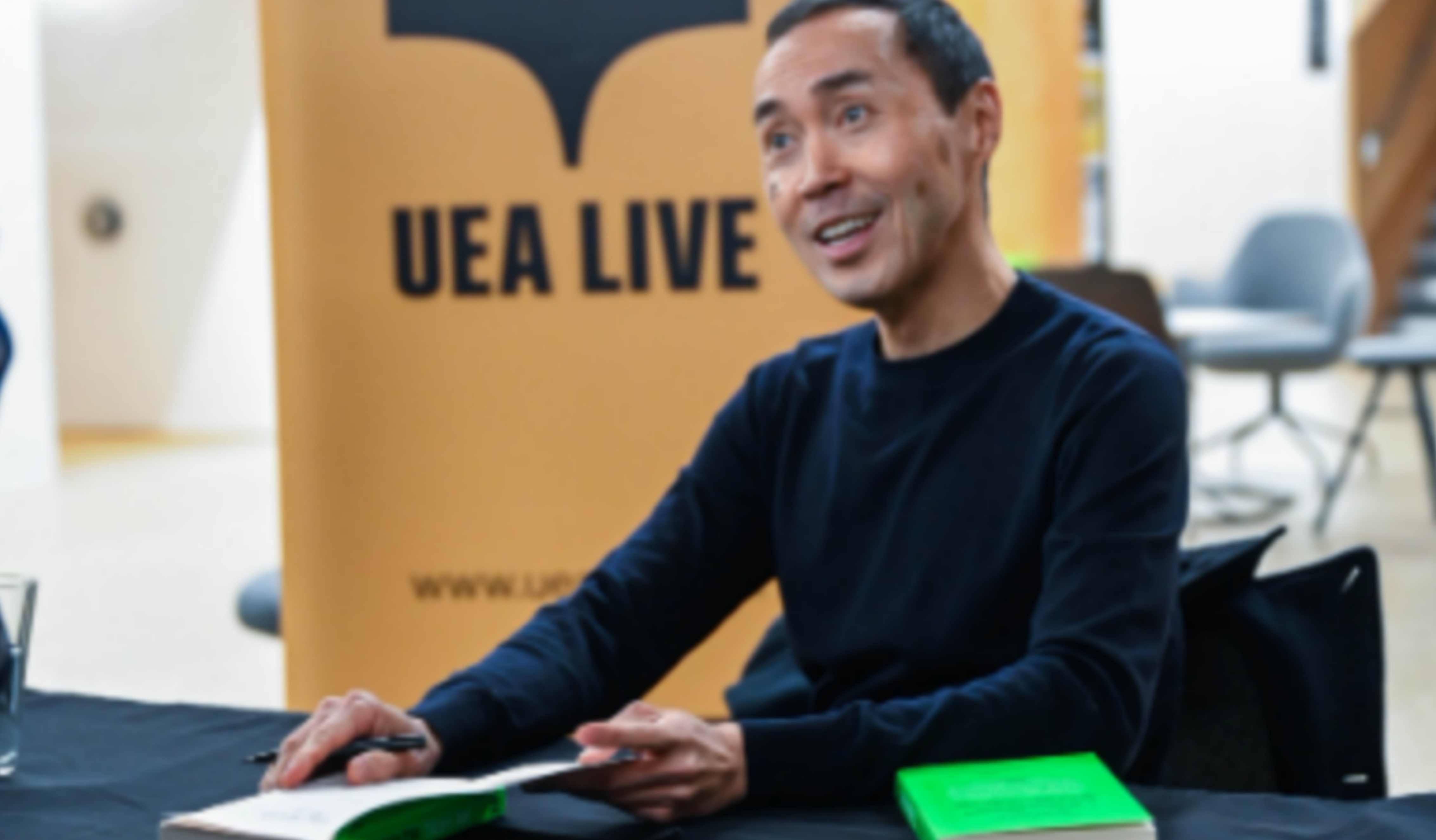
On March 10th, Tash Aw, a Malaysian writer, attended UEA Live to talk about his new novel, The South, an exploration of the private and public clashing.
The novel takes place over the duration of less than a month, mapping the falling in love of two boys, Jay and Chuan. Asking profound questions of who the characters are and who they have been, The South explores how people experience time; how a few weeks can be both quick and long; how memory is different to recollection and how that impacts our experience of time.
Aw does this expertly through his dual play of past and present, through multiple narrative points of view and tenses.
Tash’s writerly devices and choices
As a writer, Aw said that he is always trying to massage a story into a shape. “You have the idea for the story, but you must meld that into a form.” He says that it is imperative that writers are sensitive to the departures a story takes – “don’t fight against this, go with it.”
Aw said that as soon as he started writing The South, he realised that he couldn’t just present the story from Jay’s perspective; the story is about the experience of everyone.
While it may seem like an event may only impact one person, it isn’t exclusive. The impact ripples, affecting everyone in seemingly different, but no less important, ways.
Aw was asked about the introduction of the ‘I’ narrator, one that seems to leave as soon as they appear. Aw said it felt instinctive to include them, because ultimately, he was trying to tell the story of what it was like to be sixteen years old quickly approaching seventeen, but this was just a reconstruction.
He remarked that the ‘I’ narrator was a particular part that editors pushed back on. He spoke about why he feels they did so, “editors are afraid that readers won’t be able to grasp complexity,” and yet, this was many audience members favourite part.
Another device that is used effectively is setting. Aw talked about how the landscape isn’t just a backdrop, but a character in its own right.
The emotions of the land are communicated through the physical sensations of the characters. It becomes melancholic when the boys ride on the road and Jay thinks about the finiteness of that moment.
Arguably, the landscape is ‘nothing;’ it is desolate and barren, and yet, it is transformative. It is a place of love and joy, the ground that allows this family to become a collective in the face of their dysfunctional and disconnected past.
Language as a vessel
Aw spoke about how language works in The South. The characters don’t yet have the vocabulary to express their interiority; hence their external language is plain and clear. Aw said that language, in this way, is a vessel.
It serves the characters and world, instead of being something separate from it. Namely, Aw talked about how, for him, when language becomes an aesthetic in and of itself, that is when a novel dies for him; language should be representative of the story it is telling.
He also spoke about how some subjects are universally difficult, specifically love and sexuality, which explains the family’s inability to speak about it – because no one can.
The family in The South are somewhat a reflection of Aw and his family.
He spoke about how he was close to them, when he was young, but then suddenly found himself at a distance when he began reading and writing; he felt he no longer had the language to communicate with them.
The political novel
When Aw first came to the UK and started taking writing workshops, he was told that it was best to keep politics out of writing.
“Politics don’t have a place at the dinner table,” he said, but how can that be? Writing is a reflection of human experience and politics is, arguably an essential, part of that.
“Writers are often writing from the margins and those that say politics aren’t a part of that are coming from a place of privilege.” Aw wanted to invert what people thought of as a political novel.
The South never explicitly mentions politics and its precise absence makes it that much more apparent, asking questions like: can the briefest of touches be political? Can the smell of the one you love be political?
Yes, because relationships are political. Jay and Chuan’s relationship is political because they come from different lives (backgrounds, classes and families) and have to leave each other because of it.
The world you leave behind is still there.
Jay struggles to understand that everything he leaves behind will continue, regardless of whether he is there or not, demonstrating the guilt that many people who experience class migration feel; the privilege you pursue is shadowed by the underprivileged left behind.
Namely, Aw explores the nature of belonging and inheritance. He explores what inheritance means beyond who the farm will belong to in the future.
He looks at what the children have inherited from their mother: their inability to talk to each other.
They are experiencing a life that is boundless with opportunity, but trapped in this bubble, on this certain farm and with these people they should be closest to, yet they can’t speak to.
Furthermore, the nature of belonging in this story goes beyond just being between themselves and to the farm, but to a nation.
The family are immigrants from China, complicating their sense of belonging in a country we can assume to be Malaysia, although not explicitly mentioned. The reason the grandfather wanted to own a piece of land, even if it’s as crappy and desolate as the farm, is because he wanted to own a bit of land, to feel like he belongs in this nation.
Aw’s The South is full of complexity and richness, exploring the nature of humanity through many different lenses.
How does the body connect with land? How does language work or fail? How do we communicate with others? How do we belong?
Aw’s talk is part of a series held by UEA Live.
Still to come is Yann Martel, author of the renowned Life of Pi, talking about his new book Son of Nobody, where the lives of Troy are brought into the walls of contemporary Oxford, on Friday 27th March.
To wrap up, Cecile Pin will be talking about her novel Celestial Lights, following the journey of an astronaut embarking on a ten-year mission, on Tuesday 21st April.
Student tickets are £6, and the events are a great chance to see authors right on your doorstep!
To book, go to https://www.uealive.com/
Image credit: Emily Bond



Leave a Reply