
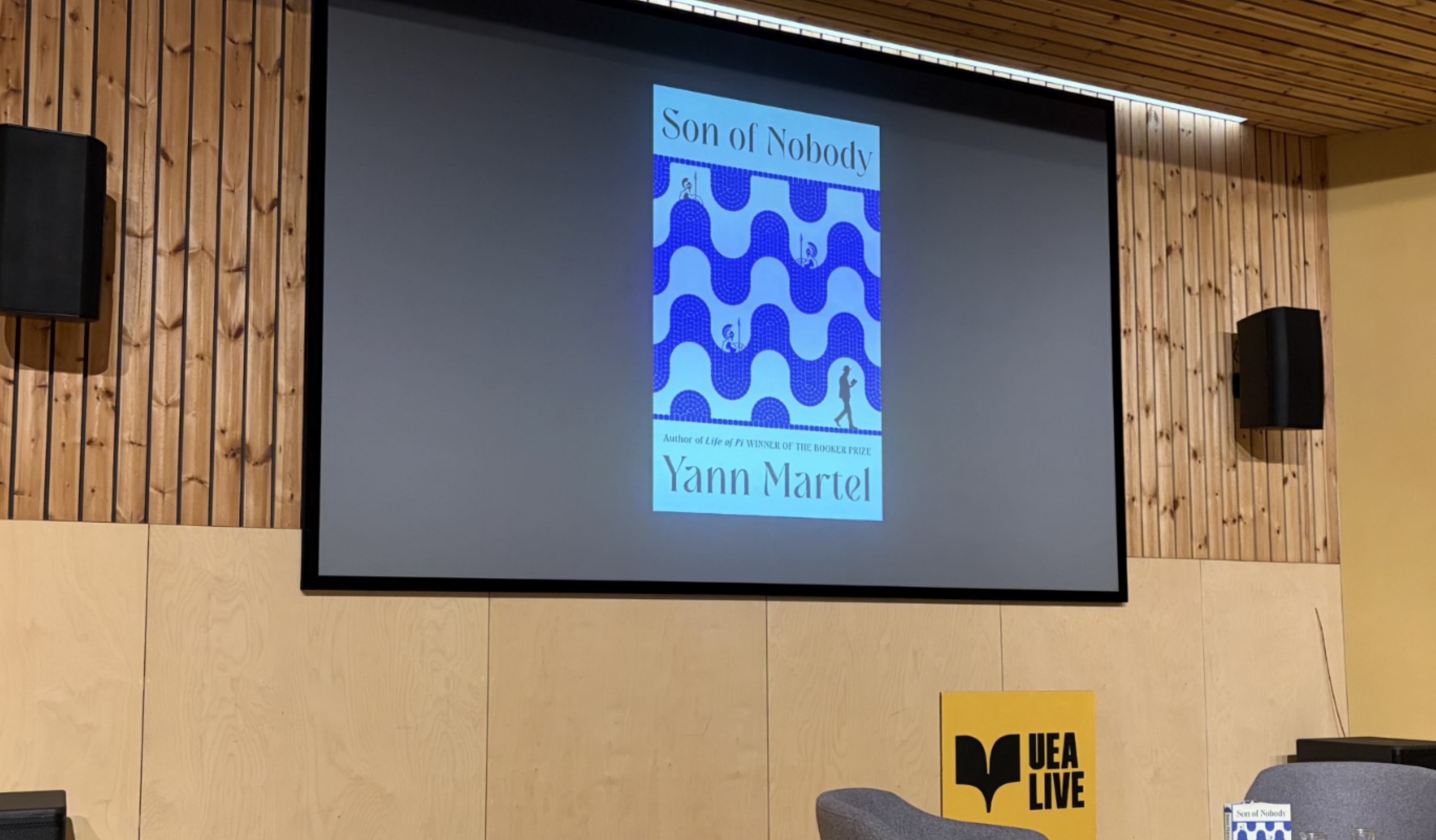
Man Booker Prize winning author Yann Martel visited UEA Live last week to discuss his new novel Son of Nobody – his first in a decade.
The novel follows Canadian scholar, Harlow Donne, who leaves his children and marriage for Oxford University, to uncover a lost account of the Trojan war.
The novel has a dual narrative, exploring Harlow’s intriguing discovery of this lost manuscript and personal turmoil, along with the intriguing Greek myth that lies within it.
The novel’s title Son of Nobody, is an ode to the epic poem The Psoad. Its protagonist is a Greek commoner identified as Psoas of Midea, known throughout as “son of nobody.”
Martel said that such Greek myths “invite readers to participate” and mentioned his intrigue about how Christopher Nolan’s upcoming film The Odyssey, would adapt such myths.
Martel stated his motivation for the book partially came from exploring the perspective of the “common man” and why a common soldier would even spend 10 years at war.
“We live a life of waiting,” Martel states. “To learn how to live is to learn how to wait.” It was these musings that made Martel frame one of the two narratives in the book about such a “son of nobody.”
Son of Nobody uniquely experiments with typography, with footnotes taking up most of one page and “fragments” on the other. Martel stated each section has its own “geography” and its “own life” and “after a while readers stop thinking about” the novel’s layout.
Martel hopes the top and bottom structure “asks readers to examine how they fit together.”
Inspirations for Son of Nobody
Contrasting Napoleon Bonaparte and Jesus Christ, Martel made the point of how historical facts do not guarantee individuals or stories live long in human memory. More is known historically about Napoleon, and yet the events of Jesus’s life are more broadly known.
Martel argues that “facts can be altered through stories.” Only one lower class man speaks in The Iliad Book Two, and Martel wanted to alter the facts of such myths to interrogate this. Myths allow writers to “take control of the narrative” and challenge the stories perpetuated by those in positions of power.
Such narrative framing allowed Martel to “create a parallel of tragedy in one man’s life” (the scholar Harlow Donne) and contrast this with wider tragedy in war. The Greeks travel to Troy, hoping for success, Harlow similarly travels to Oxford to study.
On ancient myths and metaphors
On the topic of reinventing ancient myths for modern readers, Martel advised “just close your eyes and use your imagination.”
Part of the reason Martel chose the subject of myth was to avoid being topical: “we can’t write about today because we don’t understand today.”
Martel also discussed how myths are a form of metaphor, remarking “people take on metaphors and make it their own.” Referring to his use of metaphor in Life of Pi, Martel said it was the first book he wrote where he felt he “spoke with people” and that “art is about inviting people to participate” through such use of myth and metaphor.
Martel’s influences as a writer
Growing up around devout Roman Catholicism in Quebec Canada influenced Martel’s career as a writer. “Art replaced religion,” Martel stated about his upbringing in the 1970s & 80s, facilitating his intrigue in writing.
His travels to India in the 1990s influenced his interest in religion and metaphor. He observed manifestations of religion that were “harmless” and “beautiful,” contrasting the experiences of his adolescence in Canada.
This led him to write the Booker Prize winning Life of Pi, which was later adapted for cinema by Ang Lee and won four Oscars. Martel’s view is that, similarly to myths, religion should “not be reduced to rationality” alone.
Such experiences of religion were linked to Ancient Greek texts used as inspiration for Son of Nobody. Martel’s belief is that there “has to be an echo” between the Gospels and the Iliad, as both texts were written in Greek.
King Agamemnon sacrificing his eldest daughter in Greek myths strongly parallels with Jesus’ crucifixion, in Martel’s view. However, Martel also noted the tonal antithesis between both historic texts, with the Gospels being “about love” whilst there “is no redemption” in the Iliad.
Martel’s writing style
“Planning everything” was Martel’s method of brainstorming the novel. He stated that he “must have had 1,000 drafts” during the ten years he worked on the text due to “obsessively re-reading” it. Such dedication was because of Martel’s belief that it’s “a beautiful thing to be working on something you find beautiful.”
Advice for UEA writers
Martel’s advice to writers at UEA? “When you’re a writer, you are your first reader,” and this is how to know whether a project will have appeal. “A text has to be amusing, has to entertain” whilst also making readers contemplate. Writing is “your way of commenting on life.” Martel enjoys “playing with the texture of words,” and says you “have to like being in the [planning] process fully.”
“Art comes down to connection and chemistry,” Martel advised one audience member when also asked about writing myths. “Don’t be too worried about facts” and “follow your muse, if you don’t, you’ll be lost.”
Readers were also encouraged to go into Son of Nobody “with an open mind” – Martel reassured that it is not necessary to have read The Iliad or any other Greek myths beforehand.
Martel’s talk was part of UEA Live’s Spring Program.
The final talk is from Somerset Maugham award-winner Cecile Pin on Tuesday 21st April discussing their second novel Celestial Lights.
Student tickets are only £6.
To book, head to https://www.uealive.com
Image credit: Samuel Haines




Leave a Reply