
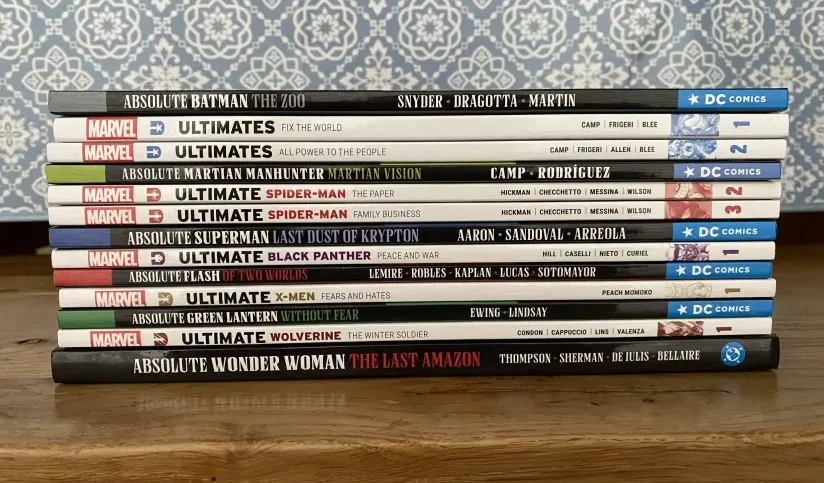
For most of my life, there has been a stigma around comic books – people say they are impossible to get into. This is true for the two largest publishers: Marvel and DC, who have almost a century of stories with the same characters. Status quos change every few years. Characters who die rarely remain dead. Around once a decade, a crossover event leads to all of existence being torn apart, only to be put back together without much fuss. It’s a lot.
Outside of these companies is where many of comic’s modern classics reside, published at places such as Image Comics and Boom! Studios. With their emphasis on creator-owned work, their comics don’t have to fit into company-wide initiatives. Long form narratives such as Monstress (my personal favourite comic) and Saga could have only thrived there.
Over the last few years however, Marvel and DC have both launched imprints that have reignited interest in their brands outside of their main continuities. There are explanations for how these worlds were created. You do not need to know them to read these comics. There are even explanation videos on YouTube by the creators such as OwenLikesComics should you seriously require the context.
Over at Marvel there was the Ultimate Universe beginning in late 2023, depicting a world where many characters had been prevented from becoming the superheroes audiences know and love. It is overseen by legendary comic book writer Jonathan Hickman, who was brought on board to run the project for two years.
The headline title was Ultimate Spider-Man by Jonathan Hickman and Marco Checchetto. Here Peter Parker is an adult, married to Mary-Jane Watson and has two children, before he is bitten by the spider to become the iconic hero. Its main appeal was how fresh it feels compared to the mainline Amazing Spider-Man, where Peter has felt stuck without character growth for years. Any change would have been received positively, and this change offered so much potential.
The series is confident in its ability to make you care for the characters; there are whole issues where Peter doesn’t suit up. However, the longer it goes on, the more it loses momentum. Its story struggles to fit into the one-month-in-universe per issue structure the imprint’s titles are supposed to have, but most ignore.
The only other title to follow this structure is The Ultimates by Deniz Camp and Juan Frigeri, the Avengers of the universe. This has a “hero of the week” feel, introducing reimagined versions of Marvel’s heroes to join an expanding resistance network. Each issue ends with the number of months left to prepare for a cataclysmic event, a task that quickly feels impossible.
It is the kind of comic you would not expect a company as large as Marvel to publish, unafraid to explore current social issues in a manner that makes it feel radical. Its large cast and episodic format could be viewed as a lack of focus, but Camp finds ways to make each issue stand out. For example, #11, following Thor around the Nine Realms, is told in a style mimicking a Norse saga, including rhyming poetic verse.
A more unrecognisable team is the Ultimate X-Men by Peach Momoko, a manga inspired title featuring a group of lesser-known X-Men and original characters, brought to life with gorgeous watercolour art. Visually no other title is like it. Its focus on character means there is little in the way of traditional super heroics. They have powers and fight villains, but no one suits up. Momoko uses this to tell a personal story embedded in Japanese culture.
If you want to see staple X-Men characters, Ultimate Wolverine by Chris Condon and Alessandro Cappuccio has you covered, presenting Wolverine as the assassin, The Winter Soldier, and many fellow X-Men as militia trying to take him back. And if your favourite X-Man is Storm, then Ultimate Black Panther by Bryan Hill and Stefano Caselli is the place to go. It fits the mould of a modern update of the king of Wakanda’s origin, rather than an alternate take on the material, but is a great Black Panther story.
Across at the distinguished competition DC Comics, there is the Absolute Universe, which launched in October 2024. The premise here is taking their beloved superheroes and removing or changing everything that made them who they are. These comics feel darker, asking the question: what if these characters were created today? However, despite their tone, each one shows that they still manage to represent everything about themselves at their core.
In the line’s most successful title, Absolute Batman by Scott Snyder and Nick Dragotta, Bruce Wayne is a regular citizen of Gotham, who also happens to be almost seven feet tall. The page layouts can at first appear overcrowded, but this is simply Dragotta’s style of drawing. The rough-around-the-edges quality adds to its appeal. Every design reveal for an Absolute version of a Batman villain goes viral with how over the top they are.
Absolute Wonder Woman by Kelly Thompson and Hayden Sherman takes Diana away from the Amazons to be raised in Hell. Gone is the lasso of truth, and in its place is an assortment of lassos that grant Diana a range of magical powers which come with a cost.
Rounding out the Trinity, Absolute Superman by Jason Aaron and Rafa Sandoval borrows aspects of Supergirl’s origin as someone who grew up on Krypton before its destruction. It’s a globe-hopping story where Superman battles villains associated with other heroes in the main comics, whilst keeping the character’s roots as a champion of humanity.
After the success of the first three titles, three more were added, starting with Absolute Green Lantern by Al Ewing and Jahnoy Lindsay, which remixes the intergalactic lore of the Green Lantern Corps into cosmic horror in a quiet Nevada town. Absolute Flash by Jeff Lemire and Nick Robles ironically has the slowest start, but picks up steam the further it goes, featuring some of the most interesting Absolute redesigns for the Flash and his Rogues gallery.
Whilst other titles have reimagined these characters, Absolute Martian Manhunter by Deniz Camp and Javier Rodriguez offers a complete reinvention, taking complete advantage of the comic book medium to tell a psychedelic mystery-thriller that will be wrapped up later this year. The entire story will be collected in two volumes.
The similarities between these two initiatives are their focus on letting the creators tell the story they want to tell without the editorial interference you would find in mainline titles, and it has shown success both critically and commercially. As of November 2025, the Absolute Universe comics have sold 8.2 million copies. Nearly 3 million are for Absolute Batman. Whilst no sales figures are available for the Ultimate universe, its reception has been the most positive for anything Marvel has published in the last few years.
DC has clearly learned from this success, its Next Level initiative which launched in March features creator-focused titles in the main universe, with the teams behind the books allowed to tell the stories they want with the characters they have.
Writers like Kelly Thompson and Scott Synder have said the universe is not going anywhere anytime soon. Later this year there will be new titles, with miniseries for Absolute Catwoman by Che Grayson, Scott Snyder, and Bengal and Absolute Green Arrow by Pornsak Pichetshote and Rafael Albuquerque launching in June and May respectively.
As for Marvel, it is harder to tell what lessons it has learned. The Ultimate universe has been a success, but by the end of May it will have ended. For comics, two years is a short time, however this decision was due to honouring the contract given to Jonathan Hickman. Deniz Camp has said there were ideas to continue The Ultimates, but ultimately (pun intended) that was also wrapped up. In a medium where stories are designed to run indefinitely, the fact these series will all receive a definitive end is something to be admired.
Whilst the common consensus right now is that DC has the upper hand over Marvel; one editorial reshuffle could undo the company’s willingness to trust its creators and allow them to take risks. If there is any advice to take from this article, it is to follow the creators and discover their independent works. Marvel and DC can publish fantastic stories, but independent comics is where the real gems are.
Image credit: Ollie Wheaton



Leave a Reply