
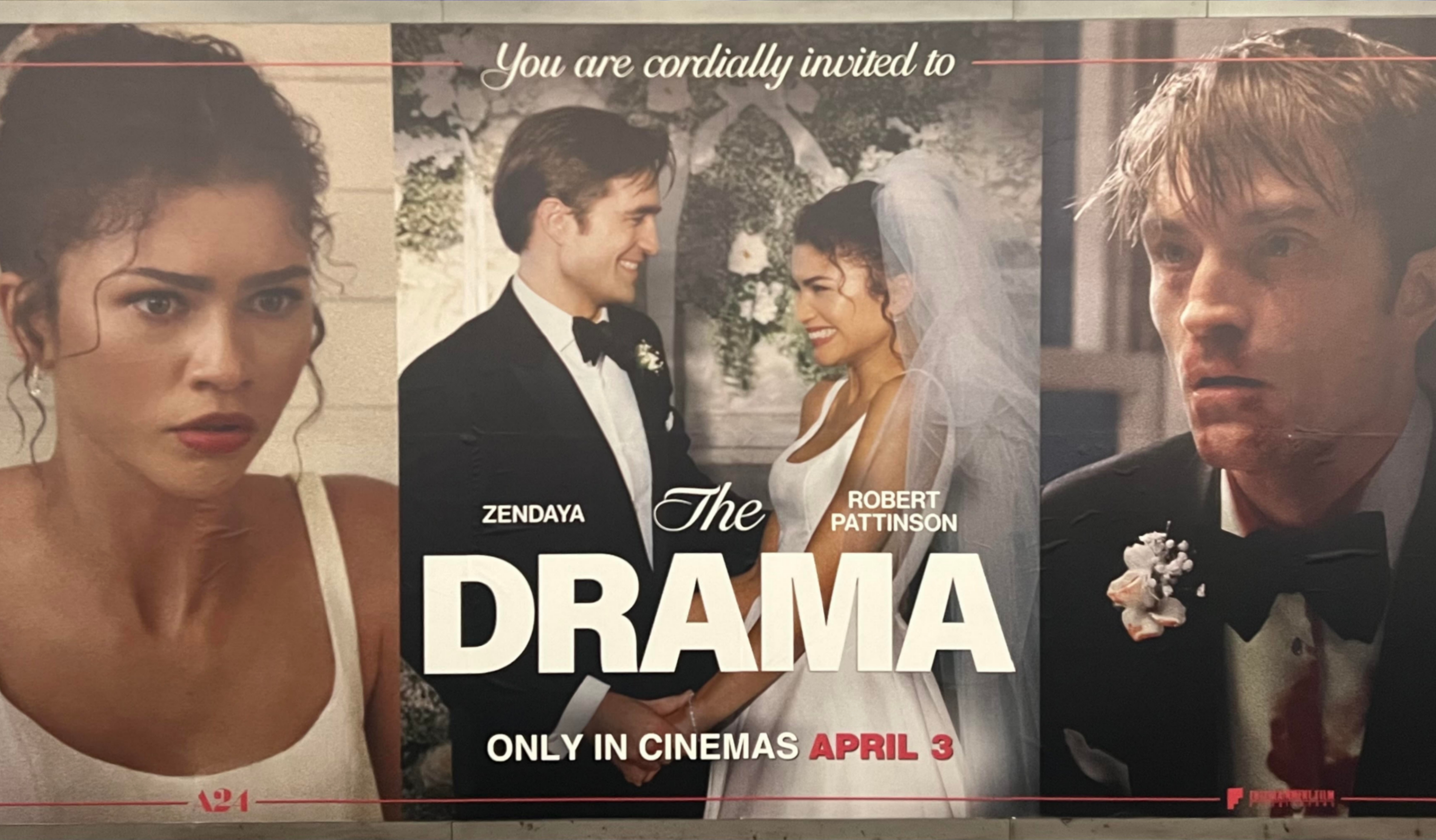
Written and directed by Norwegian Amanda Award winner Kristoffer Borgli, The Drama stars Zendaya and Robert Pattinson at the top of their game.
It’s another strong entry for A24, an independent studio that has come to excel in both box office success and awards recognition
The Drama has been creating heat since its initial teaser trailer in December, with interest intensifying following the full trailer release in February.
Happy couple Charlie (Robert Pattinson) and Emma (Zendaya) are finalising last-minute wedding preparations for their big day, set to take place in a week’s time.
During a dinner tasting with their best man and maid of honour, the question, “What is the worst thing you have ever done?”, is posed to the table. From the trailer, we are shown the reactions to each of the stories, ending with shock and anger when Emma’s is revealed.
The question of what could be so terrible was enough to draw packed cinemas when The Drama was released in the UK on 3 April.
This unlikely “romcom” is filled with dark humour, leaving the audience sitting uncomfortably throughout.
Driven by the moral contention surrounding the twist in Emma’s secret, what makes the film so compelling is its examination of people’s limits on violence, and how unconditional love for a partner or friend truly is. As a result, The Drama cannot be watched at a surface level.
Each character at the dinner rehearsal tells the story of the worst thing they have done; arguably, the remaining three stories are worse (subject to personal opinion) than Emma’s, as she does not actually do anything.
Following this twist, the film watches the group bounce off each other’s reactions, slowly beginning to unravel.
Rachel, the maid of honour, is the most affected by the confession, to the point that she revokes her role in the wedding. Her character represents the outrage-driven “cancel culture” prevalent in today’s society, where many jump on the bandwagon, urging others to do the same, claiming that neutrality is complicity. In reality, the situation spirals as individuals wait for the next target of collective outrage.
Rachel’s character inevitably becomes a paradox, pushing her own ideals onto others while failing to uphold them herself. Her influence over Charlie is clear, as she suggests Emma’s actions stain his own character.
He struggles to process the revelation, searching for a moral answer he seems unable to reach independently – again mirroring a wider tendency, particularly on social media, where individuals increasingly rely on others to formulate their own opinions.
The film’s structure reinforces this tension. By intercutting real-time events with dramatised sequences imagined by Charlie as he spirals, it allows the audience to understand his perspective more fully.
Flashbacks to Emma’s experience further complicate the narrative, leaving it up to the viewer to decide who, if anyone, is in the wrong.
The Drama ultimately tests the audience’s media literacy while offering timely and relevant social commentary.
Punctuated by moments of sharp humour, it leaves viewers to decide where they themselves draw the line, making it a must-watch for 2026.
Image credit: Amelie Cook




Leave a Reply