
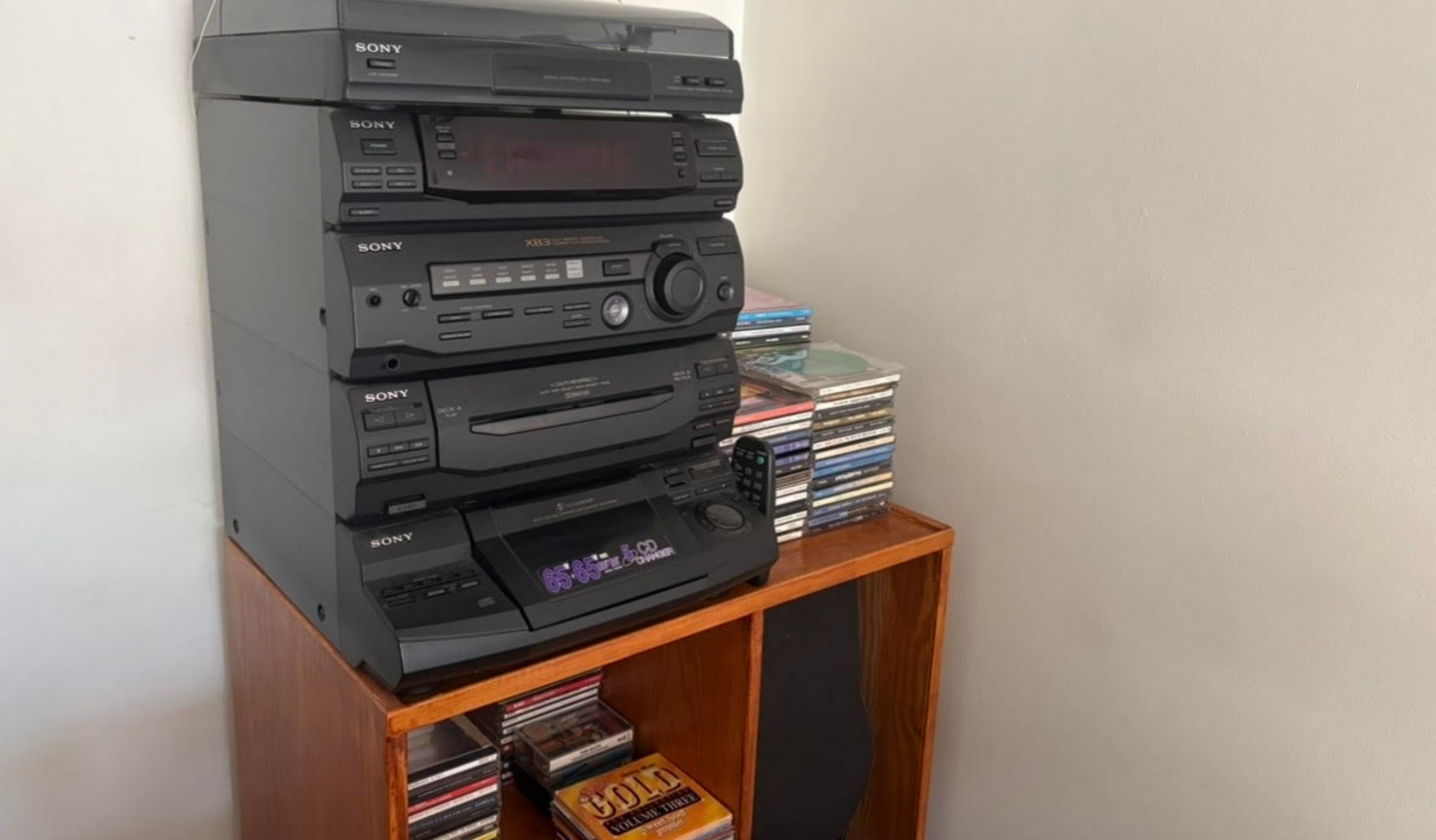
A couple of weeks ago, I was with my dad, sifting through his old CDs that had been collecting dust in the back of the garage. He told me to take whatever I wanted.
I didn’t know most of the artists. I didn’t even have a CD player anymore – long past the days of my hot pink one, which I’d once insisted would have to be pried from my cold, dead fingers.
It sat there now, dusted over, matching the CDs. Both had become obsolete, replaced by newer tech, functional only as a kind of nostalgic reprieve at the edges of memory.
Standing there, it felt like something had shifted – not just in my relationship to the music, but in how anything gets passed down at all in a world where most of our culture no longer has a physical form.
I recognised a couple – Ben Howard’s Every Kingdom, Portishead’s Dummy – albums I’d once begged to have turned off, back when I refused to believe in any genre beyond the 2000s pop princesses of Lady Gaga and Britney Spears. But beyond that, though, there was a distance I couldn’t quite account for. It wasn’t just unfamiliarity. It felt closer to something shared slipping out of reach – ephemeral, like dust catching the light before settling back into the garage.
I’ve wandered through HMV before, absent-mindedly flipping through records, comforted by their physicality – the idea that music could still exist as something you could hold, something with edges and weight. But the feeling never really lasts.
I feel like an imposter, like I’ve stepped into an IKEA showroom version of a record shop – a staged imitation of a life I’ve never actually lived.
I found music alone – through Spotify recommendations, through playlists I’ve curated and reshaped until they feel like extensions of myself. I take pride in their specificity, their supposed uniqueness.
But there’s nothing to inherit.
I keep returning to a scene in Joachim Trier’s The Worst Person in the World. Near the end of his life, past love interest, Aksel, reflects on the generational gap between himself and the protagonist, Julie – how he grew up in a time when culture was passed along through objects: books, comics, things you could live among. There’s a romance to it, but also a resignation. In the end, he calls it futile.
Maybe it is. But it doesn’t feel unimportant.
Because it’s in death that this question sharpens, taking shape in the act of sorting through what someone leaves behind. Notes in the margins of books, scratched records handled one too many times – each object offering a partial way back into who they were. Media becomes more than something consumed; it becomes a fossil record of the self.
My grandmother’s living room feels like a shrine to that idea. The TV sits at the centre, flanked by a record player, stacks of CDs, old videotapes, even 80s video games. Most of it doesn’t work anymore – the technology required to run it long outpaced by everything that followed. But picking any of it up still feels like stepping back into something whole. Like the dust catching the light again.
But what happens when there are no tangible remnants?
When a life is stored instead in something as abstract as “the cloud” – a term that feels less like a place and more like a disappearing act. Try explaining it to your grandparents without them wondering how anything can exist in the sky. Even now, it doesn’t entirely feel real.
When I die, there will be nothing to sift through. Or at least, nothing like this.
My generation – Gen Z – is the first whose sentimental geography is partly intangible. For many of us, nostalgia isn’t tied to somewhere you can return to, but to something like Minecraft – its textures, its music, the YouTube culture that grew around it. Those worlds feel as familiar as the soft fibres of a childhood carpet, the absent-minded pulling at a flaking leather sofa.
But there’s nothing to pick up. Nothing that holds it in place.
The worlds we built with friends exist only in memory – and memory fades. One day, I’ll forget them entirely, and there will be no relic to bring them back.
CDs scratch, tapes degrade. What’s changed is subtler: the loss of return, as something once within reach quietly disappears.
Millennials might have existed somewhere in between, balancing physical and digital life. But for us, everything has been immediate, accessible, endlessly replaceable for most of our lives. Because of that, it rarely feels at risk.
Physical media was never really about lasting forever. It was about leaving something behind – something that could be picked up, handled, passed on.
After all the scrolling, the saving, the quiet accumulation of things that now live somewhere in the cloud, what are we actually left with?
Not nothing – just something harder to return to.
Like dust in the light, visible only at the right angle. And if no one thinks to look, it’s as if it were never there at all.
Image credit: Charlotte Ward


Leave a Reply