
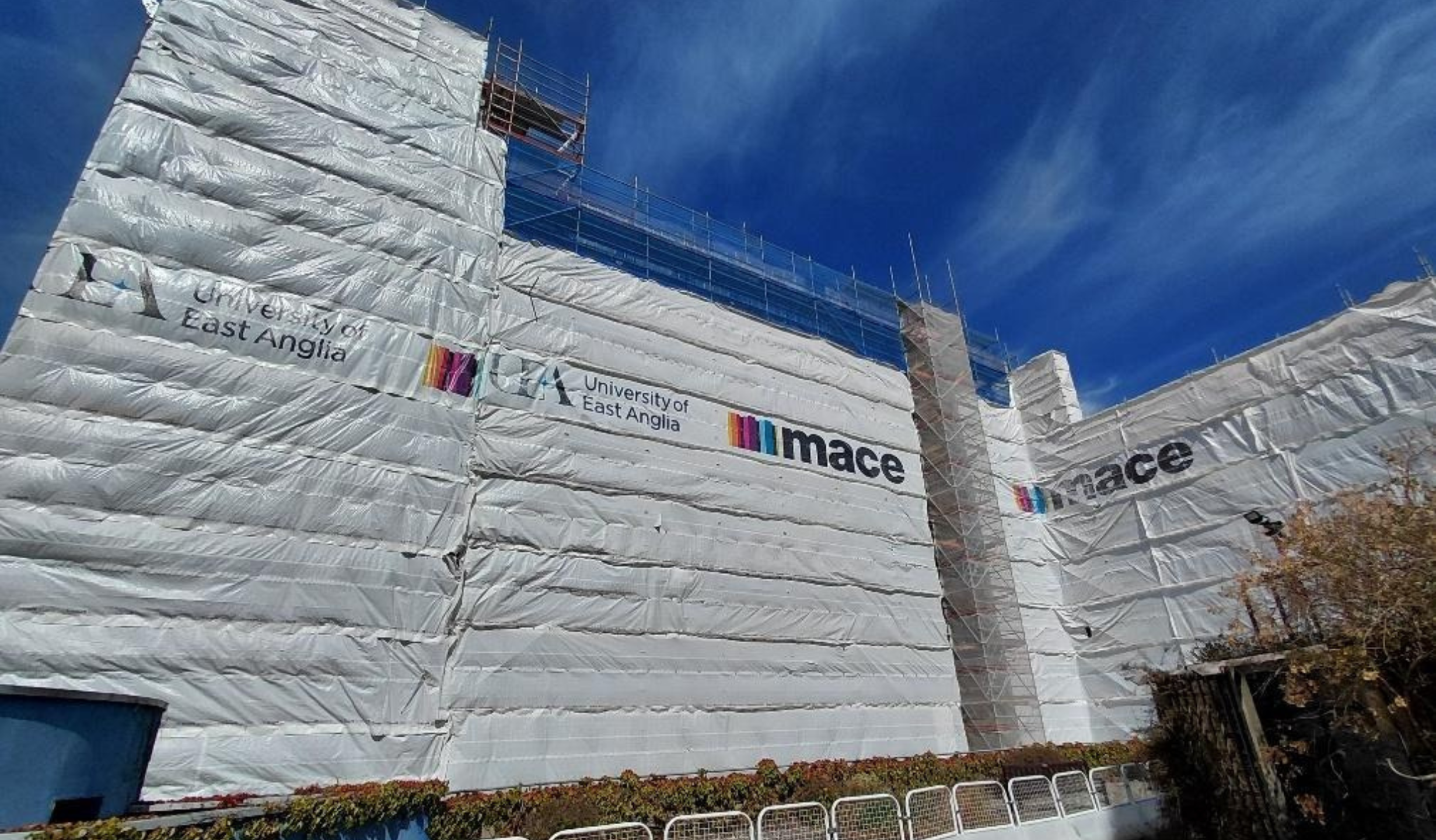
A brutalist university structure from the 1960s is entering the final 12 months of redevelopment construction.
Work on the University of East Anglia’s (UEA) Building 3 is expected to finish mid-way through next year and will open towards the end of 2027, marking Phase 1/4 of the Lasdun Wall Redevelopment Project.
A budget of £151 million has been set aside for the work, which will include two floors of teaching space and another two floors of labs.

Stephen Wells, Director of Estates and Facilities at the UEA, stressed the importance of modernising the Grade II listed architecture, which will become wheelchair accessible for the first time.
“If you look at the landscape and you look at the level changes and the challenge that we have with our campus, the walkways are above ground. For the first time ever, there will effectively be a very nice modern ramp that will go into the building,” said Steven Wells.

“The eventual plan with the Lasdun Wall, when all four phases are complete, is that you’ll be able to go through the whole building in turn. Buildings 3, 4, 5, 6. You’ll be able to come out at the far end by the Sainsbury Centre with a level floor that goes right the way through,” he said.
The Lasdun Wall was originally opened in 1968 by the architect Sir Denys Lasdun and became protected under the National Heritage Listing in 2003.
The project is also intended to play a significant role in UEA’s environmental goals.
“We believe that this is a significant opportunity towards the journey to net zero, which we know the [UEA] has a target to get to by 2045. We’re also currently estimating it will reduce the running cost of the building by about 80-85%,” said Steven Wells.
Improved insulation, thermally efficient windows and energy efficient lights are some of the techniques included in the plans.
“If you go into the Lasdun Wall, it looks tired. It needs refreshing and it needs refurbishment,” said Steven Wells.
He continued, “It needs the infrastructure changing. It’s assisting to delivering on our net zero targets and accessibility.”
“It’s a modern teaching and learning space and protects our research,” said Steven Wells.
Image credit: Jamie Mann




Leave a Reply