
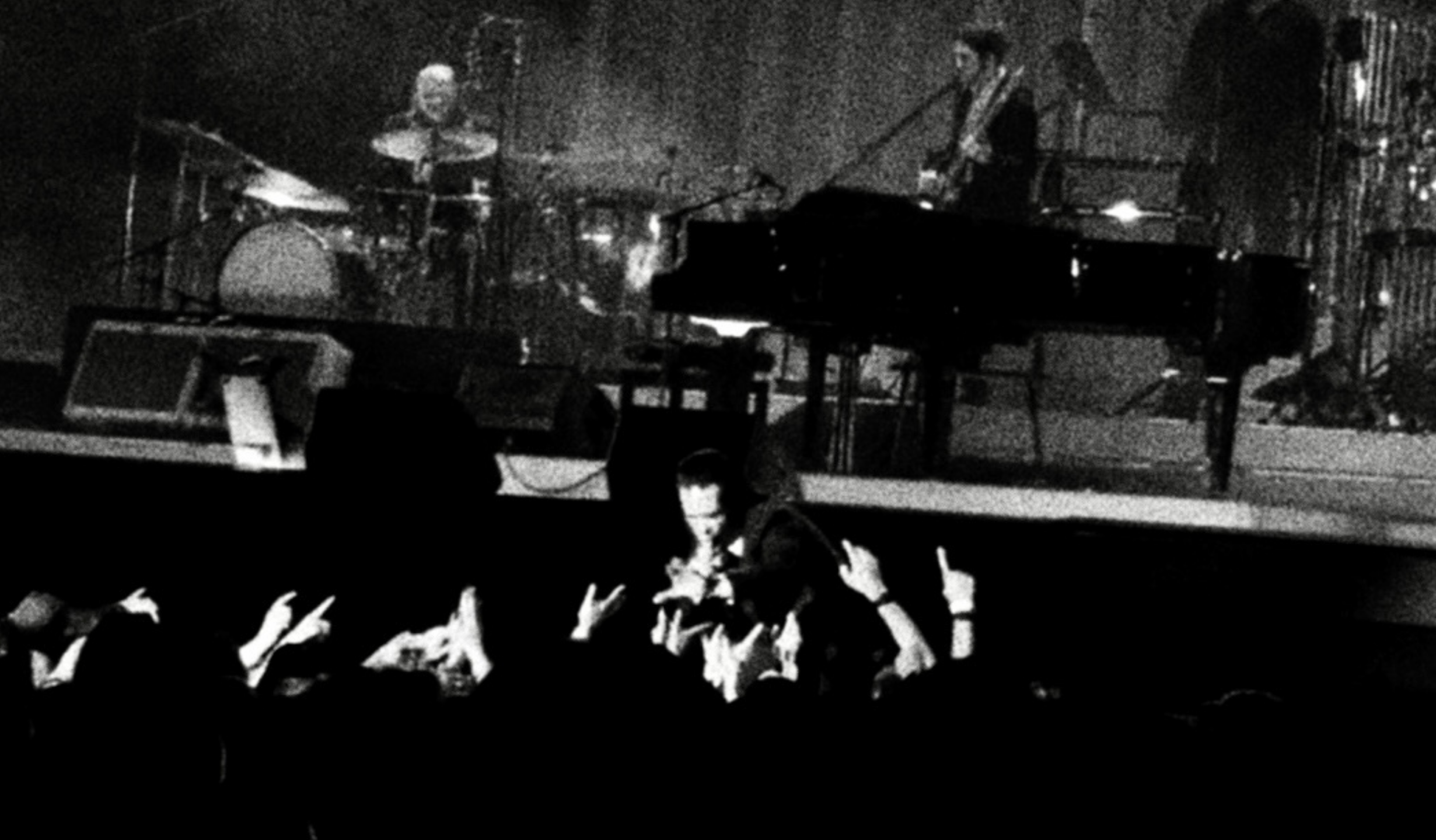
Here he comes, with the glint of his heel tossing the spotlight across the crowd. Against a wall of Black Seeds, Mr. Stagger Lee, hand stained red and gliding across the stage at La Prima Estate, Italy. He’s worn many faces across his career, like the misanthropic shadow of Ziggy Stardust, a duke suited with black-dye stains and pointing with Adam’s index into the crowd. Nick Cave stands and declares:
“Get Ready For Love!”
Throughout his career Nick Cave has used songwriting as a vehicle for storytelling. He uses this writing style as a way of inhabiting a variety of characters – usually disturbed or intimidating figures with a hunger for violence.
From his 1996 album Murder Ballads, the song O Malley’s Bar sees Cave paint a portrait of a young, narcissistic man who carries out a western-style shooting at his local town bar. Cave voices the shooter and wanders fiercely through the character’s disturbing psyche, the track landing at eight minutes long with some of the most violent and yet simple couplets in modern song;
I jammed the barrel under her chin
And her face looked raw and vicious
Her head it landed in the sink
With all the dirty dishes
(Nick Cave, O Malleys Bar, Murder Ballds, 1996)
Nick performs the shooter’s arrogance with a disturbing intimacy that gives powerful life to the character. So much so that one can even visualise the shooter’s posture and movements; he rises out of the song with the frenzied liveliness of a Ralph Steadman drawing.
O Malley’s was left off the setlist in Italy, with bigger character-driven songs performed instead (Red Right Hand, The Mercy Seat etc.) The most notable performance of these character-driven songs was Jubilee Street, a sonic transcendence that tensely rises in spirit and instrumentation. Warren Ellis’ Fender Mustang gradually let the repeating guitar riff grow wings, as Cave desperately sang of a prostitute named Bee undergoing metaphysical transformation.
I glanced to the left of me as the song spread into its ensembled climax. An older Italian lady twisted, giving over control of her body to the song’s nervous system, her arms wildly flailing in the gust of drums and distortion pedals. In Flamenco they call this Duende, that frenzied place where you tango with death, “a state of tragedy-inspired ecstasy.” (Gerald Howson, The Flamencos Of Cadiz Bay, 1965)
In his early career, Cave implemented this fictionalised, character-based writing style consistently – perhaps partly as a means of structuring his own mythic stage character. Early interviews and film cameos such as in Wim Wenders’ Berlin-set myth Wings Of Desire (1987) show him as a combative, cynical figure who shows many traits of the violent characters in his songs (particularly present in his performances).
Nick has consistently cited Johnny Cash as a baseline inspiration point for his work. Cash’s cultural presence has always had a mythic quality, whether as the outlaw figure in his early days or the worn voice facing the reaper in his later recordings – Cash’s work has often felt like something beyond himself. Perhaps part of Cave’s early inspiration from Johnny Cash was circling this idea of the musician building myth through their work.
Through the 2010s, Nick Cave experienced great loss in his personal life. This experience with grief fragmented his work, seeing him largely leave behind story-based writing and disassembling his mythic persona with his starkly vulnerable and harrowing album Ghosteen. Two tracks from the album where played at the concert, with the song Hollywood spiralling into a grand, melancholic desperation.
Cave’s processing of greif through his work layed him bare to his audience, undoing the myth of the cynical, transgressive rocker and offering something more human.
The concert was part of his Wild God tour, his first fully formed Bad Seeds tour since this change in his artistic approach and identity. The gig was set to the backdrop of an Italian mountain range and the nearby sea – perhaps nature’s reflection of Cave’s deliverance from the dark valleys of his violent characters and into something wider, clearer and more human.
Cave sang of Frogs and hurled his body deep into the crowd, hands holding his waistcoat as he belted down at a range of faces. Not a veiled figure of myth of a character but something immensely vulnerable, broken and yet powerful. Nick’s performance pounded with a grace that could perhaps be read as prophet-like, but it was still human, still made of skin, a strange flesh-bound contradiction on the Italian coast. It marked a peak in Cave’s career, a broken and imperfect assembly of transcendence.



Leave a Reply