
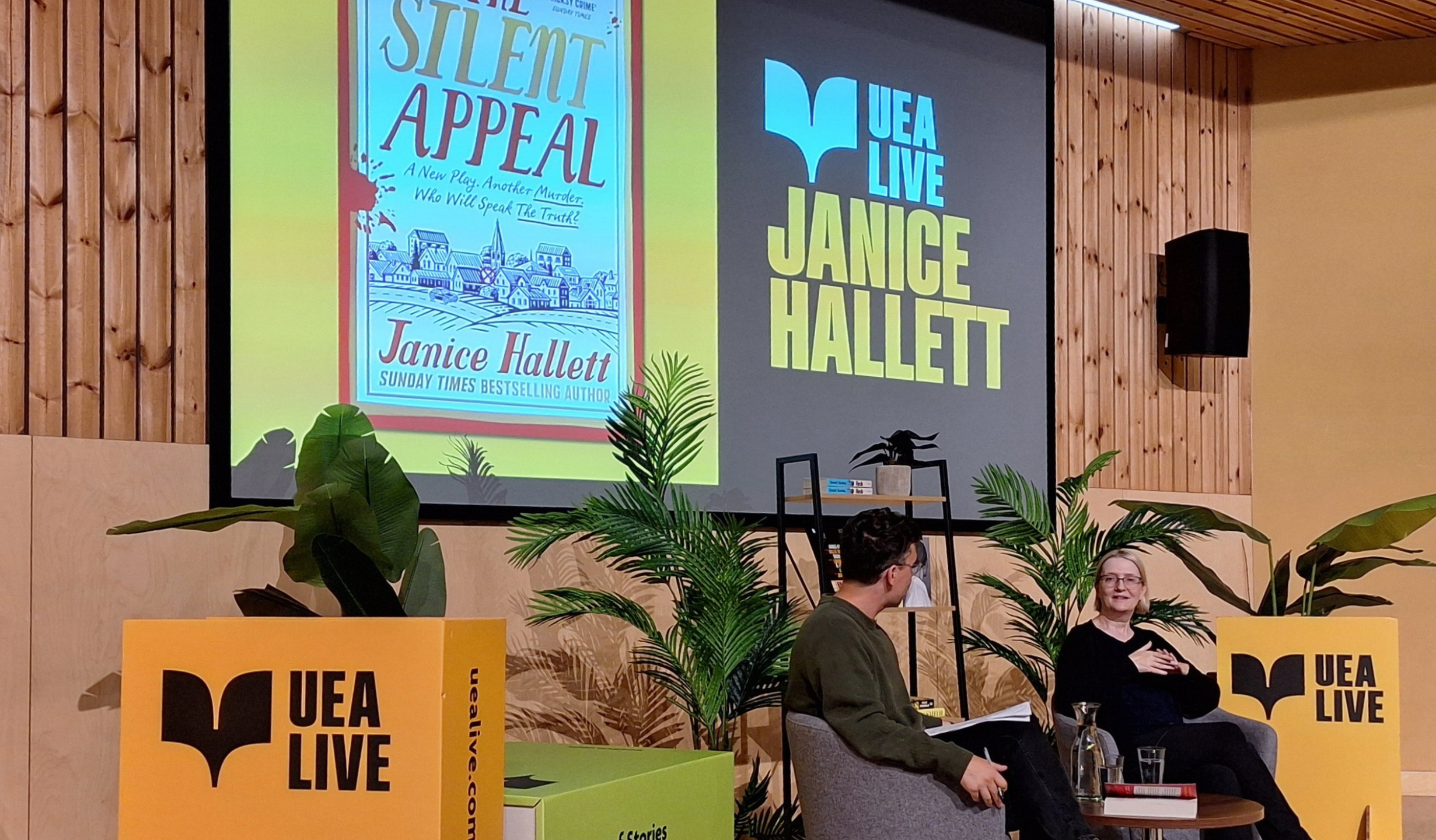
If Janice Hallett could label her own genre, it would be “crime with lots of swearing”.
The University of East Anglia’s literary festival, UEA Live, returns this autumn with best-selling crime fiction writer Janice Hallett. Chaired by Dr Nathan Ashman, Lecturer in Crime Writing at UEA, the event took place at the Enterprise Centre on Wednesday, 30 September.
Hallett’s newest novel, The Silent Appeal, takes readers back to the small town of Lockwood, the setting for her debut novel, The Appeal.
Going through email correspondence, text messages and audio transcripts, readers are invited to join law students Charlotte and Femi in solving the layered mysteries surrounding each case.
Once again, the Fairway Players, Lockwood’s amateur dramatics society, take centre stage as they prepare to put on another play — this time, Agatha Christie’s The Hollow.
What is it about a play that makes it the perfect stage for a murder mystery? Staging a play, Hallett points out, is time-consuming, intense and stressful, leading to petty rivalries and negativity. “Passions run so high,” she said. “People care so much about putting a play on.”
Even so, Hallett’s novels take on a comedic air, as seen in the characters’ personalities and interactions with one another. All her characters are inspired by different people she has met in real life.
“I love Issy so much,” she admitted, referring to Isabel Beck, a character who first appeared in The Appeal. “She is a part of me, someone I feared I was at some point.”
Hallett shared a humorous anecdote: After The Appeal came out, she was “bombarded with three or four emails from friends, apologising for being Issy”, who is known for sending neurotic emails and being overly clingy.

To construct memorable characters with distinct voices, Hallett engages in a productive hobby: eavesdropping.
“I’m a big eavesdropper,” she confessed. “I love listening to people talk in trains and buses.” Eavesdropping is her secret to polishing an ear for dialogue. “What people say relates to how they feel or what they want.”
Hallett’s knack for dialogue also stems from her background in screenwriting. Dialogue, for Hallett, articulates the way different characters look at the world based on their unique experiences.
Through her trademark epistolary style, readers can observe “people altering how they speak to each other, depending on who they are talking to and what they want.”
Perhaps the biggest plot twist of the evening was Hallett’s confession that she dives right into first drafts without any plotting. For Hallett, the joy of writing is in discovery: letting the characters lead her into the story.
“It sounds mad, but I hear [the characters’] voices… I write the same way the reader reads the book.”
Her only compass is her document word count, which dictates her pacing. For example, once she hits 20,000 words and 50,000 words, she knows that “something has to happen, someone has to die somewhere”.
Once a first draft is finished, Hallett and her editor go through months of multiple revisions. “If I wasn’t such a pantser, I wouldn’t have such a big structural edit,” she admitted. But Hallett revels in the “joyous mess” of rewriting — and her process has worked for her.
Juggling multiple manuscripts, screenwriting projects and other responsibilities, Hallett has to write a thousand words a day and seven days a week to stay on track.
Still, she wouldn’t have it any other way.
“It’s something I love doing. I don’t resent that level of writing. As long as I keep that joy in writing, the reader will enjoy reading that. Fingers crossed.”
Another surprise? Writer’s block has never knocked on Hallett’s door. “You can’t have writer’s block when you’re a journalist,” she quipped. Her experience as a magazine editor has trained her to churn out content under pressure.
Hallett now has set her sights on writing for children. Her children’s murder mystery series, A Box Full of Murders, was inspired by a conversation she had at an event in 2022.
A reader told her that her ten-year-old son, a reluctant reader, had picked up her copy of The Appeal and read it from start to end. The epistolary format helped him grow attached to the story and the characters.
Since then, Hallett has aimed to inspire more young children to start reading — by writing crime fiction with much less swearing.
UEA Live’s Autumn programme continues with a stellar line-up of authors featuring Hallie Rubenhold, David Szalay, Louise Doughty, Jill Dawson, Zadie Smith, and John Lanchester.
Student tickets are £6 and bookable at https://www.uealive.com/.
Image credits: Neo Xin Yuan



Leave a Reply