
Steve Howard
What were your role(s) at Concrete?
Publisher – I started Concrete in 92 and was around for a few years as an undergrad and then part time PG ( I started Livewire two years before so was used to juggling work and other bits).
Do you have any favourite stories or stand out moments from your time with Concrete?
Not really a writer, so the stand out is just getting the first (or possibly the second!) issue out. From a standing start, and self funded (no uni or SU finance at that stage) we managed to turn out something that for the era looked professional.
Were there any key events, developments or changes in Concrete during your time?
Just getting issue one out the door was an achievement. It was printed locally by the company that produced EDP and Evening. I delivered the master copies for the first issue in a rucksack in the middle of the night on my bike – no Internet then for digital delivery! Issue one of the paper I funder myself, then a small group of thus, then a company was formed. At its peak adverts paid for the entire print run, equipment costs and the salary of our sabbatical editor.
Do you have a favourite article that you wrote?
Never a big writer – there were others far more skilled than me. The only bylines I got were the filler stories at the last minute. No complaints though.
What was your proudest Concrete moment?
Watching the Evening News delivery driver getting mobbed as the copies of the paper were delivered. In a world where there was no Insta of Facebook (no internet effectively!) we were the only real source of campus news.
What have you done since leaving, and has your experience with Concrete helped you?
Nothing particularly journalism or publishing related. I was a Computer Systems student (one of just 6!) and it was the time of the dot com boom. I eventually went to London to try my luck, and although I made ‘a few quid’ I lost almost just as much. I now live back in Norwich, and occasionally pop in to UH to pick up a copy. I’m happy to see some of the hard working team of the era now in top level jobs in the media though.
Anything else you’d like to add!
Congratulations on getting to 400. Its a very different newspaper now to what we produced, but then times, attitudes and circumstances are very different too – some for the better, some not! Keep up the good work, and if you get a birthday cake, save me a slice!
Simon Mann
What were your role(s) at Concrete?
I came to UEA in 1991, as a 42 year old mature student in EAS. My involvement with ‘Concrete’ began when I attended the paper’s first recruitment meeting in December 1991. I wrote in it regularly (but infrequently) from edition 1 in January 1992 (a feature about concrete, as I had once been a readymixed concrete plant manager) until edition 81 in January 1998 (a centre page spread proposing the legalisation of all drugs).
I also wrote two front page lead stories – ‘Cod Off’, issue 40 in November 1994 (one of the four issues submitted when we won the 1995 Student Paper of the Year award), and ‘£35,000 Cover Up’, issue 44 in February 1995.
I was never a section editor, although I was consultant editor from 1996 until I left UEA in January 1998.
However, my principal involvement with ‘Concrete’ was with the business and commercial side. The paper was set up by Steve Howard (a SYS student who had previously co-founded Livewire) as a personal venture, unsupported – at that time – by the Union or the University. However, Chris Bigsby (Dean of EAS) gave us room 2:29 in EAS to work in, until The Union gave us room 1:32 in Union House in January 1993.
Steve funded the first issue by selling all the ads, needed to pay the cost of printing the paper at ECN, for which he was personally liable.
I started selling ads from the second issue, and was advertising manager from the fourth onwards. I also funded most of the equipment that enabled us to produce the paper as it expanded.
Initially, the paper just survived from issue to issue, using Steve’s and mine’s personal bank accounts. In May 1993, Steve, Peter Hart (the paper’s second editor) and I set up The Event entertainment and leisure guide, and the three of us formed a company (Planet Zog Ltd) to run it, and to better manage the finances.
By the time we sold the paper to the Union in July 1994, for £6,800 (about £17,000 today), we had sold £58,000 in ads (about £145,000 today).
I think it was greatly to the Union’s credit (and particularly Lizzi Watson, the Union Sabbatical Finance Officer) that it accepted our proposal. Without their foresight, ‘Concrete’ would have ended at issue 35.
As you will know, they agreed to fund a Sabbatical Editorship, as we had proposed. Additionally, Steve, Peter, myself, and later ‘Concrete’s third editor, Niall Hampton (together with other members of the team) went on to produce the Union’s annual Student Handbook.
This turned a production that cost the Union quite a lot of money, into a profitable enterprise that also benefitted from the ‘Concrete’ production magic!
We also went on to produce Norwich City College’s Student Handbook.
Do you have any favourite stories or stand out moments from your time with Concrete?
Too many to list! My personal favourite moment was attending the NUS / Guardian Student Newspaper of the Year award ceremony, the first time we won the title in 1995.
Another (rather quirky) time was when ECN were publishing The Event regionally as an insert in the EDP. I was told that at that (sadly, brief) time, the significant increase in our circulation made Planet Zog Ltd the largest privately owned and run student publishing enterprise in Europe.
Were there any key events, developments or changes in Concrete during your time?
Again, after being closely involved in Concrete for its first six years, too many to list!
Do you have a favourite article that you wrote?
The ‘Cod Off’ front page article referred to above.
What was your proudest Concrete moment?
Not a moment, but my pride in Concrete throughout its early years.
That is, helping – with others – to keep the paper truly independent (financially and editorially) for so long. I strongly believe that this dual independence created a very strong (and durable) working culture and spirit in Concrete.
I am also proud that my financial and business involvement helped Concrete to survive so long, enabling the paper to provide a first foundation for so many careers in journalism.
What have you done since leaving, and has your experience with Concrete helped you?
I worked as a Probation Officer (and briefly as a Manager in Electronic Monitoring – ie: tagging) from 1998 until my retirement in 2012.
Although my involvement in Concrete did not feature in my career, the overall experience was one of the most significant in my life (to date!).
Anything else you’d like to add!
Steve Howard conceived and founded the paper almost single-handed. He had already founded Livewire only the year before, a remarkable double achievement of entrepreneurship and energy.
He also took the personal financial risk of arranging and funding the first edition, and for several editions he alone did all the paper’s layout and design on SYS computers.
Peter Hart was an energetic and inspirational figure in the paper, being heavily involved in setting it up, and being Features Editor from the first edition. He was Concrete’s second editor, and his commitment to it (which included close involvement in all aspects of the paper’s management) was such that he took a Sabbatical year out to do the job.
Peter Hart
What were your role(s) at Concrete?
I was one of the founding members of the Concrete team when Steve Howard had the brilliant idea of setting up a campus newspaper. I was editor for two years which were 92/93 and 93/94.
Do you have any favourite stories or stand out moments from your time with Concrete?
I loved it all! I learned skills that I still use today, 30 years later and I made friends for life. There was such a thrill in filling the pages of the newspaper each fortnight and seeing it come out in print.
When we began, we were entirely self-funded with no support from the Union – so on several occasions we thought we’d need to close as our advertising income didn’t look like it would cover our print costs.
Thanks to the brilliant Simon Mann, who sold the ads and did so much more besides, we kept going and I’m delighted to see Concrete still going strong.
Were there any key events, developments or changes in Concrete during your time?
It was a time of huge technological change. The first few issues were painstakingly printed out and stuck down on A3 sheets, before being taken down to EDP so that printing plates could be made from them. Later, the pages were stored on disk but still hand-delivered to the printers – there was no way of sending them electronically like there is today.
I remember when we went from black and white to colour, which felt so exciting at the time. We also funded my second year of editorship as a sabbatical, entirely from the advertising revenue with no Union support.
For a while we even printed a separate events guide, The Event, which was distributed in venues throughout Norwich.
Do you have a favourite article that you wrote?
There are probably too many to detail – but I remember a few headlines we loved at the time:
– Cod Off! – A story about plans for a campus chippy floundering
– Daring Two Who Took The Mickey – Pranksters who ran a Mickey Mouse flag up the University flagpole
– Student Union bans KitKat! – A Nestle boycott
What was your proudest Concrete moment?
Getting the paper finished every fortnight always felt like a huge achievement. Seeing people picking it up in the Union and reading it with their coffee or pint was a fantastic feeling. Distributing it under the door of every room in every residence on campus – not so enjoyable. Seeing my successors win national student media awards time and again makes me very proud to have been there at the beginning.
What have you done since leaving, and has your experience with Concrete helped you?
I’ve always maintained that experience gained on Concrete is invaluable and will put you head and shoulders above other job applicants. Whenever I’ve looked at CVs from entry-level job applicants over the past three decades, I’ve always been keen to see whether they had the passion to get involved in student media at university – if they had, then invariably they had acquired some great skills and experience necessary to do the job.
Since Concrete and UEA, I’ve spent my career working in print and digital publishing in the youth, women’s and lifestyle markets at UK media businesses including Emap (now Bauer), the BBC, Immediate Media and Reach PLC. Having worked in youth and children’s publishing for more than 20 years – including editing Top Of The Pops Magazine and devising and launching Pokémon Magazine – I’m currently the acting deputy editor of OK! online.
Anything else you’d like to add!
If anyone reading this has any doubts about whether or not to get involved with Concrete, then just go for it – you won’t regret it. And if you’re currently a member of the team, thank you for carrying the baton, I hope you’re having a lot of fun. And most of all, good luck for now and the future!
John Barton
What were your role(s) at Concrete?
In the founding team, writer and various! Was handling distribution as well I remember. Wrote the first front page article Modular Mess Up and a few more after that.
Do you have any favourite stories or stand out moments from your time with Concrete?
I think just being involved in starting it and working with that early team – Polly, Peter, Steve, Simon, etc was an amazing experience looking back.
Were there any key events, developments or changes in Concrete during your time?
We won student newspaper of the year during my time which really reinforced what we were doing.
Do you have a favourite article that you wrote?
It’s a hazy memory but I wrote one about tall women dating shorter men. People seemed to find that funny I recall. I somehow remember that one. I also wrote a short history of student newspapers/publications leading up to Concrete. Modular Mess Up being the first ever front page I suppose is what I am proud of – not so much the writing but the fact it symbolized the moment when it became real and people had something to read again.
What was your proudest Concrete moment?
Being part of the team that started it. I am so happy that the teams down the years have continued it. It’s not an easy thing and what an achievement.
What have you done since leaving, and has your experience with Concrete helped you?
I have tinkered with some freelance writing but I left the UK a long time ago and life took a different and unexpected path. I am living in the north of Japan now which seems a million miles from Norwich.
Anything else you’d like to add!
I wish I could remember more!
Shaun Harley
What were your role(s) at Concrete?
I was part of the original team in 1992 under editor Polly Graham and mostly covered sports – the UEA football, rugby and hockey teams.
Do you have any favourite stories or stand out moments from your time with Concrete?
I learned the hard way to check details when I misspelled the name of a Scandinavian rugby player, who ‘wanted a friendly word’ in the grads bar. He was twice my size and so played an important role in my early journalism education. Thankfully, he liked beer, so I bought him a few drinks and all was well. I didn’t repeat my mistake.
What have you done since leaving, and has your experience with Concrete helped you?
After UEA, I trained as a journalist and worked for several consumer magazines in London for a few years before making the jump to the corporate world. Working on Concrete gave me confidence to pitch ideas and I enjoyed being part of the original editorial team, which was full of ambition.
Kay Spragg
What were your role(s) at Concrete?
Copy editor 95-96 and 97-98
Do you have any favourite stories or stand out moments from your time with Concrete?
Leaving a typo in the Event section in the hope that one of the section editors would spot it eventually. They didn’t, so of course I had to fix it before we went to press.
Were there any key events, developments or changes in Concrete during your time?
Winning the Student Media award in 1995 I think, so it was awarded for the year before I started but felt like a really great achievement.
What was your proudest Concrete moment?
Supporting newbies to copy edit the articles that had been written.
What have you done since leaving, and has your experience with Concrete helped you?
I got my first job in publishing in 1999 thanks to my experience at Concrete. The key thing at interview was the fact I wanted to put my red pen to good use and edit rather than write.
I currently work at Oxford University Press and have done for 13 years. Ready for early retirement soon though 🙂
Anything else you’d like to add!
Concrete was a great experience for me and possibly as useful to my career as my degree.
Marcos Simpson
What were your role(s) at Concrete?
Sports writer, c.1996
Do you have any favourite stories or stand out moments from your time with Concrete?
I mostly wrote about myself.
Using pseudonyms based on the Nottingham Forest reserve team if the early 90s, this enabled me to extol quite how good I was at sport!
Do you have a favourite article that you wrote?
Marcos marks the way! 1st may 1996.
…with finals a week or two away, I led the fencing team to a Busa 1/4 final victory over Oxford university
What have you done since leaving, and has your experience with Concrete helped you?
Finance director.
The concise writing style has helped hugely with business memos / reports
Anything else you’d like to add!
Great craic
Paul Stokes
What were your role(s) at Concrete?
Music Editor, Arts Editor 1996-1999
Do you have any favourite stories or stand out moments from your time with Concrete?
Despite not being a snapper, Gore Vidal let me take his photo for the paper. I also got to interview quite a few of visiting authors while I was arts editor, so chatting to people like Ian McEwan, Malcolm Bradbury and Charlie Higson about their times at UEA was really encouraging.
Were there any key events, developments or changes in Concrete during your time?
The logo changed from blue to red while I working on the paper, I think it was the great James Curtis’ idea. We also did a magazine New Student Guide in 99 which I believe was the first one in full colour. As much as it ages us – and it was a bit against the rules – the day someone managed to link up the office’s four PCs so we could have a multiple player game of Doom across the network in a non press week really felt like the future - it was dated in just a couple of years.
Do you have a favourite article that you wrote?
I interviewed Stephen Fry on the day I graduated which ran in the paper the first issue after I left (Sept 99) which in my head is good, though I’ve not seen it for years. Also, an interview with Martin Bell and music column I wrote about reissues stick out in my mind. The latter is ironic as I think I was arguing tongue-in-cheek against bonus tracks and special editions that started appearing in the late 90s. Considering I’ve gone on to write sleeve notes for such editions, I was clearly wrong.
What was your proudest Concrete moment?
Generally, seeing people reading the paper every other Wednesday on campus. Production weekends were these rituals where about five of us would be locked in the office for 48 hours – only going home to sleep – as we edited and designed the pages. We would then drive down to the EDP in town to take the exported pages in to be printed on these really unstable, old mobile hard drives on Sunday night… we’d then wait three days to find out what would come back. Seeing everyone reading the paper in the Square or the students union before you’d grabbed a copy yourself was always a great moment. It was everywhere. As the internet was a lot more basic back then – NME.COM was the only address I knew by heart – it really felt like a communal moment for the whole university every fortnight.
More specifically to me, I convinced the now author (my friend and fellow student) Luke Turner to write for my music section, so I’m proud to have played a tiny role in his marvelous writing career.
What have you done since leaving, and has your experience with Concrete helped you?
Concrete definitely helped me get onto a journalism course after UEA, while all the music I wrote about and the experience of interviewing artists who played in Norwich and the UEA, directly led to me becoming a not entirely unsuccessful music journalist for the last 20 years when I finished that. I’ve had some truly amazing journalistic experiences, that I can genuinely trace back to Concrete asking me to interview Audioweb in 1996.
Anything else you’d like to add!
I eventually ended up as an editor at NME, so memorising its website address ultimately proved useful in case you were wondering.
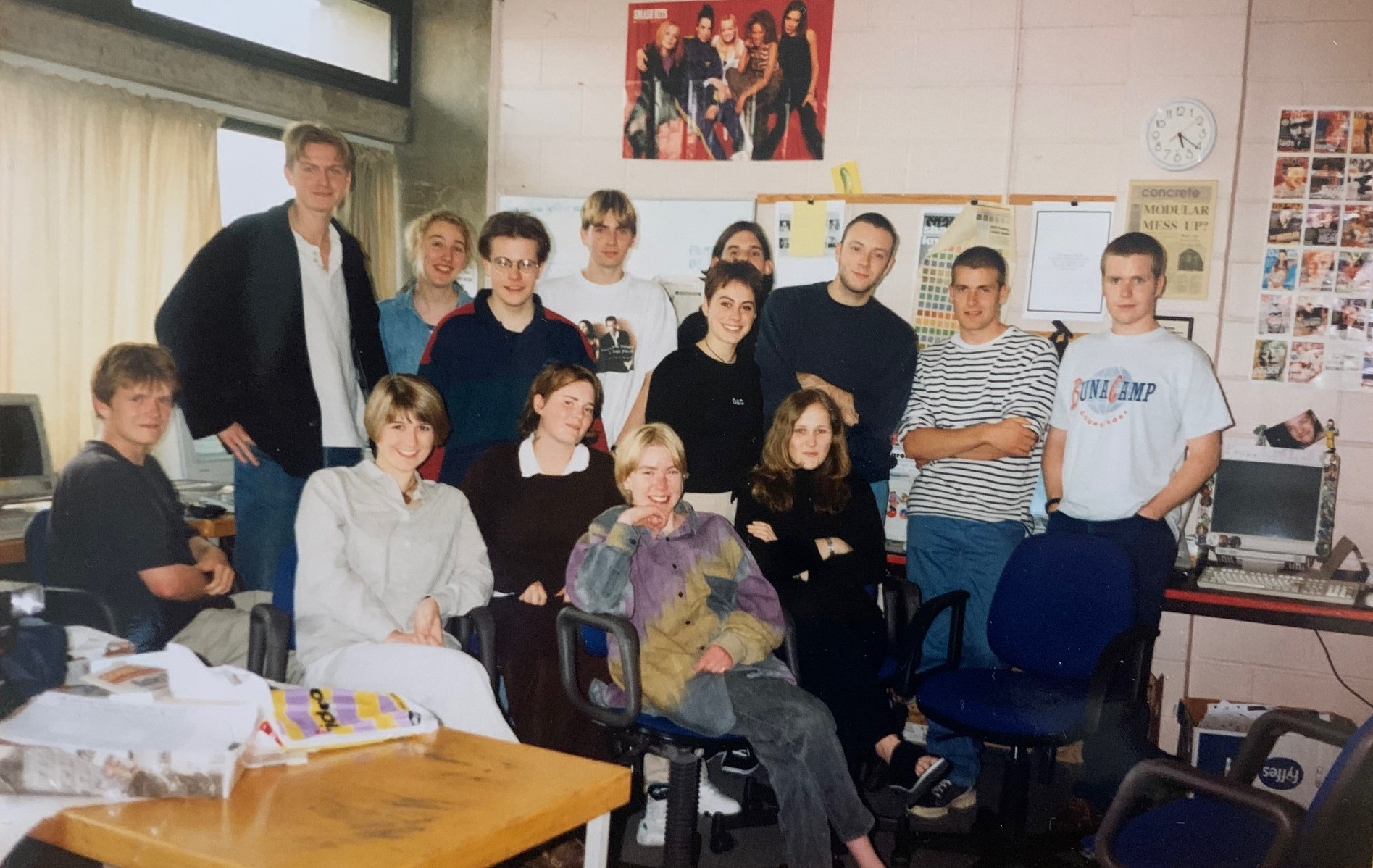
Image: Simon Mann (Concrete 96-97 team in the office, incl. from the left – (seated) Matt Fasken, (standing) Nick Triggle, standing next to him, Emma Newbury. Third from right, James Curtis (Editor), seated below him, Jane Kirby (Editor ‘97 – ‘98))


Leave a Reply