
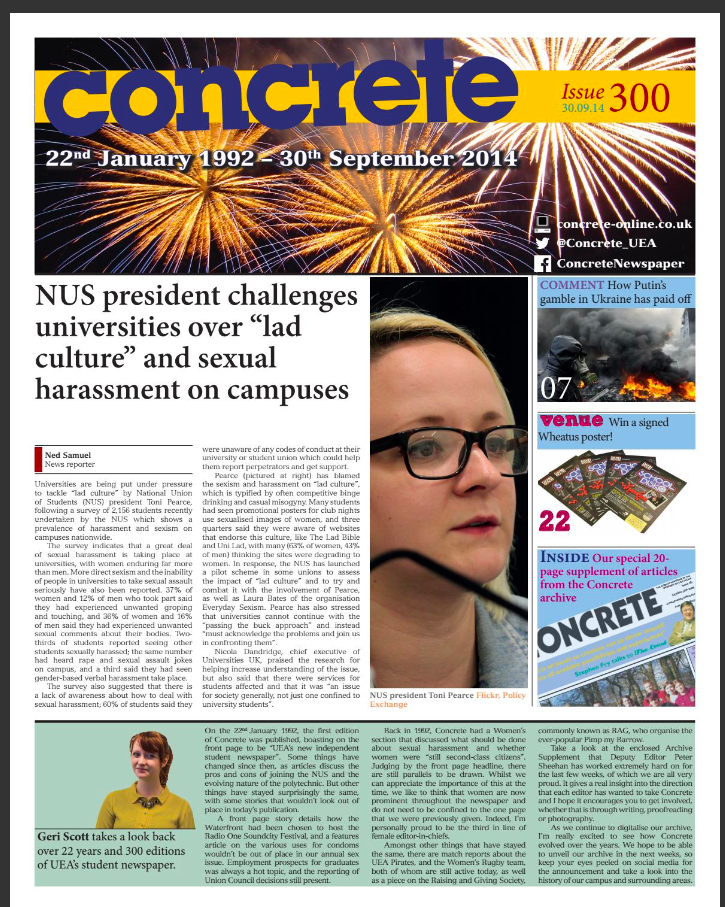
Today we’re rolling back the years and revisiting archived comment articles. It’s time to reflect on some historical hot takes and assess the ways in which the judgements of UEA’s students have aged over the past 30 years.
Issue 300 | 30/09/2014 | How Putin’s gamble in Ukraine has paid off – Matt Finucane

Here, Matt addresses the conclusion of Russia’s annexation of Crimea (or if you rather, the start of the Russo-Ukrainian war).
“For all the verbal support and encouragement lent to Ukraine by Western pundits and policymakers alike, it is worth remembering their habit of being prodigal with words yet frugal with actions. This allows Russia to exploit this tendency and frame western countries as toothless as well as self-serving. […] A western world being quickly re-acquainted with the nature of international geopolitical relations has only one options remaining: to get serious with both its rhetoric and its resolve”
Though this was certainly an accurate summation regarding the original conflict in Crimea, it is interesting to see just how much this has changed since the beginning of Russia’s full-scale invasion. The contemporary geopolitical landscape has propelled a shift in international relations, demanding a far more assertive stance against Russia’s aggression. Perhaps driven by moral imperative, or perhaps by recognition of the strategic importance of Ukraine in Europe, western nations have had to significantly recalibrate their approach and provide more tangible support to Ukraine. The importance of maintaining European stability, and a collective commitment to the principles of liberal democracy in the face of rising authoritarian movements (in Europe and beyond) have contributed to this recalibration, fostering a more resolute and united front in response to the ongoing conflict. There’s only so long you can try calling a leader like Putin’s bluff before he supersedes everybody’s expectations (then, you might actually have to do something).
Issue 200 | 14/02/2007 | Who do you think you are? – Rachel Morris

Here, Rachel reflects on the difficulties and the pressure in adopting a solid political or ethical stance at university.
“There is a general understanding that by now, we should be able to state our opinions and beliefs concerning particular issues; whether they are ethical, political or otherwise. These opinions and beliefs often lead to an obsession with categorisation and people become heavily concerned with conforming to ideologies […] Those who are unable or reluctant to state their position on ethical issues or political debates should not necessarily be labelled apathetic. This is surely a time in our lives that grants us the freedom to ‘break the mould’, escape from parental influence and really take the time out to evaluate, develop and absorb new ideas and ways of thinking.”
These words echo true now even more so than they did over 15 years ago. The landscape of political discourse has undergone a profound transformation in the last 15 years. The rise of populism, epitomized by figures such as Trump and Bolsonaro, has injected a new intensity into our political discourse. The ideological battleground that Rachel sought to navigate within her university setting was actually in a far less confusing or compromising state than it is today. Studies indicate that political polarisation had actually been decreasing in the 15 years leading up to when this article was published in 2007. Though since the advent of the global financial crisis (among several other events that have disrupted western neoliberal hegemony worldwide), polarisation has only been on the increase. Rachel’s cau6on against succumbing to the pressures of categorization carries more weight now than ever, in an era where poli6cal identites are polarized to the extreme and potentially dangerous radical movements are emerging in the UK and beyond. In a political landscape divided by certainties, Rachel suggests (I think correctly) that our doubts unite us and contribute to healthier more productive discourse.
Issue 001 | 22/01/1992 | Are Women Still Second Class Citizens? – Gill Fenwick

Here, Gill discusses the advent of “Women aware week” organised by the NUS in an attempt to achieve better female representation and outcomes across UK universities.
“’Women Aware Week’ began on Monday, and consists of a number of talks, a debate, self- defence classes, a free showing of “Thelma and Louise’ and a ‘women aware disco’. Richard Hewison of the NUS organised this event because he recognized the need for a Women’s Officer and Action Committee, such as the one that dissolved last year due to disputes and lack of interest. Richard feels that a newly elected committee is needed “to ensure greater equal access and opportunities not only within the union and educa=on, but hopefully within society as well”. Issues that need to be tackled include safety on campus, no late lectures so that women do not have to return to their rooms alone after dark, improved creche facilities and an anonymous marking system.”
Despite progress in various areas (such as those targeted by the aforementioned campaign), it remains disheartening that in 2024, we still have a long way to go with this issue. A number of women still feel unsafe walking at night on university campuses. Worse still, research indicates that around one in five female students will experience some form of sexual violence whilst at university. There should be no doubt that despite there being many advancements in awareness, reporting, and other outcomes for women, the prevalence of these incidents indicates the importance of ongoing efforts to create a safer environment. On a positive note, there has been significant progress in access to abortion and healthcare outcomes for women since 1992 due to improved access to reproductive healthcare services and advancements in medical practices. Though as seen by the US Supreme Court’s infamous ruling on abortion last year, we should never take progress for granted, and continue to strive and confront issues in the same vein as Hewison and Fenwick.





Leave a Reply