
Content warning: Discussion of Antisemitism, Islamophobia, and violence.
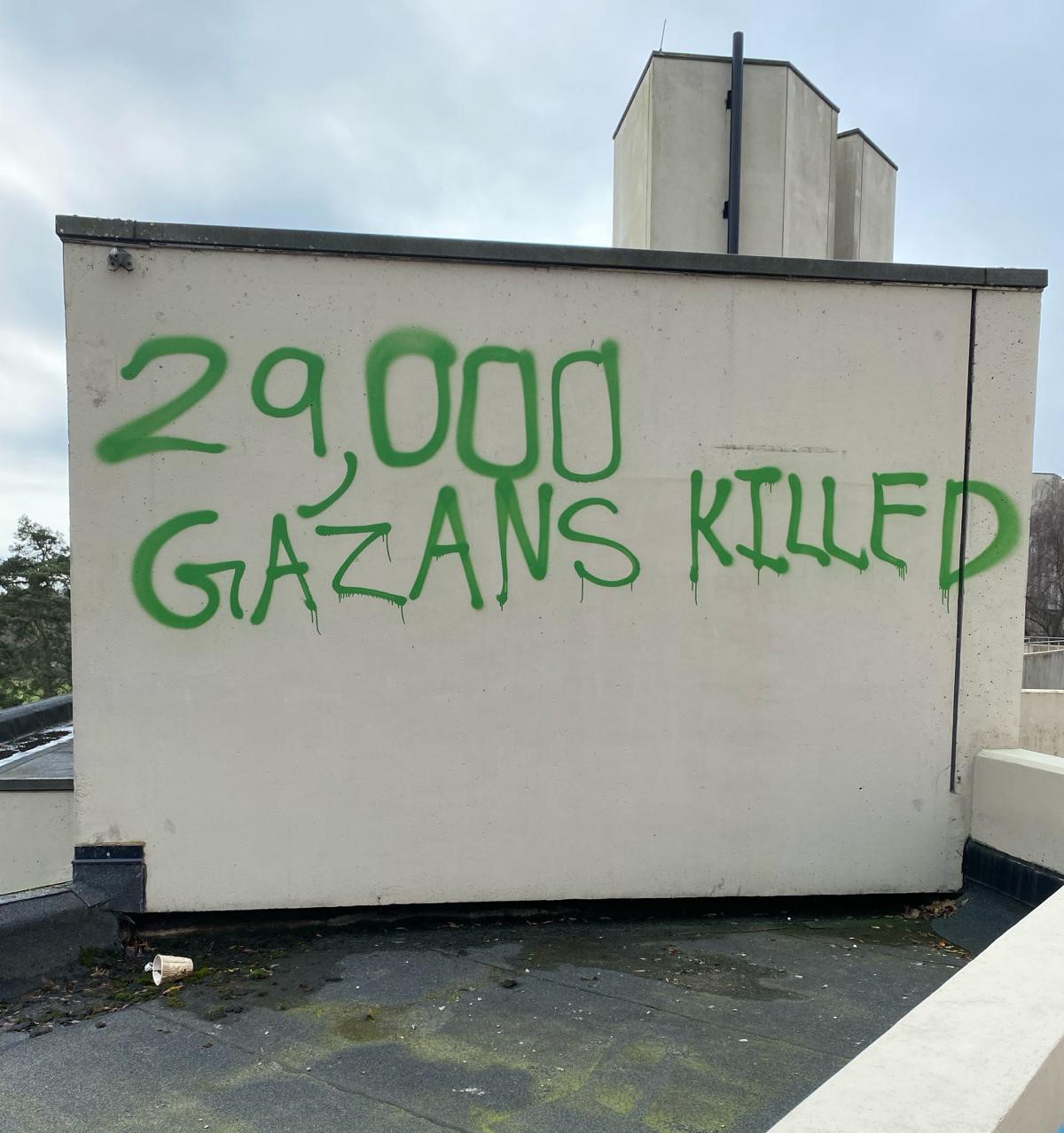
On Monday, February 19th, graffiti described by UEA as “antisemitic” was discovered by staff on campus. In a statement to BBC News Norfolk, a university spokesperson said the graffiti would be removed, and UEA was working with the police to identify who was responsible.
Following coverage in local media, Vice Chancellor Prof. David Maguire explained in an all-student/staff email, “In recent days, we have sadly witnessed a rise in instances of antisemitism across our community, including graffiti on our campus walls, comments made during a university event, and inappropriate comments on social media. This is unacceptable and we are taking action to ensure that perpetrators are dealt with swiftly. For the most serious offenses this could include disciplinary action and a police investigation. We will not tolerate antisemitism, Islamophobia, or any form of racism, hate crime, harassment, or discrimination here.” A similar public statement was posted on the UEA website, adding, “The comments made do not reflect the views of the University and do not meet our values”.
The messages written in graffiti read as follows:
- “29,000 Gazans killed”
- “Zionism = Colonialism”
- “Judaism opposes Zionism”
- “End Apartied; 26 journalists killed in Gaza”
- “[UEA] Banks with Barclays – finances genocide of the Palestinian people”
- “Macron, Sunak and Trudeau war criminals”
- “Our freedom is incomplete without the freedom of the Palestinians” – a quote from the former President of South Africa, Nelson Mandela.
An academic source – who asked to remain anonymous – told Concrete that “Prior to the release of the [Vice-Chancellor’s] statement, it was agreed at numerous levels of leadership up to the VC’s office, that, while the action of graffiti should rightly be condemned, it would not be right to label the incident as antisemitic,” adding, “somewhere between this collective agreement and being made public by the VC, the message had been changed for no clear reason”.
Opposition to the university’s handling of the incident has, however, been expressed by a number of students through several university societies, who claim the messages relayed in the graffiti were not “antisemitic” and that the sentiment of the VC’s statement goes against the university’s aim of creating “a safe, inclusive and respectful culture on campus for all”.
A statement responding to UEA’s handling of the issue was released by the UEA Palestinian Solidarity Society and was jointly signed by UEA Labour, Arab, Islamic, Burlesque, Young Greens, Pakistani, Disney, and Dev societies on Monday 26th February.
Beginning, “We wish to express our deep concern at the university’s response to the incident of graffiti on campus last Tuesday,” the ten-page statement was released via an Instagram post. It goes on to explain, “We first want to recognise that anonymous graffiti can be perceived as intimidating. As the Palestinian Society at UEA, we do not endorse this action”.
The statement then expands on its concerns, detailing “several reasons why the university’s handling of this incident was unhelpful, inflammatory, and counterproductive.” The statement can be found in full on the UEA Palestinian Society’s Instagram page.
The Vice-Chancellor also referred to “comments made during a university event.” Concrete understands this refers to a speech made at UEA’s Innovation and Impact Awards ceremony earlier in February, where the platform was used to say “[UEA] are staying silent” on the Israel-Palestine conflict and its decision to continue banking with Barclays, which, the academic stated “holds over £4 billion in shares, loans and underwriting to 9 companies whose weapons, components, and military technology are being used right now [by the Israeli government] in the current attacks”.
They also used the term “From the river to the sea”, which some – including some members of the current UK Conservative government and the Labour party – claim is antisemitic.
One student who witnessed the speech (who asked to remain anonymous) told Concrete his view that, “This was an impassioned speech calling out the untold and unjustifiable mass human suffering that is going on in Gaza, made by a highly experienced and educated person. [The phrase] is neither antisemitic nor explicitly Islamic; it calls for equality for all that live in historic Palestine and recognises that nowhere – be it Gaza, the West Bank, Jerusalem, as citizens of Israel, or in diaspora – do Palestinians have equal rights with their Jewish neighbours. Quite literally, from the river to the sea, no Palestinian is free.”
The American Jewish Committee on the other hand, labels the term “a rallying cry for terrorist groups and their sympathizers, [including] Hamas, which called for Israel’s destruction in its original governing charter in 1988”. Conversely, as detailed by the Jewish Virtual Library, the Likud Party of Israeli PM Benjamin Netanyahu used a similar phrase in the party’s original manifesto in 1977, stating that “between the [Mediterranean] Sea and the [River] Jordan, there will only be Israeli sovereignty.”
It is important to point out the meaning and context of this phrase is contested both between and within Palestinian, Israeli, and global Jewish communities.
Amnesty International says, “Interpretations might vary, but there’s nothing in the words themselves that suggests antisemitism or calls for racial or political dominance over Israel. The assumption that calling for freedom for Palestinians necessitates the destruction of the State of Israel is a manipulation of this phrase.”
Other Jewish-based groups, for example, use parts of the phrase to call for bilateral peace between Israel and Palestine, such as Jewish Voice for Peace, which includes in its mission statement, “We picture Palestinians — from the Jordan River to the Mediterranean Sea — living with their inalienable rights respected.”
Concrete is unaware of the exact “comments on social media” the Vice-Chancellor was referring to in his statement.
The UEA Jewish Society was approached for comment, but they declined to respond.
When contacted for further comment on the collective issues, the University reiterated the Vice-Chancellor’s statement, saying, “As a university, we have a particular responsibility to create an environment where staff and students can feel comfortable to express lawful opinions and challenge established ideas in appropriate ways. At the same time, we have an obligation to continue to foster a safe, inclusive and respectful culture on campus. I appreciate that this is a complex and contested space, and that some have very strong feelings, but we must avoid this having deleterious impacts on others in our community.”
If you are affected or concerned about any of the issues raised in this article, you can contact:
- Nathan Wyatt – Wellbeing, Community and Diversity Officer (SU)
- Student Services
- https://reportandsupport.uea.ac.uk
Image: Concrete



Leave a Reply