
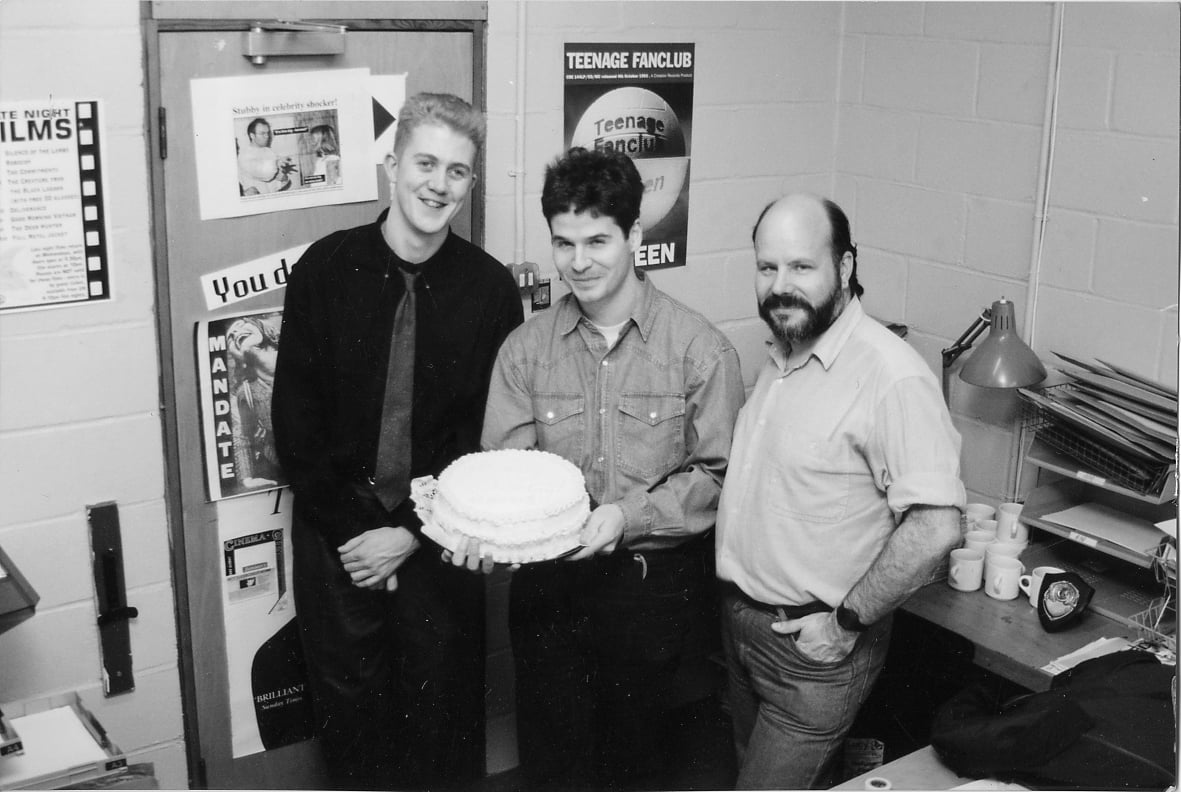
Concrete was the brainchild of Steve Howard, who had set up Livewire only a few years before. It was started as a private enterprise with no involvement from UEA or the SU and was initially run from the corner of the Livewire office. The paper’s first meeting was held in December 1991.
After Christmas, the team were given an office in the old ARTS building by the Dean of the School of English and American Studies, Professor Chris Bigsby, and the first issue was published on Wednesday 22nd January 1992. Peter Hart, who was Arts Editor at the time, told us how “the first few issues were painstakingly printed out and stuck on A3 sheets, before being taken to [Eastern Counties Newspapers] so that printing plates could be made from them,” whilst Steve recalled “I delivered the master copies for the first issue in a rucksack in the middle of the night on my bike.” These early editions had a print run of 5000.
In a history compiled in 1994, Concrete’s founders recalled how they “had to beg and borrow production equipment, and the paper survived on a knife-edge from issue to issue [only becoming commercially successful from the fourth].” As the paper grew, Advertising Manager Simon Mann funded the purchase of more sophisticated production equipment, being repaid through growing advertising sales (which by July 1994 had accumulated to £58,000). According to the history, the ‘page make-up process’ was “technically more advanced than that used by the ‘Evening News’ in Norwich.” From September 1992, the SU provided an office upstairs in Union House, with one final move within the building in January 1993.


In May 1993, responding to a campus survey which suggested the need for an entertainment guide, Concrete’s managers (Steve, Simon and Peter) created The Event. Alongside this, the trio formed a company, Planet Zog Ltd., with all three as directors. This enabled them to formalise the business of the paper, which had previously been run through Steve and Simon’s bank accounts, while from September, Peter intercalated and took a student income from the company to edit both publications.
When The Event launched in September, it had a print run of 10,000 and was sold in 150 local newsagents, as well as being distributed on campus and at local colleges. Simon also recalls that at one stage it was included as an insert in the EDP. Whilst Concrete had initially covered arts content within the main paper, followed by a pull-out called Happenings from January 1993, it now dedicated 28-pages to the subject! This made Concrete and The Event ‘Britain’s largest student paper!’ Unfortunately, this wasn’t to last, as by March 1994, despite its commercial success, The Event was ended as a separate publication after nine issues and incorporated into Concrete, as the workload was too high for the Planet Zog team to manage alone.
This heavy burden ultimately led to the sale of Concrete to the SU on 27th July 1994. The terms of the transfer made clear the paper would maintain its editorial independence, a status we maintain to this day. It also set out that Steve and Simon would be paid to continue their design and advertising work respectively. The price paid by the union was £6756.25 (around £17,000 today), which covered the purchase of Planet Zog’s ‘computing equipment, accessories and software.’ As Simon put it, “I think it was greatly to the Union’s credit (and particularly Lizzi Watson, the Union Sabbatical Finance Officer) that it accepted our proposal. Without their foresight, Concrete would have ended at issue 35.”

The relationship with the SU in the period leading up to the late 90s was relatively harmonious, with the union going as far as to fund a Sabbatical Editorial position from 1995, which previously had to be covered solely on revenue from advertisements.
It was at this point that Concrete was gaining attention on a national level, with their win of ‘Student Newspaper of the Year’ in the 1995 Guardian/ NUS Award Ceremony granting them a long-awaited recognition. Kay Spragg (Copy Editor 1995-98) says it “felt like a really great achievement.” With judge and Editor-in-Chief of The Guardian and The Observer, Peter Preston, attributing Concrete’s win to its ‘brash tabloid style’ that ‘seems perpetually to get up the nose of authority’ we can gain an insight into both the visual and written developments of Concrete over the next few years.

The latter half of the 1990s saw a boom in Concrete’s contact with celebrities, with notable interviews taking place with Arthur Miller (1995), Tony Blair (1996), Tim Burton (1997) and Stephen Fry (1999).
However, it was not just interviewing big names that preoccupied a position as editor, but the steady involvement that went on behind the scenes. Paul Stokes (Music/Arts Editor 1996-99) states, “Production weekends were these rituals where about five of us would be locked in the office for 48 hours – only going home to sleep.” He also describes the introduction of a new system of printing that came about during the decade, recalling “We would then drive down to the EDP in town to take the exported pages in to be printed on these really unstable, old mobile hard drives on Sunday night. We’d then wait three days to find out what would come back.” It was a demanding process and what with The Event re-expanding and becoming a separate pull-out supplement in January 1996, both writers and editors had to be truly committed.
In January 1997, Concrete decided to lean into the informal nature already present in many articles, with the distinctive purple logo and header being replaced with a tabloid red. This symbolised a new era for the paper, one which was not afraid of a pun for a headline or colourful front page. Sports (and later Deputy) Editor Nick Henegan notes that ‘our red top tabloid approach to news at UEA wound a few people up.’ However, this does not suggest that the news covered was trivial. For instance, that November, Concrete released a front-page story titled ‘Tight-Fisted UEA’, an article critiquing the installation of a £10 fee for guests at graduation.

Ultimately, looking back through the 90s it is hard not to be in awe of the people to whom we owe the creation of our newspaper, their incredible resourcefulness and diligence being so evident. However, it is often the mistakes made or the distinctive ‘student’ sensibility that marks their responses as so touching. From Shaun Harley’s (Early 90s Sports Writer) run-in with a Scandinavian rugby player whose name he misspelt to Marcos Simpsons’ (Mid-90s Sports Writer) anonymous articles about his own sporting prowess, there is a willingness not to take oneself too seriously but to work hard for something bigger than simply one person.
Find out more about Issue 1 of Concrete here!
With thanks to Simon Mann for filling in many gaps in the story
Top Image: Concrete’s 1st Birthday – Peter Hart, Steve Howard, Simon Mann




Leave a Reply