
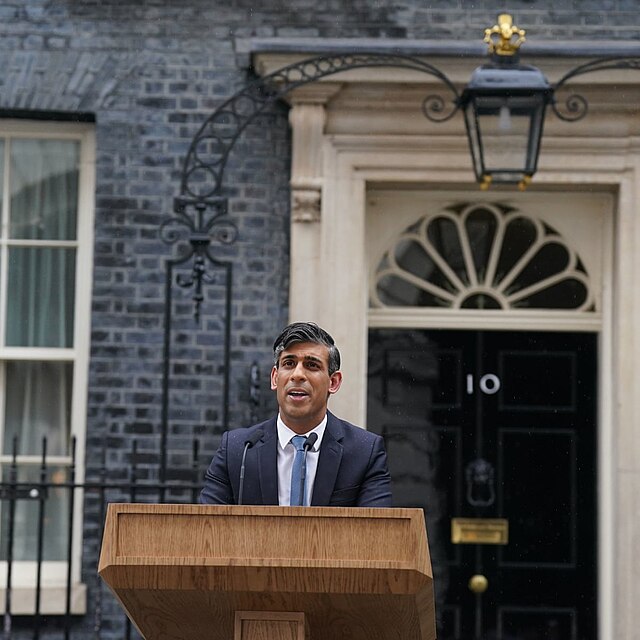
On the 22nd of May, Rishi Sunak called for a general election. With the sound of the New Labour anthem, ‘Things can only get Better’, blaring in the background and the rain soaking through the Prime Minister’s suit, it was hardly an energetic start to the forthcoming six weeks.
This despondent scene symbolised to many the state of a weary government, desperately fighting against matters beyond their capability and their control. No more clearly can this be seen than in the current BBC opinion poll, which places the intention for voters to choose the Conservatives at only 22% (merely an 8% lead in front of Nigel Farage’s Reform). This unpopularity is not new. The consistent level of national disrepute has but heightened the surprise towards Sunak’s decision to call a snap election for the 4th of July. Although it may be assumed the announcement was planned to coincide with the day that inflation dropped by 2.3%, his inability to wait until later in the year has caused concern over the claimed economic stability that Sunak professes his government can achieve. This loss of trust for the Conservative’s economic policy is but another reaction towards the flatlining in wage growth and the record increase in taxation, making many claim the 4th of July to be a ‘cost-of-living election’.
Perhaps the greatest degree of apathy and lack of trust towards politics and politicians can be found amongst the younger generations, with the British Youth Council discerning that ‘71% of young people don’t feel that political parties speak directly to young people in the lead-up to elections’. However, the dwindling numbers of youth voters cannot only be equated to disengagement. The Electoral Commission declared last year that ‘young people are the least likely to be aware of voter ID requirement’.
For many Concrete readers, this article is simply a clarification of what is already exceedingly familiar. However, for those who have never voted before, or see politics as something that ‘other people talk about’, it may be a useful starting point to one of the most important decisions you will make this year.
How do I vote?
In order to vote you…
- Must be a British citizen, a qualifying Commonwealth citizen or a Republic of Ireland citizen with a UK address.
- Must be of eighteen years or above
- Must not be serving under a criminal sentence
- Must not be a peer of the House of Lords.
Crucially, you must also register to vote. This closes on the 18th of June. Registration is simple and takes a matter of minutes to complete. To do so follow the subsequent link, https://www.registertovote.service.gov.uk/country-of-residence and fill out the form on the government website.
To vote you may visit a polling station within your constituency, equipped with a valid form of ID (https://www.gov.uk/how-to-vote/photo-id-youll-need). Alternatively, if you are away, you can either apply for a postal vote or you can vote by proxy (nominating someone to vote on your behalf).
Polling stations in close proximity to the university (Norwich South) are as follows,
- UN1, St Mary’s Church Hall
- UN2, The Hive
- UN3, St Anne’s Church Hall
- UN4, St Peter’s Jessopp Road Church
- UN5, West Earlham Community Centre
If you are residing outside of the university this summer, you can find your nearest polling station on the website https://wheredoivote.co.uk.
After leaving the polling station you may be asked to participate in an exit poll. This is a survey taken of how voters cast their ballot and is often made by media outlets in order to gain insight into the outcome of the election. Exit polls take place throughout the country with outlets selecting a variety of constituencies that they believe would be demographically representative.
Voting begins at 7am on Thursday the 4th of July and ends at 10pm that evening. Immediately after the polling stations close, the count begins. Typically, the first results from smaller constituencies are presented at around midnight. As we journey through the early hours of the morning, there can be some speculation over the outcome of the election, with the majority of the votes filing in between 2am and 4am. However, final results are usually reported at around 6am.
How does voting work and what is First-Past-the-Post?
The United Kingdom is divided into 650 constituencies. Each constituency is represented by a Member of Parliament who takes a seat in the House of Commons and represents the interests of those within their constituency. On average, constituencies range from 60,000-80,000 people, meaning that some cover vast expanses of land and others very little.
In the 5-8 weeks before a general election, candidates from a range of political parties campaign against each other to become an MP. To win they must secure the greatest number of votes of any candidate within the constituency. This voting system is called First-Past-the-Post; the name of which is derived from horse racing. Much like in the races, the winner must simply be the furthest ahead (in this case, in terms of the number of votes). This means that many victories are secured without the majority of the vote. It is because of this that First-Past-the-Post is becoming increasingly unpopular throughout the UK, with parties such as the Greens and the Liberal Democrats often feeling the brunt of the system. Although they may succeed in a sizeable proportion of the national vote, their lack of 1st place positions results in a diminutive representation in parliament. However, parties that often benefit from the ‘winner-takes-all’ format (often Conservative and occasionally Labour) maintain that it promotes strong majority governments that can be more unanimous in decision-making.
One of the most popular alternatives for First-Past-the-Post is the Single Transferable Vote (a type of Proportional Representation). To learn more about this, keep up to date with Concrete in the following weeks!
If a party is able to secure 326 seats within the House of Commons, then they have achieved a majority government. If they attain less than 326 seats, then we have a ‘Hung Parliament’. The party with the largest number of seats is then faced with a choice. They can call for a ‘snap election’ (an election called earlier than scheduled) in the hope of attaining more seats, they can organise a Coalition government (a government formed by more than one political party) or they can continue with a minority government.
What is the difference between a Local and a General Election?
The format in which local councils are arranged differs depending on what part of the UK you are situated in. For example, Norfolk is part of a two-tier council system. This means that we have we have a County Council and multiple local district councils (including Norwich City Council). The County Council is responsible for services and facilities, including roads and schools, whereas the district councils look after specific issues such as anti-social behaviour and litter.
In a local election, citizens vote for councillors within their local authorities to have leverage over the decisions made within their area. This is an example of devolution, meaning that power has been decentralised from Westminster, allowing government on a local level. Despite this, unlike MPs, councillors cannot debate or vote on proposed legislation.
Local elections take place every year. However, not every councillor is a candidate. Councillors have a span of three years in their post, however they start the role in varying years. Alternatively, general elections take place approximately every five years, with MPs being voted in at the same time.
To read more about the recent local elections, see Co-Editor-In-Chief Jamie Bryson’s article ‘Local Elections 2024: Labour Loses Control of Norwich City Council as Greens Gain’ in the latest issue of Concrete (https://concreteuea.co.uk/2024/05/14/local-elections-labour-loses-control-of-norwich-city-council/).
What are the Labour and Conservative parties standing for?
At the time of writing, the Labour Party and the Conservative Party have not yet published their manifestos, with both being due this week. However, they have provided mission statements. Below is a brief overview of the plans they have pitched to the general public through their first broadcasted political debates and their websites.
Labour’s ‘Five Missions’
‘Get Britain Building Again’- Labour wants to build more homes and aid first-time buyers to purchase houses within their local area. They intend to reform planning laws.
‘Switch on Great British Energy’- A plan for a publicly owned clean power company. Labour claims that it will cut energy bills and provide employment.
‘Get the NHS Back on its Feet’- They intend to pay doctors and nurses overtime in order to work through the accumulation of appointments over recent years. They claim they will be able to afford this through ‘closing the loopholes’ in the Conservative non-dom plan and targeting tax evasion.
‘Take Back Our Streets’- Labour wants to fund 13,000 more police and PCSOs. They believe in tougher crimes for rapists and aim to ‘halve violence against women and girls’.
‘Break Down Barriers to Opportunity’- The Party claims they will introduce free school breakfast clubs and provide teachers with specialisms in science and maths. They intend to pay for this partly through ‘removing tax breaks for private schools’.
Conservative’s ‘Our Plan’
‘Halve Inflation’– No prospective plan declared as of yet. We can likely expect a continuation of current policy.
‘Grow the Economy’- No prospective plan declared as of yet. We can likely expect a continuation of current policy.
‘Reduce Debt’- No prospective plan declared as of yet. We can likely expect a continuation of current policy.
‘Cut NHS Waiting Lists’- The Conservatives want to train new doctors and nurses and continue with what they claim to be ‘record funding’ and an ‘increase in checks and scans’.
‘Stop the Boats’- The Party has scheduled flights to Rwanda for asylum seekers under a deportation scheme. They believe that it will act as a deterrent for those attempting to reach the UK.
Although not part of the Conservative’s ‘Our Plan’, Sunak’s announcement of a return to National Service has caused ripples throughout the nation. Sunak declares that it would install a ‘renewed sense of pride in our country’.
Keep up to date with the Concrete website to read our upcoming article on manifestos.
Who are the Party Leaders?
Rishi Sunak (Conservative)

First elected in 2015 as the MP for Richmond Yorks, Rishi Sunak has climbed the ranks of the Conservative Party, achieving the positions of Chief Secretary to the Treasury, Chancellor of the Exchequer and in 2022, Prime Minister. Sunak grew up in Southampton with parents in the medical profession and went on to study PPE at Oxford University. His first career was in investment, where he claims to have ‘seen first-hand how politicians should support free enterprise and innovation to ensure our future prosperity’.
Keir Starmer (Labour)

Keir Starmer grew up in Surrey in the 60s and 70s. His father was employed as a toolmaker and his mother worked as a nurse. Starmer became the first in his family to attend university and headed off to Leeds at eighteen years old to study Law. It was from this that Starmer began working as a barrister and achieved the prominent position of Director of Public Prosecutions in 2008. Taking a change of direction in his career, he was first elected as an MP in 2015 and has since held the role of Shadow Brexit Secretary under Jeremy Corbyn. Starmer ascended to the position of leader of the Party in 2020 and has led the party ideologically further to the right.
Ed Davey (Liberal Democrats)

Ed Davey has spent the majority of his career supporting the Liberal Democrats, with his appointment as an economics researcher for the party taking place in 1989. However, it was in 1997 that Davey first claimed a seat in the House of Commons for the former constituency of Surbiton. Davey’s position within the party has increased steadily throughout the years, with his appointment as head of the party coming in 2020. When looking to his personal life, Davey has been a carer since he was young and has vowed to be a ‘voice of carers’ moving forward.
Carla Denyer and Adrian Ramsay (Green Party)

Carla Denyer began campaigning in Sixth Form to promote fair trade and an end to the Iraq War. This streak of activism has permeated her career, with her leaving her role as a mechanical engineer to become a Bristol City Councillor in 2015 and campaign for fossil-free divestment. Since then, she has risen in the ranks of the Green Party, with her appointment as Co-leader taking place in 2021. Denyer has also become the first openly bisexual leader of any major political party in England.
Adrian Ramsay is a figure that may be recognisable to many Norwichians. Serving as Norwich City Councillor from 2003-2011, Ramsay has flown through the ranks of the Green Party and was appointed as Co-leader in 2021. Ramsay continues to remain steadfast to his local area through his campaigning to be MP for Waveney Valley in the upcoming election. As a UEA alumni in Politics and Sociology, Ramsay’s story is particularly interesting for Concrete and we intend to cover him in greater detail within the next few weeks.
Nigel Farage (Reform)

Best known for his role in the causation of Brexit, Farage has become a figure that passionately divides opinions. Leaving the Conservative Party in 1992, Farage became a key founder of UKIP, leading the party from 2006 until the EU referendum. In 2019, Farage created the Brexit Party, launched to promote a ‘clean-break Brexit’. Today the party exists as Reform and markets itself as ‘the new Conservative movement’, pushing the boundaries of mainstream British politics towards the right. Although until recently, Farage has denied his intention to campaign in the 2024 election, he announced his changed decision to stand on the 3rd of June.
John Swinney (Scottish National Party)

John Swinney is one of the more recent of the leading politicians to succeed to the head of the party, with him taking the position only last month. Despite this, Swinney has a long history in politics, with his joining the SNP in 1979 and even serving as party leader between 2000 and 2004. It is therefore not surprising that he is ‘Scotland’s longest serving elected parliamentarian’ and a prominent figure in Scottish politics. Swinney is married to BBC Scotland journalist Elizabeth Quigley and resides in Blairgowrie, in his Perthshire North constituency.
Who are the Candidates within my Constituency?
Norwich South
- Labour: Clive Lewis
- Conservative: David Thomas
- Liberal Democrats: Sean Bennett
- Green: Jamie Osborn
- Reform UK: Graham Burton
- Party of Women: Lina Law
- Independent: Elizabeth Davey
Norwich North
- Labour &Co-op*: Alice Macdonald
- Conservative: Charlotte Salomon
- Liberal Democrats: Chika Bilikisu Akinwale
- Green: Ben Price
- Reform UK: Nick Taylor
- Independent: Fiona Ruth Grace
*The Labour and Co-operative Party is a section of Labour who are also members of the Co-operative Party. The Co-operative Party was founded in 1917 and aims to build a community in which both power and wealth are fairly distributed.
If you would like to learn more about some of our local candidates, keep an eye on the Concrete Instagram where we will be posting videos of our interviews with Clive Lewis, David Thomas and Jamie Osborn.

What next?
With the general election taking place in less than four weeks’ time, Concrete aims to try and cover as many different topics, views and opinions as possible. We are interviewing local candidates and tackling issues such as voter apathy, LGBTQ+ policies, Gaza, Climate Change and much more. If you would like to join us in providing the UEA with student journalism focused on the 2024 General Election, please reach out on Instagram @concreteuea and through email using Concrete.Editor@uea.ac.uk.




One response to “A Beginner’s Guide to the General Election”