
Instating an election artist is an odd decision that often becomes a still more odd process for those involved. For the artist, they are placed face to face with the epitome of the social order that they so often seek to deconstruct. For the politicians, well, there’s nothing worse than one of those ‘creatives’ following you around…Despite this, every election, Parliament finds someone- to find someone- to dig around in the pool of British Contemporary artists and to pull out a figure that will be able to capture a new sort of landscape. This relates to the rather murky, highly contrasting political scene. The trick, and one that hasn’t always been achieved, is to select someone who is able to depict this in a way that is ‘suitably controversial’. What is markedly out of bounds, is the type of controversial that would lead it to be banned from its destined position as part of the Parliamentary Art Collection. Strangely enough, not all artists got the memo.
Of course, this role often becomes a contained, suffocated form of protest, but it does not necessarily lead to bad art. Perhaps one of the most celebrated artists to take on this position since its creation in 2001 is Jonathan Yeo. Although his name may sound unfamiliar to some, his recent portrait of King Charles III has become a viral sensation. Yeo’s decision to use lurid red colours across the entirety of the piece has led many to perceive the portrait as highly unflattering and even demonic. Although this can hardly be high praise, Yeo’s career is certainly one that can withstand it. Despite being initially simplistic in form (a triptych in traditional oil paints), his depiction of the 2001 election is a powerful representation of Blair’s success. Yeo ensured that the size of each canvas, corresponded with the size of the electoral win, allowing for the public to visualise the result. However, perhaps the most interesting element of the artwork is the direction in which each man is looking, with Blair’s eyes cast upwards and beyond the frame, Kennedy’s glancing downwards and Hague’s locking with the viewer. The interpretations of this, as you might imagine, are endless.

However, what Yeo’s art lacks in immediate excitement, David Godbold’s work in 2009 makes up for in the spectacle it provoked. Using ink and pencil on tracing paper, Godbold overlayed his artwork atop parliamentary letters, legal advice, election leaflets and other paper ephemera he found along the campaign trail. It was through this contrast with his often biblically inspired drawings, that Godbold was able to create a direct commentary against the text itself. Godbold stated that ‘Actually doing the commissions was extremely interesting but the real politics began when I submitted the drawings’. It was in this submission that Godbold faced what he claims to be censorship against many of his works. This included a sketch of a naked ‘generic’ male politician, a piece using the word ‘Bastard’ and the use of a racist letter in which he made no attempt to hide the sender. Godbold claimed that his art was withheld from him by Commons authorities for a fortnight, with there being no plan to pay him until he had made the changes they believed were necessary. The dispute was resolved through legal help and resulted in only eighteen of the artworks being displayed in Westminster’s Portcullis House. Hugo Swire, who became chair of the Commons Art Committee after the election, responded to the situation by stating, “Artists are artists and they have an artistic temperament. Politicians are politicians and we have a political temperament.”
It is difficult to detach Godbold’s work from the condition in which it was presented to the British public; a showdown of our nation’s artistic talent against our political sector. However, if we regard only the work itself, Godbold appears to be critiquing institutions far more than political individuals. In the piece ‘Feeling Litigious?’, which used the aforementioned racist letter, Godbold depicts Moses on the mount, clutching the tablet of the 10 commandments. However, it is implied that on the tablet are the 227 Promises of the 2005 Labour election manifesto. Godbold worked alongside David Lammy (to whom the letter was addressed) in order to create a piece of artwork that they both felt appropriately dealt with the issue of racism that, despite the 227 Promises, remained as prevalent as ever.

Another stand-out artist to have taken up this role is Cornelia Parker. Perhaps best known in the Contemporary art scene for her work in sculpture, Parker’s involvement in the 2017 election garnered more coverage than ever before. Using her iPhone and her Instagram, Parker uploaded hundreds of informal photographs covering the entirety of the election campaign. By piecing these photographs together Parker was able to create ‘Election Abstract’. This was a three-minute video detailing occurrences, great and small, starting from Theresa May’s calling of the election to the disaster of the Grenfell Tower fire directly after the election. Fourteen of these photographs were selected to become part of the Parliamentary Art Collection, many of which featured an often amusing use of text in everyday life. However, what remains arguably the most captivating part of the piece is the use of sound. By creating a soundscape filled with the often overlooked noises of traffic, crowds, escalators and footsteps, the viewer is able to be quite vividly transported back to 2017. In terms of expressing a distinct moment in time and history, Parker must be the victor.
Watch ‘Election Abstract’ here: https://www.youtube.com/watch?v=KFFUXXdlRqA&list=PLj3mInRJqIekW08zm2keMIpv3ApeS3dBb

On the 6th of June 2024, the role of election artist fell upon Joanne Coates of North Yorkshire. Coates works through the medium of photography to capture what she claims to be ‘stories around power, identity, wealth, and poverty’. Her recent work has often taken a quiet, gothic turn, with her use of monochrome coming to the forefront in her 2022 exhibition ‘Lie of the Land’. Her embrace of her rural lifestyle within her photography makes her an inspired choice for a role that has often focused on the dominant urban nature of political campaigns. Many are keenly waiting to see what she creates.

The irony of an article on the Election Artist won’t be lost on some readers, particularly in the wake of the manifesto launch a couple of weeks ago, which proved arts and culture to be almost unprecedentedly low on the list of party priorities. In spite of this, what is rife within the manifestos, are references to British ‘culture’ and British ‘values’. With minimal explanation of what this is and what it entails, there can be little information garnered on the shape of British art within the next few years. It is because of this looming instability, that although the concept of an ‘Election Artist’ might seem to be a living, breathing, painting contradiction, it cannot be dismissed. The fact that politicians will be forced to see and interact with the artwork has been claimed to be only a positive outcome for the arts community.
Even if Parliament does embrace the arts through gritted teeth, better that than not at all.
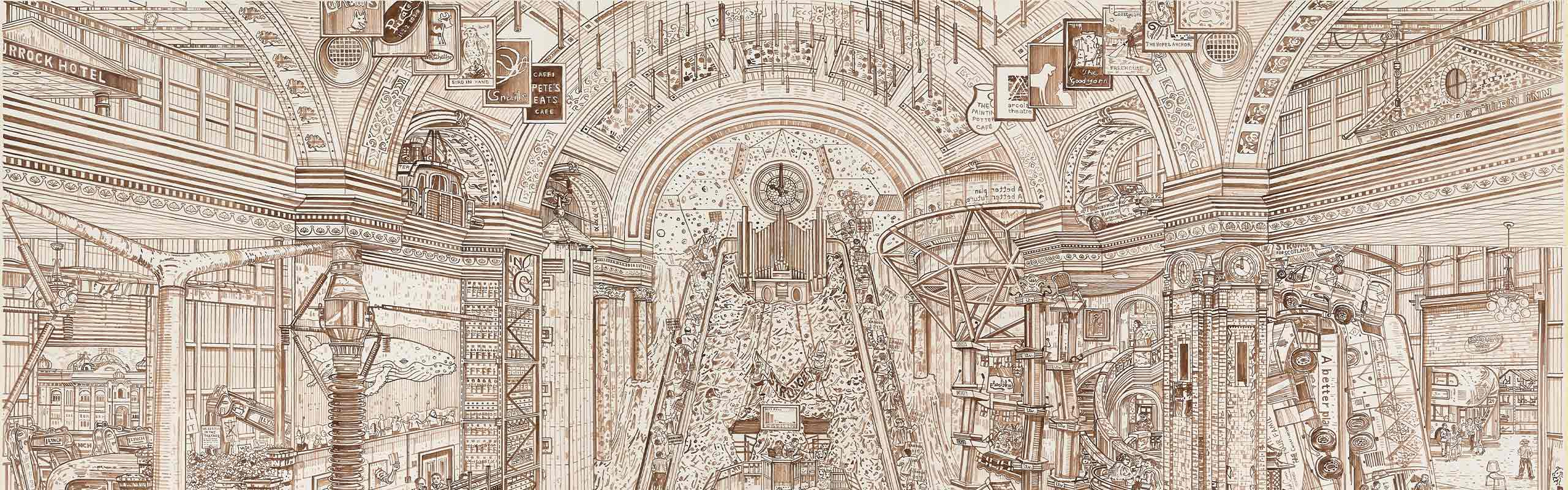
(Feature image depicts ‘The Government Stable’ by Election Artist for 2015, Adam Dant- Credit to Heritage Collections UK Parliament)




Leave a Reply