
Fiona:
On the 14th of May, Matthew and I had the pleasure of visiting the Roger Ackling exhibition Sunlight in Norwich Castle Museum. On the first day of the summer break, there was something remarkably fitting in this. Not simply in the use of the sun through the process of creating the artwork, but in the freshness, the sense of the present that the exhibition embodied. This is an even more remarkable feat when it is acknowledged that plenty of the pieces are decades old.

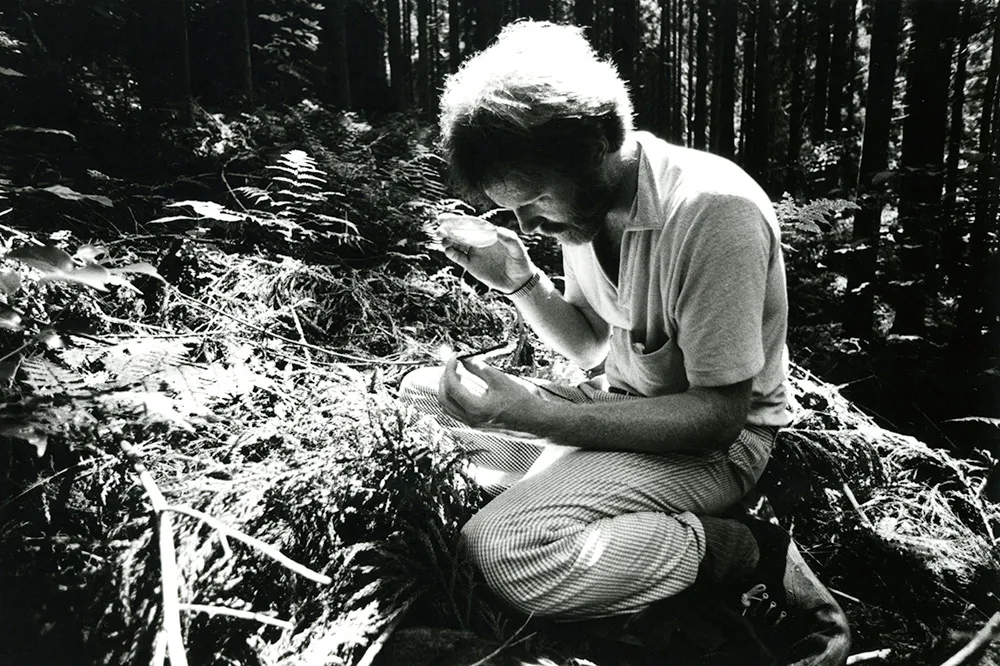
Roger Ackling (1947-2014) was described to us as ‘an artist’s artist’. This goes as far as to acknowledge the influence and respect he garnered from his contemporaries through his unusual technique and the quiet beauty of his work. Ackling’s primary method of creating was with wood and natural or scrap materials, on which he would burn tiny circles by focusing sunlight through the lens of a magnifying glass. By doing so he was able to create both patterns and lines, as well as capture the sunlight at a distinct moment in time.
Matthew:
The name of this exhibition, Sunlight, primarily refers to this technique. However, I think it’s also reflective of the positive, rather hopeful energy of his work and this exhibition. Ackling’s method and materials mean there’s a real connection to the natural world which makes his pieces feel all the more wholesome.
The exhibition takes a chronological approach, starting with his earliest work and moving through to the art produced towards the end of his life. Personally, the 1970s pieces were my favourites, with some sharing design similarities with official government documents, which made them particularly aesthetically pleasing. This flare for textual as well as artistic design could also be seen in Ackling’s exhibition labels accompanying some of the works, which Fiona and I both loved!
Other highlights for me included the wall of tree images with the leaves represented by paper dots (which even made me say ‘wow’ when we first saw them!) and the cityscape towards the end of the exhibition. It was also great to see some of Ackling’s poetry and notes from his time as a lecturer, as well as a film with other artists discussing his work. Both these additions really helped to get a better sense of the man and his importance to the art world.

I do feel our visit was enhanced by meeting curator Amanda Geitner, whose love for Ackling’s work shone through. I would definitely recommend checking out the events she is running with guests in the exhibition to get the most out of it!
Fiona:
One of the details that Amanda was able to explain to us was Ackling’s close connection with Norfolk. By informing us of his home in Weybourne and how he took to the Norfolk coastline to collect driftwood and discarded materials, it made the exhibition feel all the more personal and grounded within its current home at Norwich Castle. Although Ackling unfortunately is no longer around to see it, the location at the centre of Norfolk life is surely a fitting tribute to his own lifetime of work.

Being sentimental lends itself well to this collection. There is something touching in Ackling’s ability to capture time in a physical form, for a moment to be held in the balance right in front of you. Knowing this process, and having an understanding of it, turns these marks into something akin to a secret shared with the artist. It is truly breathtaking that something so unassuming is able to mark both time and space so succinctly.
I’ve been lucky enough to visit a good amount of art galleries and exhibitions, but I would argue that this was a particularly special one. Ackling’s art was so subtly impressive, Amanda so informative and the space so uplifting that it was truly a wonderful way to start the summer. On a personal level, the visit to ‘Sunlight’ marked a moment in time for me, just as successfully as Ackling marked it himself.
Photos Credited to Norwich Castle Museum



Leave a Reply