
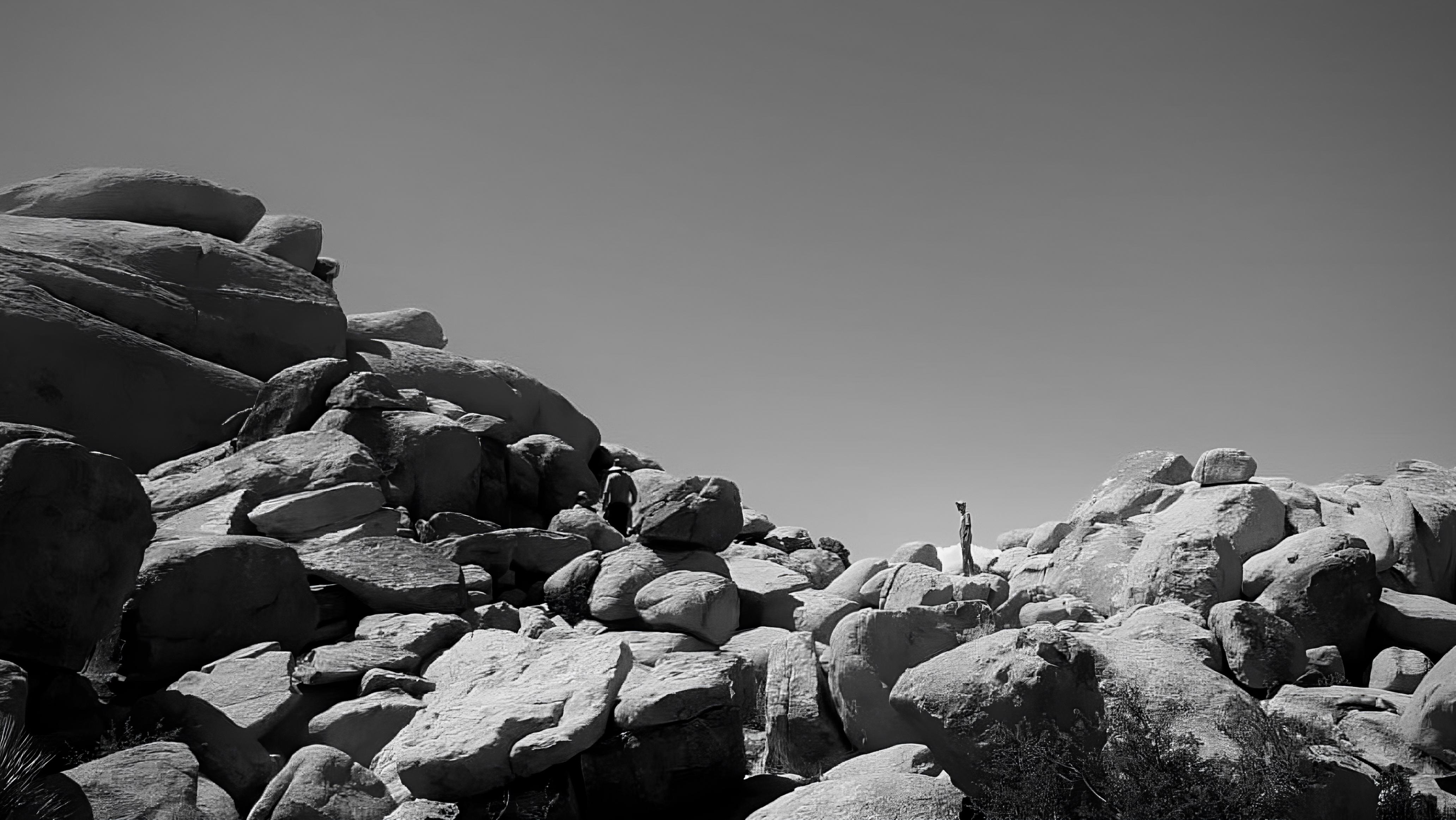
September 7th 2023 was a date I had been looking forward to for a while, not only because my dad and I were set to visit Joshua Tree National Park for the first time, but because three album releases had booked my calendar. My dad’s taste skews more towards pop, so Olivia Rodrigo’s Guts got our first listen. The endless desert highways on the way to the park were now coloured with the excruciating turmoil of Olivia’s coming of age. Rising star Teezo Touchdown had released his debut album, however his thrashy lead single had left my dad confused when I played it to him the night before. So, as the park’s rolling hills and looming boulders started to make their appearance on our voyage, I pressed play on James Blake’s new album Playing Robots Into Heaven, an experience which stays with me to this day.
James Blake appeared on my radar after a number of high-profile collaborations in the hip-hop world. Blake claimed an ethereal presence alongside the harsh climates of Metro Boomin or Travis Scott works, a contrast that immediately made sense. It was obvious that Blake had come from a singer-songwriter background, so how intriguing was it that he ventured into rap? What direction would he possibly take as a soloist?
I would come to learn that James Blake is an esteemed electronic musician – this album acts as a return to form after years of more commercial endeavours – but Robots feels first and foremost like a cinematic work of sci-fi, presenting a deeply affected soul to a cold, synthesiser wall: a world to get lost in.
The strange arrangement of words which make up the album’s title can function as a literal depiction. Blake’s songs become dirges for an android funeral; but these words – Playing, Robots, Heaven – conjure up equally vivid concepts in abstraction: ceremony, dance, songmanship; synthesisers, artificial, intelligence; weightlessness, grief, ascension. With such exciting pieces of worldbuilding both in the concepts and visuals, I rushed to contextualise every song: The synth of the lead in ‘Tell Me’ sounds like an alien distress message beaming down to an Earth unable to decipher it, and who is Blake ‘Asking To Break’ from? The mythical spirits in the ‘Night Sky?’
Like any good work of sci-fi, Robots uses its mechanical aesthetics to study the coexistence of man and machine. We see them seamlessly collaborate on ‘Loading’, streamlining yearning vocals over a pulsating electronic movement to encapsulate the sensory drama of psychedelics – ironic for a robot. Afterwards comes the fallout of their separation: the robots chaotically form ‘Big Hammer’, while Blake is haunted by a regret-filled relationship with his father on ‘If You Can Hear Me’.
This conflict persists throughout the whole experience but is never resolved: Blake struggles to pronounce his truest emotions through the expressive spirits of ‘I Want You To Know’ and ‘Fire The Editor’ that are kept timid by the mortal world, the latter a conceptual ballad about trusting instincts. Blake’s deep training with analogue synths allows him to express the nuances of these stories beyond traditional song structures, but he integrates enough genre cues from both electronic and pop to keep the work accessible – these songs sit in an exhilarating uncanny valley.
Finding the man vs. machine dynamic endlessly fascinating, it should come as no surprise then that the hip-hop genre which grew to fill my playlists was not my first love, instead arriving in the form of a famously robotic electronic duo – Daft Punk. Despite being aware of them since my childhood, I only experienced the glitzy chaos of ‘Harder, Better, Faster, Stronger’ for the first time at 15 years old. After hurrying to unearth their discography, I not only found entertaining music but a fascinating philosophical conversation which took place almost entirely non-verbally. Discovery’s world outlined an exciting collaboration between humans and robots as classic funk samples synced harmoniously with warm synths. Random Access Memories told a sombre parting of ways, as machines developed consciousness and with it a tragically impossible desire to discover humanity.
But perhaps my favourite of their stories comes in their 2005 album, Human After All. As the title suggests, the album forged the humble beginnings of RAM’s existential line of questioning but in a far more hostile manner. Populated by track titles like ‘The Brainwasher’ and ‘Television Rules The Nation’, Human After All alarmed that age-old insecurities about technology’s global takeover were finally showing signs of truth.
So, it’s easy to see why I resonate with the world of Playing Robots Into Heaven. There’s a tragedy in the fact that robots could construct such an entertaining affair as Blake’s ‘Big Hammer’ or Daft Punk’s ‘Robot Rock’. On Human After All’s closer, simply titled ‘Emotion’, a fleeting humanity struggles to materialise in a world so devoid of it – this same spirit lives on in the voice of ‘I Want You To Know’.
The soundscape James Blake offers is equally beautiful as it is terrifying, with a brutalist aesthetic to fit right at home on UEA’s campus. As Robots celebrated its first anniversary just over a week ago, I truly understood the idea that this album would stick with me for the rest of my life. Is love truly valuable? What is my purpose? I will be humbled by letting the androids mirror my same existential melancholy, only dressed in metallic wiring. Safe to say, my dad didn’t like the album.
Credit: Ralf Teschner



Leave a Reply to Matteo PatelCancel reply