
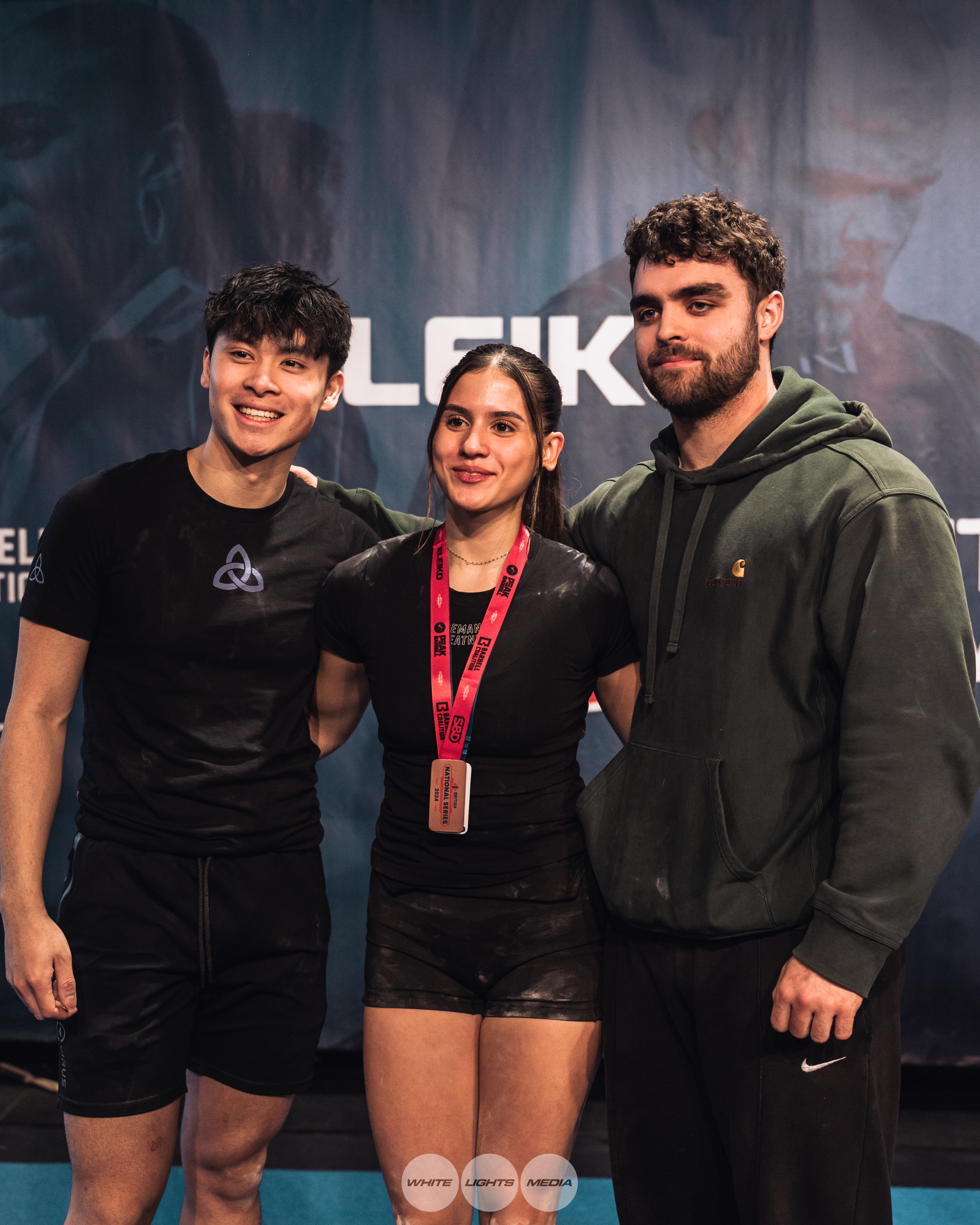
The power of social media is to never be underestimated. After all, it makes meeting a total stranger that little bit easier. Sitting amongst the few that frequent the Unio cafe during the summer break, I don’t think myself and Amy Middlemas have ever felt so grateful for profile pictures. “I was hoping I would recognise you from your Instagram”, Middlemas tells me with a hint of nervousness- it’s unexpected given her powerful exterior and knowing the immense weights she lifts on a daily basis.
Having only discovered powerlifting in December of 2022; at 21, Middlemas is a force to be reckoned with. Within the space of 18 months, Middlemas found herself going from a powerlifting rookie, to placing 5th at the FISU Powerlifting Championships. How did she begin? “I met my boyfriend in first year and he was really into powerlifting-style training… he introduced me to strength training and really training to get stronger.”
It wasn’t long before Middlemas found herself enjoying the powerlifting style and carried on as part of her workout routine. It was when Amy’s boyfriend, Tom Stapley, decided that he wanted to compete in powerlifting, that they started the transition to competitive powerlifting. “I remember that I was like ‘no, that is not what I decided to do in sport, I’m nowhere good enough,’” Middlemas recalls of her hesitation to go competitive. “But (Tom), as a person, is really motivating and really believed that I could do it.”
Determined to get the ball rolling on their powerlifting journey, Tom had discovered through word-of-mouth at the gym that ex-student Justin Lam was setting up his powerlifting business, Exalted Strength. Just starting out, Lam offered to coach both Amy and Tom for free as part of a case study. The competition that the pair had decided to take place in was only a month away, but in that time, Lam had taught Middlemas all about powerlifting, including the rules of the competition. “We really threw ourselves in at the deep-end… we were kind of overwhelmed, but we went to this competition a month later and I loved it so much.”
Even though Middlemas faced a few “technical errors”, her love for competitive powerlifting excelled and she immediately signed herself up to another competition. Throwing every personal trainer’s powerlifting rule book out of the window, Amy didn’t leave much training time between her next competitions, having competed in 3 competitions within 3 months. “After the first comp, I should’ve took a block, where I would build my strength, build my skills, but I didn’t. I just went comp, comp, comp, comp, because I was so excited.”
Middlemas had intended to compete in Nationals after BUCS in April 2023, but decided against it in order to give herself a break to build on her muscle and strength. As she began to train during the block, Amy likens the training process to “when you’re in high school and you know people that are really sporty and they swim at 5am in the morning and they train 5/6 days a week and you just think ‘oh my god, like, you’re crazy’, and then I looked at myself and thought, ‘I’m doing that as well’.”
In a typical week, Middlemas trains for 5 days with each session lasting around 2-3 hours. “A typical week would be training the core lifts, squat lifts, bench dead lifts and then you have primary days, secondary days, and tertiary days.” The primary, secondary and tertiary days are associated with which type of training Middlemas will do. Whilst each day includes benching; squats, deadlifting and accessories are progressively added over the weeks. Leading up to the competition, the workout routine changes: “I really admire coaches for it,” she smiles, “I don’t know how it works- it’s like magic- but they adapt the volume and the load leading up to comp to make your body exactly primed for competition day.” At around 5 weeks away from the competition, Middlemas goes from high reps to being brought down to lower reps at a higher weight. Her coach takes the reps down to a “super easy” level, but by the time the competition day arrives, Middlemas gets what she describes as “super strength”.
If one thing is for certain, Middlemas defies everything you would expect when it comes to powerlifting training. Assuming that she would consistently lift heavier weights in order to build strength, Amy informs me that this common misconception is far from the truth. “People think we max out every week- go as heavy as we can, you know? People think that’s what you need to do because we do it on the platform, but that’s absolutely not the case.” Training is judged in Rate of Perceived Exertion (RPE). Originally made for athletes, powerlifters have begun to adapt the format into their training on a rating of 4-10. With an RPE of 10, the athlete has completed all the reps they can possibly do, whilst an RPE of 4 is a warm up. The in-between of a 6-7 indicates that there is space for more reps, which is where Middlemas finds herself on most days.
“I never really go over an 8/8.5 during training unless it’s at the end of a block.” With the end of a block mimicking a competition day, Middlemas was yet to lift heavier than 165kg, “I was really scared of doing 170kg and at comp I did 170kg… I feel like people that don’t know a lot about powerlifting would think that I would have to lift 170kg loads, you know?” Had she just decided to commit in the moment? “The whole point of comp is to do weights you’ve never done before, that’s the aim of it. You have bad days. But what you do in the gym – if I saw one of my competitors do it in the gym – I would expect them to get better in comp.”
Approaching her fourth year in Medicine, Middlemas is a busy student. From doing a medicine degree to powerlifting, will there ever come a point where she has to choose? “Seeing other people, you can do both. There are a lot of people in powerlifting that are in Med.” Choosing her words carefully, Middlemas admits that juggling everything is “hard”. But, what helps her most is her calendar, which is “really OCD”. Planning out her entire day, every day Amy’s key to having it all is “making time for prioritising your training and uni… everything else, you can slot in-between that.”
Recalling the weeks leading up to the World Championship’s, Middlemas’ third year exams were in line with the competition. “World’s was a week after my final exam for med this year, so I did find that a little bit stressful… I said to (Tom) ‘I can’t train for this comp’.” With third year supposedly the hardest year at UEA for Med Students with the highest retake and drop-out rate, all Middlemas had on her mind was self-doubt. “I was like, ‘oh my god, I can’t do it’ and Tom said ‘You would be doing it anyway. You would still be going to the gym four times a week minimum – it’s your lifestyle’ and when you say that, it is just a lifestyle. I can’t imagine not training. When I don’t train, I don’t feel me.”
Committed to her sport, I’m curious if that was always the case, especially when Middlemas first started out. “I didn’t expect to be where I am now when I started a year and a half ago… I didn’t start of by doing 5 days a week… I just did it for the fun of it.”
With powerlifting becoming more and more part of Middlemas’ life, she took on the role of Captain of the UEA Lifting Club last year. Transitioning to President this year, has there been much of a change? “There are obviously things I’ve had to learn, especially about the weightlifting side of the club, because I was really focused on the powerlifting side.” Amy admits that the weightlifting side “wasn’t me” and was therefore unaware about what was happening on that side of the club. “I didn’t know how many people were involved in it, their training schedule, their agreement with the gym they go to – I didn’t know any of that.” Determined to make the club “more equal”, Amy has spent her time, so far as President, sending emails and having meetings to understand the weightlifting side of the club. “I don’t want to neglect that… I really want to make it clear that that will absolutely not happen.”
Whilst she has put a lot of into the weightlifting side, Amy is evidently proud of what the powerlifting side of the club has become. “It has absolutely flourished this year. We’ve got so many male and female members on the BUCS team.” Having sent 7 members to BUCS this year, it is a contrast from the 3 that were sent last year. Having doubled in BUCS members, there is still interest amongst students to join who were late to qualify and train to the level required. Knowing that those students are likely to join the club for this year, Amy is “really excited”.
Middlemas’ biggest success came at the FISU World Championship’s. Held in Estonia during July, Amy describes it as “a really cool experience.” The biggest challenge of all? The self-doubt prior to accepting the invitation. “I’m quite an anxious person and the thought of doing a big competition was really, really scary. But I had my boyfriend by my side and my friends were very supportive and the team as well – the powerlifting team – when I told them about it, they were so excited… because it did go through my head a lot, like ‘should I even do it?’ Because part of me was like ‘you need to focus on your studies’ but part of me was saying ‘what if you never get this opportunity again?’”
Happy that she made the decision to go- Amy originally hadn’t been selected at all. With set criteria’s in order to be selected, competitors must compete and place top 2 in BUCS. On the day of the BUCS competition, Middlemas placed in 3rd. “I didn’t have the best day and so I wasn’t really expecting to get invited.” When watching the competition back, Amy says that it was “obvious” on where she went wrong. Feeling quite “deflated” that she wouldn’t be attending World’s, news broke that one of the girls was not eligible to compete. It was then, that Middlemas was invited to the championship. “Part of me was like ‘oh, I don’t deserve it… I came in third’. I knew I could’ve done better than that.”
In a moment of rawness, Amy reflects on her anxiety, admitting that “new things stress me out and scare me”. However, her strength has come not only in a physical form, but also mentally as she praises powerlifting for helping her social anxiety. “Performing in front of a whole audience of people and having them cheer you on and make you feel really good about yourself – even if you don’t get the lift – they still cheer for you. I think that has really helped with my anxiety.”
In aim to get used to the crowds of competitions, Amy signed up to a ‘quiet series’ after her first competition. Held in Nottingham, the competition is aimed at competitors who are anxious and want to do a relaxed competition either as practice or to qualify for a bigger competition. Without the intensity of the lights and crowds, Middlemas found it to be “a really good experience and I would recommend that to anyone, because not a lot of people know about it.”
Amy also recognises it’s not just the atmosphere but the people around you that help her more. “I think just having people around me during the competitions has been really good. It wasn’t until World’s that I’d actually got seriously anxious about a competition before. I do get a little anxious on comp day. My coach knows me – he’s really good at calming me down – but I’m a bit all over the show because I am just nervous.”
Going to World’s, Amy describes her anxiety as “like no other!” With stress levels high, Middlemas spoke with a GB coach. “We talked about what I wanted to achieve in the competition – what my lifts would be – and I started crying because I was stressed out.” Having spoken to the coach before at a BUCS competition, Amy opened up to the coach and did what Amy describes as “the sweetest thing ever… he gave me this tour of the stadium.”
Taking her on a tour of the stadium the coach showed her the platform, where the cameras and lights would be and where she would walk in. “He took me right up on the stage and showed me exactly where to stand and let me just look out and absorb it all before it obviously filled up.” With no one there, no audience in sight and no pressure on Middlemas, the experience helped her to “calm down”. When talking to the other GB coaches, she realised she wasn’t alone in how she felt. “Speaking to the GB coaches about their experiences with their anxieties – like, it’s not just me – and I think I am still anxious, but I think that it really helped me. And reflecting on that, it will really help me in the future as well.” Staying on the subject, Amy finds a comfort in the fact that “it’s people who you least expect it from as well. You know, these people appear – 120kg plus powerlifting men on Instagram – and you’re like ‘wow, they must be hard as nails’, and then they open up to you and there’s me thinking I’m on my own, and that’s just not the case. Everyone has moments like that.”
For now, Middlemas is “so excited” for the year ahead. With some Lifting Club news that she is keeping close to her chest for now, she tells me that in other news, the club will be trying out a gym contract with Adira Weightlifting. Whilst her main priority is to ensure that the club will become “more equal” and “accessible” for the team, what is she aiming for herself? “I’m going to have a little off-season until December. I’ll do a competition – hopefully with the rest of the powerlifters club.” After speaking to a few members, Amy wants to “compete in the same competition – like a regionals competition. Qualify for nationals and BUCS and then hopefully from there, I’ll be hoping to get into the international selection pool for Uni World’s or Junior World’s… maybe Euros?” Shrugging her shoulders, as if to say she’ll follow the competition wherever it takes her, she asks no one in particular, “who knows?”
Image Credit: Amy Middlemas/White Lights Media



Leave a Reply