
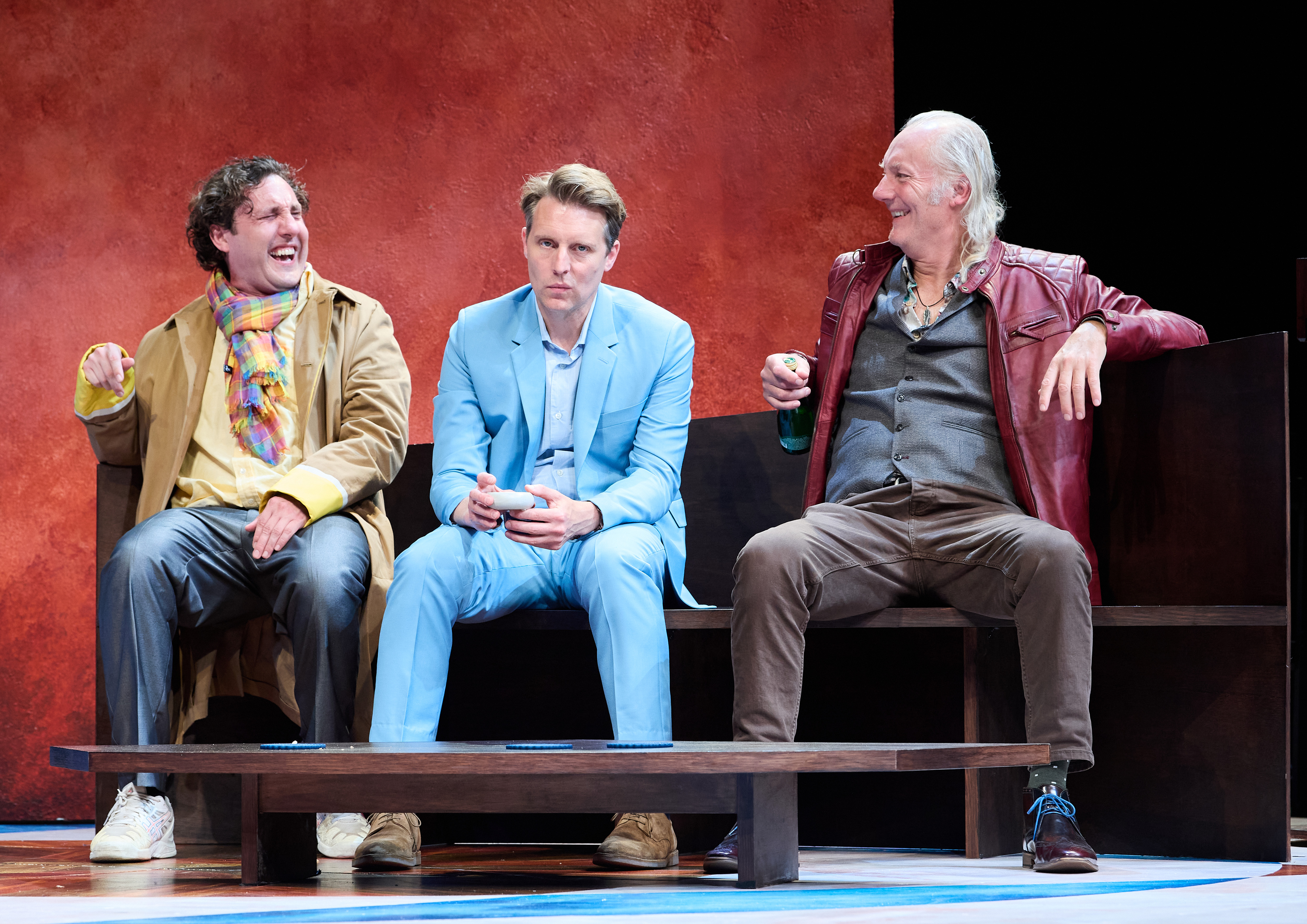
Norwich Theatre Royal presented ART, a play written by Yasmina Reza in 1994, with this new production being directed by Iqbal Khan. A fantastic production with a stellar cast. The play stuck with me, and the question that surrounds the play is, what is Art? It lingered to such a degree that I started to question what I thought theatre was. How can theatre be perceived through the eyes of the audience, yet can be different from the creator’s vision of their own work? This is shown through the characters of Marc and Serge, as the white canvas which Serge purchases causes a riff in their friendship. Can we understand who the artist is and the intentions behind it purely based on the art? Can you use Stanislavski’s techniques with Bertolt Brecht’s style of Epic Theatre? Should genre be clear as an audience member, by that I mean, should plays stick to one genre, how do you define genre? How can you review a piece of theatre when the definition of theatre is so broad; a scripted play reviewed in the same manner as a performance piece? The question which harks onto me is this; what is the essence of theatre, the drive to keep coming back, to write new material, to watch new productions, to experiment with different styles of storytelling, or to simply say something, which other’s might not be able to say. What is it that makes theatre, theatre?
If a politician spoke to a crowd, it may be scripted, and they may be an audience, but would it be considered theatre? I don’t think so. You have everything there to be considered theatre, but it is not theatre, it is a performance, but the true essence of theatre is missing. This may be a stupid example, but I hope you can understand my point. You must say then that theatre must be considered fiction, that theatre is between a level of fiction but, concurrent with world events, writing and performing as a response to the worries of the time. We see this with plays such as Tony Kushner’s Angels in America, about the AIDS epidemic of the 1980s, or Jean Paul Sartre’s play, The Respectful Prostitute, a response to rising racial relations in the United States.
Theatre is escapism, it can provide entertainment, it can be used to educate, inform the public about current events, it has and can change people’s perception about how we view the world and how we communicate and respond to difficult situations. So, is writing the main principle behind the theatre? Is theatre dependent on writing, on scripts? It is a part of the essence of the theatre. It certainly is important to theatre, but theatre can be improvised, theatre can be without words, the dramatic action on stage is conveyed through the space and movement of the people, it transcends the barrier of language into a universal experience. Theatre is a visual medium, but it was not always viewed as such. In Elizabethan times, it was common for people to say, “I’m going to hear a play”, while the Ancient Greeks used that term “I’m going to watch a play”, since a lot of their productions were outside and used the surrounding landscape. Amphitheatre’s such as in Epidaurus, in Greece were situated around nature, whilst in England, most theatres, such as The Globe, were in busy cities. Throughout the history of theatre, we have kept a lot of terms from the Ancient Greeks. Most of their productions were used for religious ceremonies. The plays were a collection of dancing, singing, with a chorus to move the story along. The Greek Chorus has changed over time into becoming an ensemble, a unified harmony between the main actors and the cast to create a realistic portrayal of the world. On the discussion of a realistic portrayal, Plato despised theatre, describing it as a distraction to reality, an imitation of what the world verily is. Theatre is an imitation to the world, but an imitation is the sincerest form of flattery. It is the essence of theatre to come from the artist interpretation of the world, and since everyone views the world differently, the form of theatre is forever changing. Theatre comes from personal experiences and for some, tragedy. Dadaism and Surrealism came about after the Great War. The death, suffering and misery of the war left many asking if there really was a meaning to life. If there was someone looking down on us, how could they allow all this bloodshed to happen? The art movements were a reaction to the conflict and the performances reflected that sense of meaninglessness and existential dread.
You can have the performing space, the lighting, sound, mise-en-scene, props, but there is one thing you cannot forget… the performer. The performer brings the script to life, to existence from mere words on a page. A performer can read from a script, or an artist may be the performer themselves, such as the performance artist, Marina Abramovic. It is within the individual that theatre is born. One must find it within themselves to try and understand themselves, or at least, what one is passionate about creating a piece of theatre. You may have no idea where to start or how anything in theatre works, but there may be an idea stirring around in that head, so you must write it down. It is so easy to forget an idea, it’s much easier to forget a great idea, and wallow in self-pity about forgetting. That is why you must write it down, Is the magic of theatre not to know what within ourselves we find intriguing? Is it ineffable, impossible to describe or understand that feeling? The theatre is a place of sanctuary for so many different people. We may not realise why a piece of art has made us feel a certain way, but everyone knows that it certainly made an impact, and that is what I believe to be the essence of theatre.
Photo Credit: Norwich Theatre Royal


Leave a Reply