
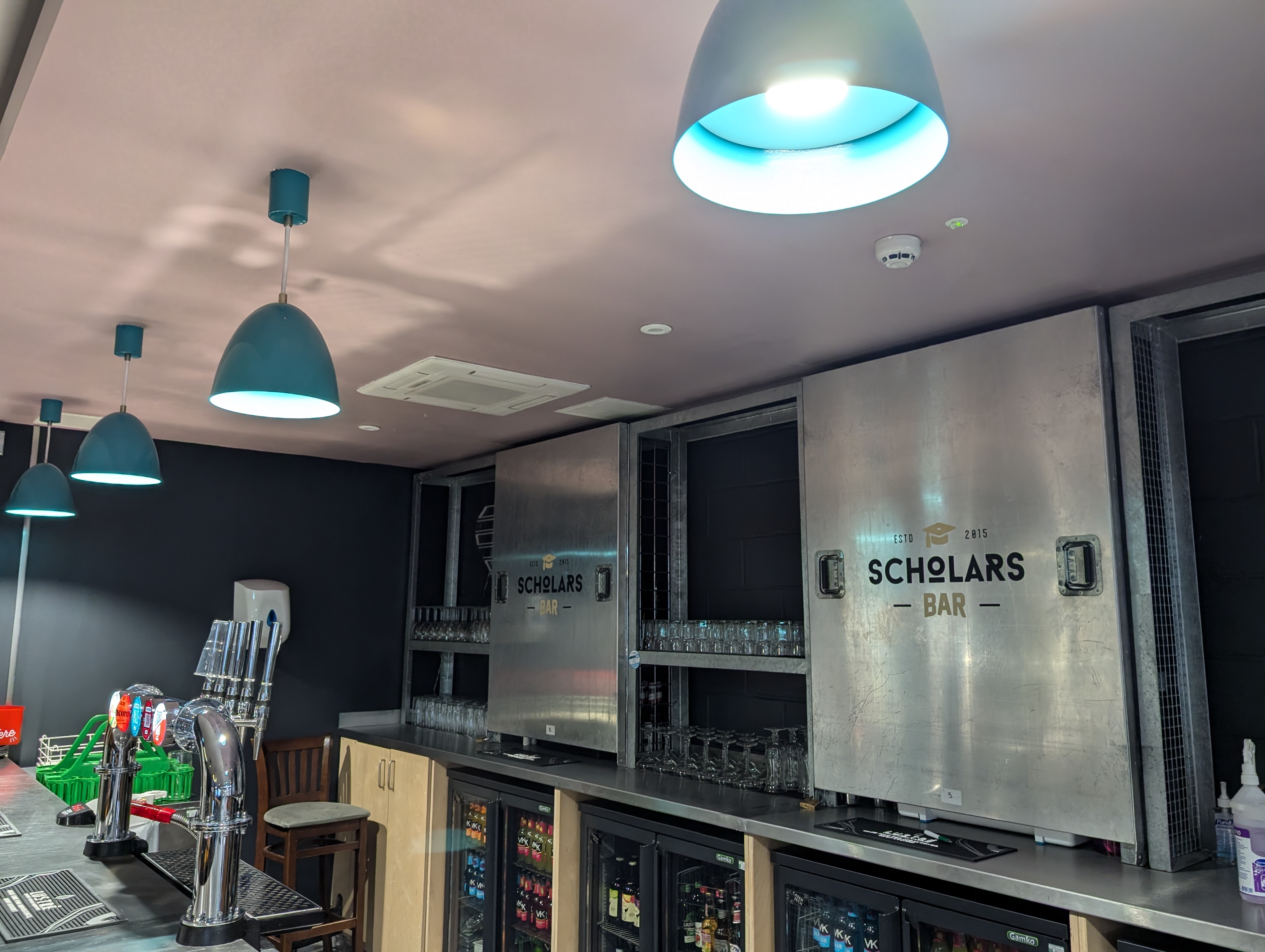
A Concrete investigation has revealed how a lack of foresight and transparency was involved in converting Scholar’s Bar to the LGBTQ+ Bar following an annual loss of around £8,000.
The decision was signed off by the Student Union’s Trustee Board prior to any discussion with students from either community, as members of the committee reportedly believed that the process between signing the contract and changing the bar was going to be a lot slower.
‘We were under the impression that there was going to be more time for students to be consulted on the rebrand’, said Welfare, Community and Diversity Officer Nathan Wyatt.
A proposal to relaunch the establishment as a space for members of the LGBTQ+ community was introduced following the consistent decline in income from Scholar’s Bar since it was first opened in 2015.
When launched, the bar was managed by the Graduate Centre Management Committee. This was part of the Postgraduate Student Association, before both groups were absorbed by the Students’ Union.
Posters on the doors of the bar, that were only removed shortly before its transition, explicitly stated that the original centre’s primary objective was to run the bar to benefit the postgraduate community and ‘not to focus on financial profit’.
An anonymous post on Concrete Confessions voiced concern that ‘The SU tried to cover up financial losses on a non-profit project by offering false hope to another minority, and it needs to do better by all of us at UEA’.
But Nathan explained that, although the aim was not to make profit, the running costs of the bar were not being raised due to external issues such as the pandemic, security fees, and the cost of living crisis impacting students.
The Students’ Union maintains that although the purpose of the bar is still not to make profit, it was no longer financially viable existing as the Scholar’s bar as it was contributing to the general debt of the union.
Overall, the Student Union has accrued approximately £3.2 million of debt through loans from University of East Anglia, bank loans, and repaying historic pension schemes.
Assistant Finance Director Tim Cave outlined the Unions clear and structured plan to repay each of these sectors – and while further financial strains from staffing costs are predicted for the coming academic year, he reassured that it represented and accounted for what Chief Executive Jumara Stone ‘believes is the best structure’.
It also allows room for pay increases for junior staff – as well as changes in executive contracts. These adjustments include reducing the Chief Executive’s sick pay allowance from the previous six months to one month, as well as extending their initial probation period. Both were implemented upon Jamara’s arrival in January 2024.
Tim explained that the previous two Chief Executive Officers ‘had left office prematurely by mutual agreement’, the most recent of which involved an exit payment of approximately £60,000 in 2024. ‘This is a habit that would be good to break’, he said.
From the start of her career with the Student Union, Jumara has remained transparent with the full-time officers as to how to remove her position if ever needed, explains Nathan Wyatt. It’s a level of transparency that the Union is financially used to working under as a charity.
As a charity body, the Union falls under a reporting framework determined by charity law. Tim Cave said that ‘we operate in an environment where there’s transparency and scrutiny’ as a result of reporting and filing their accounts with the charity commission. The Union exists under this category as it has a purpose to meet charitable aims; to provide opportunities, advice, support and representation to students.
However the Students’ Union is also a registered company and social enterprise, owning both Student Union Services Limited and the Adrian Flux Waterfront.
Adrian Flux, a Norfolk-based insurance broker, pays an annual fee to have its name affiliated with the venue, but does not own shares of or operate the club in any way.
The split between raising their own income and grants provided by the university is close to equal. Such grants come in two parts – one unconditional, block amount, and the other an optional grant offered by the UEA to support new and existing programmes, such as The Buddy Scheme that was launched in 2017.
The relationship between the university and the Students’ Union is binding as a result of the Education Act 1994 – although legally and financially, the Union continues to remain independent.
As a result, the Students’ Union is still largely dependent on its own trading for funding, mainly due to the LCR’s position as the biggest venue for music and events in Norwich.
Financially, the two biggest interactions between the Union and students are through clubs and societies memberships, and attendees to the bars – one of which being the newly rebranded LGBTQ+ Bar.
Tim Cave explains that ‘when Scholars Bar could no longer justify itself commercially, a proposal for it to have a different life with a new audience was found, without compromising its proposition to graduates’.
It’s an undeniable challenge for the bar to be both a source of income as well as a space for multiple demographics. ‘In what context can we be all things to all people?’, Tim questions.
Current Part-Time LGBTQ+ Officer Matthew Shields, who at the time of the decision to rebrand the bar was the head of UEA’s Pride Society, explained how the Students’ Union ‘should simply have been more transparent about their finances from the start… and there should always have been a conversation first’.
An accountability session was held shortly after the decision in the summer, but with many students at home during this time of year, the impact was useful but limited.
Although both LGBTQ+ and Postgraduate students appear to acknowledge that the Students’ Union meant well in their decision to repurpose the bar, it’s a general consensus that ‘they were out of touch with committees when making the decision’.
It follows a long-running lack of engagement between decisions made by the Trustee Board and university students.
Matthew has focused on breaking this cycle in his current role by nurturing the relationship between the Students’ Union and members of the LGBTQ+ community. The past lack of communication between the two has resulted in both parties running parallel events at the same time with no collaboration, such as Transgender Visibility Day in March 2024.
Matthew said he had ‘no place in making the decision’ and was not approached about the transition of the bar. He ‘felt let down that [he] wasn’t able to represent [his] community properly’.
But despite feeling like he once had to insert himself into the Union’s ongoings in order to keep up with events and plans, he says it has recently become more natural, and is going in the correct direction – this comes shortly after he, alongside fellow LGBTQ+ Trans and Non-Binary Place Officer Thea Glover, were consulted by Nathan to help shortlist new names for the LGBTQ+ Bar.
He says that the Students’ Union is taking on feedback from the community he represents as an officer by recruiting queer DJs for Liquorice, as well as encouraging students to vote for the bar’s new title. The drinking spot will be named Kaleidoscope, Dorothy’s, or Unity once votes have been counted.
Full-time officer Nathan Wyatt reflected on the decision, highlighting that ‘there was a failure on both parts, when the paper was delivered and agreed to’.
Since the rebranding, the Students’ Union has implemented Wednesday club night Liquorice, as well as offering the bar to host a new book club and karaoke nights. ‘It can also act as an overflow space for future events in other bars’, they suggest.
Image Credit: Jamie Bryson/Concrete





Leave a Reply