
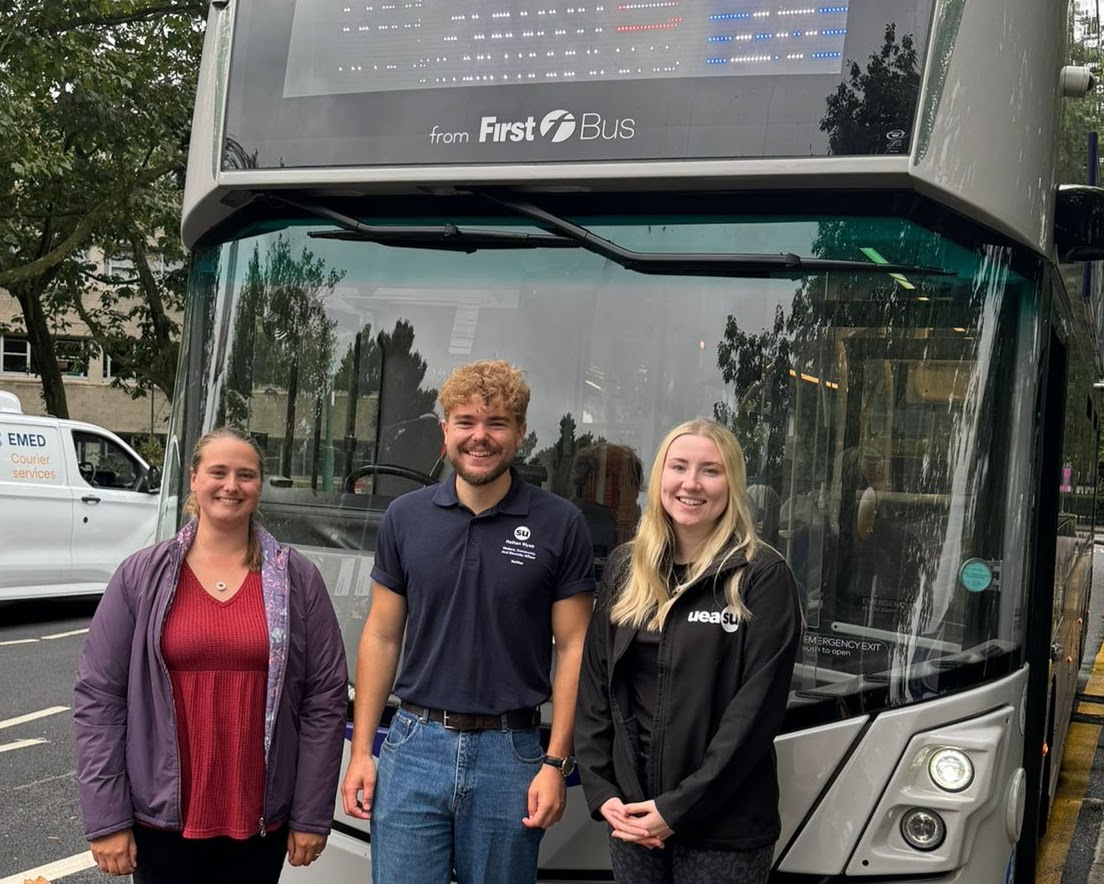
Since the Union’s foundation, its agenda and landscape has drastically changed. For example, the first Union Council meeting included a request that students “take special care about stubbing out cigarettes on the furniture.” In time, the number of students at the UEA has exponentially increased and its demographic has shifted significantly. This resulted in a gradual adaptation of the Union and its engagement with students.
This year’s FTOs recognise that the Union is a flawed entity and are working towards the facilitation of change. Three of the five Full-Time Officers (FTOs) were interviewed to gain a better insight on the structure of the SU, their roles within it and to address some of the key concerns and criticisms that the SU faces.
The Undergraduate Education Officer this year is Rebekah Temple-Fielder. This position oversees the academic wellbeing of undergraduate students, advocating for students at university-level discussions, like the University Senate. She explained that she wanted to address the academic representative system after having had “no engagement with it.” She said that often officers come to their roles after encountering problems at university.
Rebekah discussed students’ mistrust towards the SU stemming from issues of transparency. Particularly, a lack of understanding regarding how and why decisions are being made. Often students gain information from one another, or through participation in campus activities, like clubs and societies. Subsequently, not being involved within these circles can make the Union seem clique-y.
Where the SU’s website could provide further insight, students are often faced with outdated or inconclusive results. As such, sometimes it is these barriers or complications that prevent accessing information. Rebekah discussed updating and streamlining the website to ensure “no more dead ends.” This would help students better access resources and information that they need.
The Undergraduate Education Officer and Postgraduate Officer jointly oversee the School and Faculty Convenors. This year, the role of Course Representatives was removed and now students directly communicate with their Convenors. Currently there are 27 Convenors (19 School-level and 8 Faculty-level). Students’ feedback is then used in cross-faculty meetings to compare experiences. This format also helps address disparities in resources and facilities, she said “sometimes you don’t realise it until you put two people from different schools in a room.”
Rebekah argued that “you can always do better with the quality of education.” She emphasised it being “the element of university that students are paying for.” This spans from reducing printing costs to ensuring that every student has a positive sense of engagement with their academic supervisor.
Reflecting on the overall role of the officer, Rebekah described it as a “weird” position to be in, as it can involve a range of activities from “throwing stuff out on a nightclub stage to having meetings with the Vice Chancellor. So, there’s no middle ground.”
Bhaskar Bukkanahalli Shivanna is currently in the role of Postgraduate Officer. The position advocates for the postgraduate students, for both Taught and Research. This includes educational representation, however, expands to the broader university experience as well. So far, this has included advocating for postgraduate student representatives within societies and clubs, as well as distinct forms of postgraduate roles at School-levels.
PG Officers are responsible for postgraduate wellbeing and facilitating their engagement with the SU. The Officer works in close collaboration with the Postgraduate Committee. The Committee is elected by the Postgraduate Assembly. Together they oversee events, opportunities and spaces dedicated to postgraduates.
All FTOs adopt the positions at the beginning of July and start training and planning throughout the summer. However, postgraduate programmes continue throughout this period. Consequently, postgraduates receive limited access to services and opportunities during these months. Bhaskar explained that it can be hard to get support when everyone is “busy planning ahead for the next academic year.”
The type of students attending the UEA has changed dramatically, since the first 88 students started. This means that the positions and responsibilities within the SU are re-evaluated to ensure that it is equitably representing students of all backgrounds. For example, through a higher level of attentiveness towards cultural inclusion.
In recent years, the SU has worked in collaboration with select Schools to provide a Students of Colour Ambassadors (SOCA) scheme. It allows students of colour to work on projects that shape the experiences and curriculum within their Schools. These projects can also facilitate systematic change within the University. Currently there are 17 SOCA across nine Schools.
Each officer brings their own lived experiences to the table. In Bhaskar’s case, being an international student, he wanted to introduce more intercultural events. This was seen with the organisation of the Diwali festivities. Bhaskar shared the importance of there being “a home for students where they can celebrate their own culture.”
This year’s Campaigns and Democracy Officer is Chris Kershaw. According to him, his role is to “oversee the democratic institutions of the SU, to try and improve them.” Within that, the work ranges from signposting to facilitating larger initiatives, such as protests. Another side is engaging with groups on campus to lobby their interests regarding policies and decision-making. Through this, the SU facilitates foundational learning experiences, outside of academia, on “being fully engaged members of society.”
Union Council (UC) acts as the Union’s decision-making body, a key platform to represent student interests. Most governing processes are streamlined through UC. Meaning, all students rely on it to enact change or voice concerns. In recent years, there has been a sense of disengagement with the Union and its processes. Chris described the Union’s current infrastructure as full of “dead ends where ideas go to die.” Reflecting students’ disillusion towards it.
In response to this, the Democracy Review was introduced to examine the structures and processes in place. The Review has since resulted in a proposed system. It is still undergoing revision and is being discussed in UC meetings. Chris emphasises the need to “make sure that any of the changes that are brought in also have a level of democratic legitimacy.” One part of the proposal would be to restructure some of the Union’s organisation. For example, by replacing some of UC’s functions through Committees, to allow more concentrated approaches to decision-making. In theory, this would streamline resources and communications.
In January of this year, Jumara Stone took over the CEO position. The current officers see this as a positive marker for change in the SU. Jumara has previously stressed the need for an “adaptable and responsive” Union. The new five-year strategy stresses the importance of streamlining resources and facilitating student collaboration. The SU has recognised some of its shortcomings and is trying to ensure that students continue to want to be engaged and involved with the SU.
Want more?
Join Concrete for ‘A Day in the Life of…an SU Officer’. We followed two of our current Officers for a day to get a glimpse of the inner workings of the SU. Watch here
Image Credit: UEA(SU)
Written by Milla Cartwright. Officers interviewed by Milla Cartwright and Mar Devonport.



Leave a Reply