
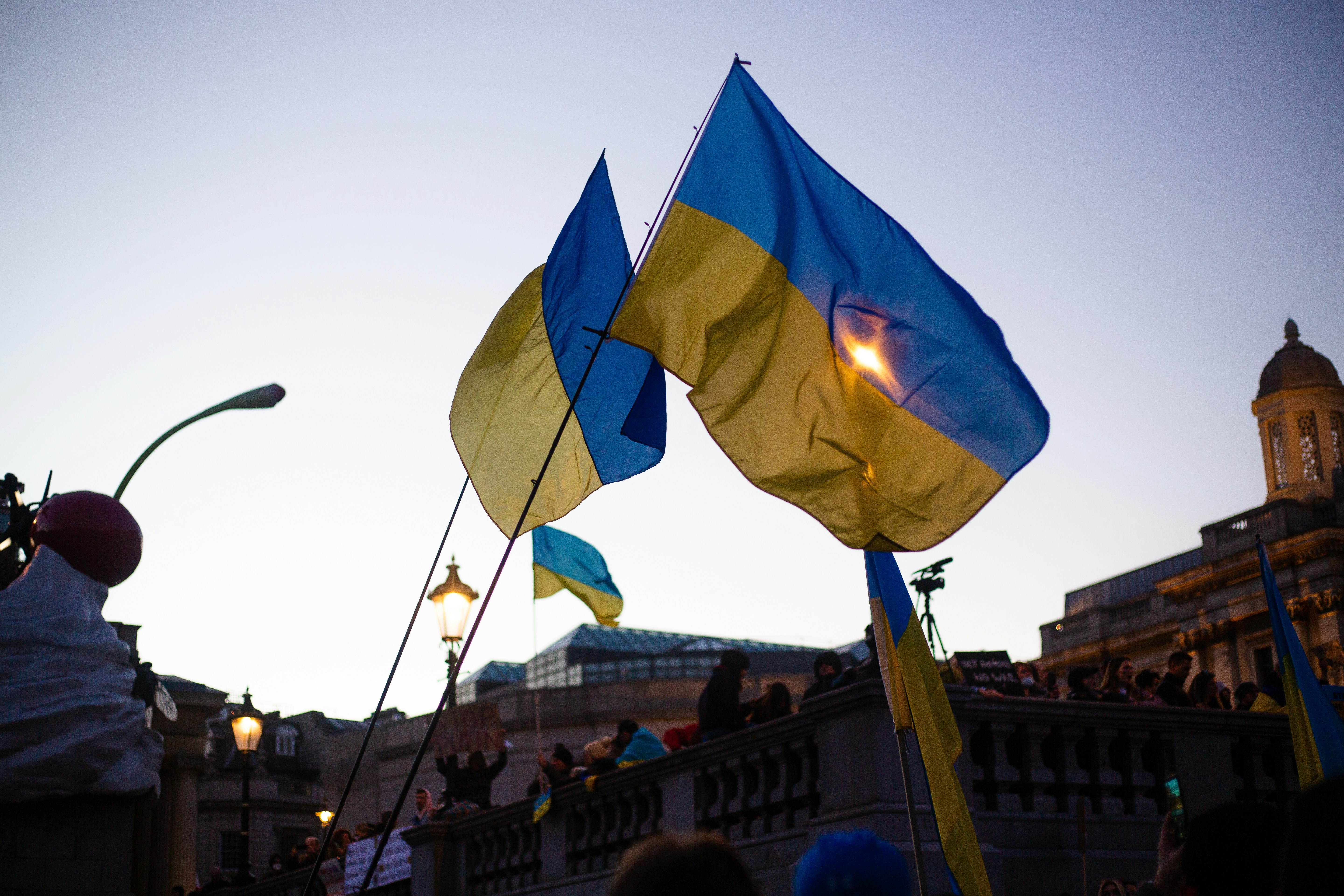
I’m at home in bed, blanketed in a thick silence. It’s not a comfortable silence, it is heavy and tense. I had a lot on my mind. While Russian officials kept saying they were only training, US and UK intelligence suggested things weren’t looking good.
Feb. 24, 2022. I can hear loud bangs in the distance. Then, car alarms — one, two, three. I want to sleep but the noises are too loud, too out of the ordinary. I open my eyes and read the clock; it’s 4:30 a.m. I glance out the window, I can see smoke rising from the direction of an airfield.
My mother pokes her head in my room and says, “Dear, the war has started.”
Another bang; I feel the house tremble. I thought I’d lost my ability to breathe. When you hear words like that, it’s like your entire world is crumbling right in front of you. Everything just stops.
I saw disbelief and fear in her tired eyes. Before she even finished that short, terrible sentence, tears were already running down my cheek.
That’s where I was three years ago, in the eastern Ukrainian region of Donetsk, exposed to the sounds of explosions; my introduction to the soundtrack of warfare.
I thought it would end in a few days.
One month later, as Russian missiles attacked our neighbourhood, we took shelter in our bathroom. The air-raid siren blaring in the background as we hid. We were there for 10 hours. Cramped in a tiny space that felt more like a trap than a shelter.
The sirens stop.
We go to the kitchen to make some tea to warm up, but before the tea was even ready, the siren started again.
We rush back to the bathroom as explosions surround us. I wondered to myself if we would survive if our house was hit and imagined being buried alive under the rubble; it terrified me.
That day the decision to leave was made.
For the next 36 hours on the train, my only thoughts were on what will be next; where we were going. Under such stress, I couldn’t even think about food.
We were able to get a space in one of the train compartments, which is only supposed to hold a family of four. Ours held 14 women and children. The atmosphere was tense – some people cried, some were silent, others couldn’t stop talking, but everyone was glued to the news on their phones. We were all scared.
Our first night in Poland was our first night of peace since leaving home. We received help from volunteers who provided us with tickets for transportation, free SIM cards, hot meals, and translations. I felt their support; I saw it in their eyes and actions. While Poland wasn’t our final destination, I still felt a sense of kinship with the people we met.
Germany was our next destination. We luckily found long-term accommodation there and were contacted via support groups on Facebook about a space in a small village.
I had to start my life from scratch in a new country, without family and friends, more than once. In Germany, then Japan, and now the UK. I don’t know how many times I’ll have to start over, and where I will end up next.
These aren’t the memories a 20-year-old is supposed to have. I should be with friends hanging out at cafes in Kyiv, continuing my studies, building a career in media, traveling in my beautiful country, and following my dreams.
But this war has changed everything.
Happiness now means a clear sky free from missiles, a home untouched by destruction, and a family that’s still whole.
But at least I have this chance. At least I am free.
But some are not as lucky.
Egor is not. We went to the same school, and he’s a friend. When Russian forces invaded Ukraine on February 24, they stormed Mariupol, the strategic port city on the Sea of Azov. They encircled the city and pushed Ukrainian soldiers back to their last stronghold – Azovstal. For three months, they held on, starving, wounded, but unbroken. The steel plant became both a battlefield and a horrible trap.
Egor is a surviving soldier from Azovstal. But his survival came at a cost. He is being held captive in a Russian prison camp and endured a terror attack in Olenivka. In a sham trial, he was sentenced to over 25 years in prison. Most recently, he was transferred to another prison camp infamous for its brutal torture practices. I can only imagine what he is going through. And I can do nothing to stop it.
It’s difficult to know, hear, and read these stories while I am safe.
This invasion has shown the world how strong Ukrainians are. Our resilience, our unity, and our determination to protect our country, even when everything feels impossible. Our defenders are giving their lives for every centimetre of our land. We are fighting for our freedom, independence, our homes and families, our language, our culture, and our future.
It is fighting for our right to exist.


Leave a Reply