
When people talk about Edgar Wright’s Cornetto Trilogy, the same comments tend to be made time and time again. “I love Hot Fuzz!”, “Shaun of the Dead is great!”, “Isn’t Hot Fuzz one of the funniest films of all time?”. These statements are all true, of course, but when it comes to talking about the third film in the trilogy, The World’s End (2013), people tend to fall silent. “It’s okay,” “It’s not the best of the three,” “I’ve not seen that one.”
The World’s End follows a group of childhood friends reuniting to finish the bar crawl that defeated them in their youth, only for their hometown to get invaded by aliens. It’s classic Edgar Wright fare – fast-paced, packed with comedy and cinematically tight, but it’s too often overlooked when discussing his films. Perhaps I am biased. After all, the film was shot mainly in my hometown and the world’s first garden city – Letchworth Garden City.
Like many children growing up in the 2000s, watching Doctor Who was simultaneously the most exciting and the most frightening part of the week. It was not just about the aliens; it was about seeing them in London, thirty minutes down the road from my house. Yes, it was terrifying, but something about it happening so closely was deeply enthralling. With The World’s End, the aliens were on my doorstep. And now that I was a lot older, those childlike fears were replaced with an appreciation of just how cool it all was. My town, featured prominently in a film by one of my favourite directors.
Some of the pubs that were in the film share their exteriors with real pubs in Letchworth. The first four stops were filmed in nearby Welwyn, but Stop 7, “The Two Headed Dog”, is The Platform and Stop 10, “The King’s Head”, is the Arena Tavern. “The Trusty Servant” is actually a Wetherspoons!
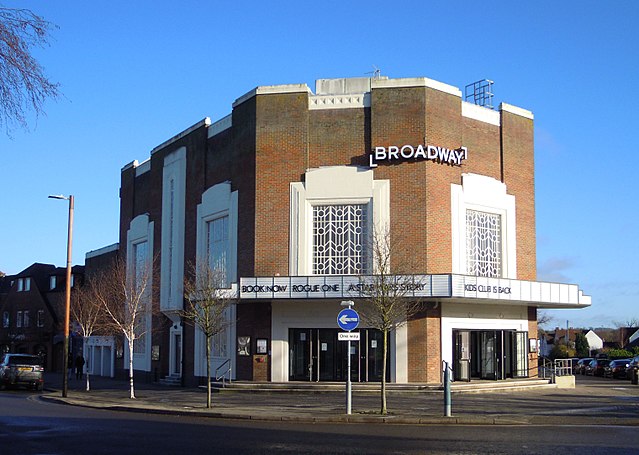
It is so surreal to see places that were important to you at some point in your life reflected back at you and knowing that people around the world will see the same shots, though without the same emotional resonance. “The Hole In The Wall” is Letchworth’s train station. The titular “The World’s End” itself is the Wilbury, the hotel where my grandad worked. The cinema where I had spent so many of my friends’ birthday parties and lazy afternoons, transformed into Pub Number 8, “The Mermaid”. The railing that I had lined up against to get in, vaulted effortlessly by Simon Pegg. “The Good Companions” is right next to what used to be a wall of colourful buttons that played children’s songs when pressed (I remember the tinny melody of Pop Goes the Weasel the most). Now they are in disrepair and boarded up, a scene befitting the themes of the film.
Unfortunately, at the time of the film’s release, I was too young to see it in Letchworth’s Broadway Cinema (or “The Mermaid” as it appears in the film). Not only would I have watched it in one of the film’s sets, but I would have also seen the exclusive intro message delivered by the main actors of the film, thanking the people of Letchworth. All I have is my dad’s tales of seeing it late at night in the town centre.
The World’s End feels more introspective than the other two films in the trilogy. Perhaps that is not fair to the other two films… Perhaps it would be more fitting to say that the introspection feels more overt. It’s deeper than most people give it credit for; at its core, it’s a film about a man who refuses to grow up, clinging to his past happiness because it’s all he has. Gary King (Simon Pegg) is an incredibly tragic figure, a man stuck in the past, trapped in a life that should have gotten better, but never did. It speaks to a common fear that many of us have or will experience at some point in our adult lives.
Gary’s conversation with Andy (Nick Frost) towards the end is a scene I still think about from time to time. He pulls his sleeve back to reveal his hospital bracelet, and in that instant, the effortlessly cool veneer of his nickname, The King, is shattered to reveal how broken and vulnerable Gary is. This subverts expectations that were set up with the first two films – that beneath the comic and snappy exterior lies real emotional depth and character. Despite it being the final film of the Cornetto Trilogy, The World’s End is not a parody like its predecessors, and that’s okay. What makes the film so special is that it is different from the ones before it, and that it doesn’t explore the same ideas.
It may not be as memorable as Shaun of the Dead, Hot Fuzz, or any of Wright’s other work, but The World’s End holds a special place in my heart. Perhaps it is for me the fact that a film so preoccupied with growing up takes place in the town where I spent my childhood.
Photo Credit: Wikimedia Commons



Leave a Reply