
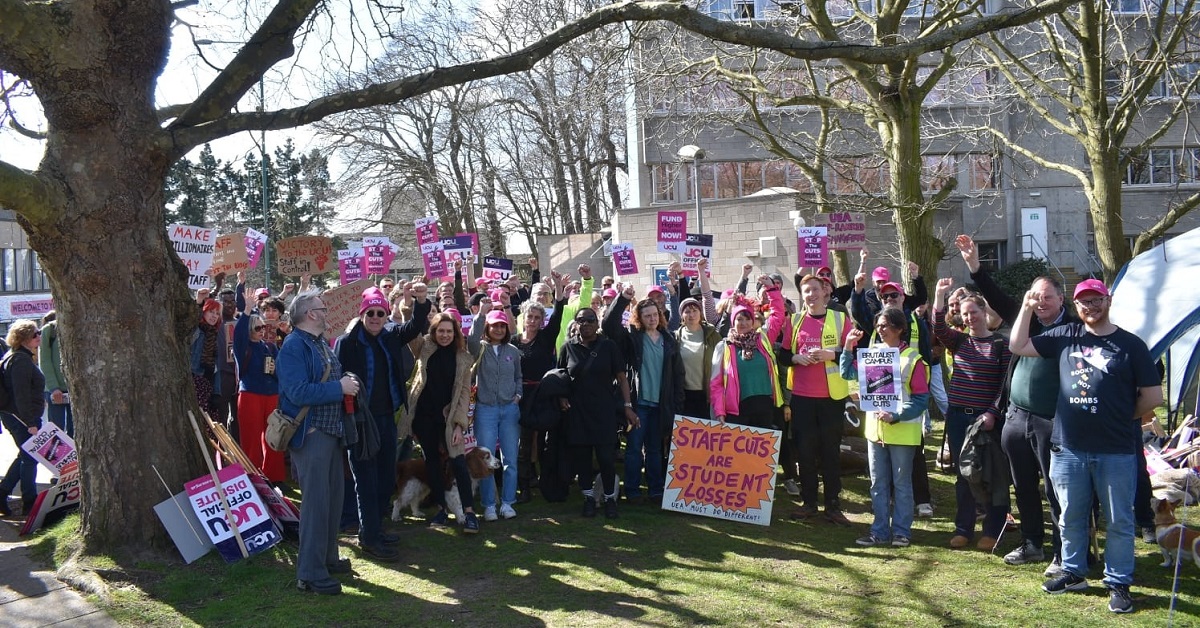
Staff at the University of East Anglia (UEA) have continued strike action throughout May, severely disrupting many students’ final semester of the academic year. For many on campus, the mood is somewhat grim, but for others, also determined.
The University and College Union (UCU), which represents academic and support staff, began coordinated industrial action earlier in the year in protest against proposed compulsory redundancies and what the union calls a “failure of financial accountability” by university management.
UEA plans to cut 163 full-time equivalent roles in an effort to close an £11 million funding gap. While most reductions have come through voluntary departures, around 30 staff still face the threat of compulsory redundancy. The union insists those cuts are unnecessary, and says alternative savings proposals have been ignored.
“It is outrageous that UEA is pressing ahead with compulsory redundancies when so many staff have already left and alternatives have been offered,” said UCU General Secretary Jo Grady. “UEA staff have gone above and beyond to protect students and save the university money. It’s time for management to do the right thing, drop the threats, and engage meaningfully.”, she added.
The university has expressed regret over the disruption and maintains that compulsory redundancies remain a “last resort.”
A Broken Model?
The standoff is the latest symptom of deeper instability in the UK higher education sector. Universities across the country are grappling with structural deficits caused by frozen tuition fees, inflation, and an overdependence on international student income. According to a 2024 Institute for Fiscal Studies report, nearly a third of UK universities are running at a deficit – a figure predicted to almost double by the end of the decade.
UEA itself has been through this before. In 2023, it announced a further £13.9 million shortfall (in addition to its then-predicted £30 million total deficit) and launched a wave of voluntary redundancies. The crisis led to the resignation of the then-Vice-Chancellor, Professor David Richardson, and sparked internal reviews. But two years later, many staff say little has changed.
“This isn’t just about jobs. It’s about trust,” a current LDC lecturer, who wished to remain anonymous, told Concrete. “We’re not the ones who broke the system, but we’re the ones paying for it, and there’s a clear limit to how much you can strip the system of its most valuable assets – its staff. That limit was reached long ago.”
Students Caught in the Middle
For students, the disruption now represents an all too familiar situation. Classes disrupted. Deadlines adjusted. Communication vague.
“I support the staff—they’re doing what they have to—but it’s still really stressful,” said a second-year psychology student who joined staff members on the picket lines earlier in May. “We don’t know what’s happening day to day, and I don’t think the university communicates effectively about it”, adding, “Whatever side you’re on, the uni does seem to give off a very ‘us and them’ attitude to it all.”
On the other hand, a fourth-year PPA student expressed to Concrete: “Of course I appreciate why staff are angry; you would be if your job was threatened like that. But I do think it’s a case of higher education being forced to adapt to broader circumstances largely out of its control…Yes, the government and maybe some VCs have made some bad decisions in the past, but I think we’re at a point now where we need people to accept the change to a degree and start working together on some positive changes and not just protesting”.
UEA says it is doing everything possible to minimise the impact on students. But the long-term risk to morale and reputation remains unsettling for many.
For now, the strikes continue, and uncertainty lingers. But one thing is clear: the tension at UEA reflects a deeper reckoning across UK universities. Staff, students, and administrators are no longer just debating budgets – they’re fighting over the soul and sustainability of higher education itself.
Chris Kershaw – the Campaigns and Democracy Officer at UEA SU told Concrete:
“As a UCU member myself, and as someone who has had the privilege of teaching at UEA during my PhD, it’s incredibly disappointing to see the university seemingly fail to engage in good faith negotiations with UCU. I think it’s telling that none of the executive team have taken voluntary pay cuts while hundreds of teaching and support staff have lost their jobs. We only need to look at the shockingly tone deaf and dismissive response that the VC gave to questions at the staff forum about him taking a pay cut to see what the executive team really think of the staff that actually make this institution run. UEA is being destroyed by the very people who should be the custodians of it for future generations. We’ll have to wait and see if this round of cuts fixes the problem, and how much more executive pay will rise in coming years”
When contacted, Professor Emma Sutton-Pavli, Senior Pro-Vice-Chancellor for Student Experience and Education at UEA, told Concrete:
“Firstly, I absolutely recognise the concerns of our students and can appreciate that this is unsettling.
“Our priority throughout has been to mitigate any impact on our students and ensure the quality of our education.
“We have sought to keep students informed throughout this round of industrial action and to reassure that UEA is dedicated to ensuring you can continue your studies, progress and graduate as planned and that all our excellent support services continue to be in place for you.
“We hope that any impact on students will be minimal. You can find out more about this in our FAQs.
“The student voice has never been more important to us in terms of taking on board your views. So please share any feedback via the We’re Listening platform. The platform is anonymous so we won’t be able to respond to you directly, but your comments will be used to update our FAQs.”
Image credit: UEA UCU




Leave a Reply