
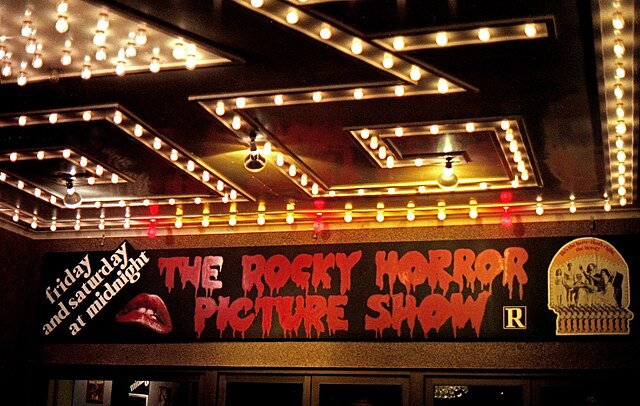
Venue Co-Editor Micah explores the history and the legacy of The Rocky Horror Picture Show as it turns 50.
The first time I watched the Rocky Horror Picture Show (1975), I hated it. In my defense, I watched it in my basement at one a.m., sitting next to my mom who wouldn’t stop singing over the movie. And yet, it fascinated me: the costumes, the constant sexual references, the fact that I couldn’t quite explain the plot, no matter how hard I tried. I immediately made my best friend watch it with me, so that I wouldn’t be alone in my confusion. For some reason, the next time they slept over, we watched it again. This time, what was intended as a hate watch became true love.
Based on Richard O’Brien’s 1973 stage musical The Rocky Horror Show, the 1975 film tells the story of a newly engaged couple who, having car troubles, end up finding solace in a manor of oversexed weirdos and murderous freaks, under the direction of Dr. Frank-N-Furter (Tim Curry), a transvestite-slash-scientist. Needless to say, it was not a box office favorite. However, in the year following its release, it gained popularity as a midnight movie where, within a few months, audiences began to show up to midnight showings in costume and yell jokes at the screen. Although the phenomenon started in New York City, by 1978 it had spread across the US, as actors (known as shadowcasts) began to perform the movie in front of the screen in addition to telling jokes. Eventually, jokes turned into props and actions, with moviegoers throwing rice and water on each other, blowing noisemakers, or raising their lighters (or phone lights) in the air. In the subsequent decades, while many jokes continue to be improvised or written by individual shadowcasts, other callbacks have become a necessity, part of an unwritten yet universally acknowledged script (such as yelling the word “asshole” when one of the newlyweds, Brad Majors (Barry Bostwick), introduces himself).
Since the end of secondary school, my best friend and I have made it a tradition to go to an evening showing of The Rocky Horror Picture Show every time I’m home. The cinema we go to, the Studio Galande, is an independent, single-screen theater in Paris that has been showing the film every week since 1978, pausing only during COVID. Not only was it the first cinema to show the film consistently, but it is now the only cinema in Europe with a shadowcast that performs every single week. The particularity of this production is its bilingualism: the film is shown in English with French subtitles, but the jokes are almost entirely in French, often relying on “frenglish” puns to poke fun at French politics and pop culture.
One of the big reasons why I love going to The Rocky Horror Picture Show is seeing people who you would never imagine together sharing a love for this originally underappreciated movie. When I was on my year abroad in the US, a college production of the show was attended by as many teen- and college-aged people as people older than my parents, many of whom had been seeing the show consistently since they, too, were in their early 20s, sharing the same jokes they shared when they were in their own college productions.
Fifty years after its release, with over fifty active shadowcasts across the US and a dozen outside of it (though not a single one in England), the film and its traditions have garnered an enthusiastic cult following. More than a film, Rocky Horror has morphed into a pop culture phenomenon, popping up in shows and movies such as Fame (1980), The Perks of Being a Wallflower (2012), or Glee (2009–2015), and evening showings have remained a refuge for outcasts of all generations.




Leave a Reply