
Venue Co-Editor Micah Petyt explores the cult hit movie ‘But I’m a Cheerleader (2000)’ and its legacy as the film turns 25.
In her 1964 essay “Notes on Camp,” Susan Sontag defines the camp aesthetic as a “love of the exaggerated, the ‘off’, of things-being-what-they’re-not,” and states that “the whole point of camp is to dethrone the serious.” Although camp and queer aesthetics are not synonymous, queer art and aesthetics often rely on campiness to subvert expectations and reject ideals of heteronormality. It is precisely through this camp lens that Jamie Babbit’s But I’m a Cheerleader (2000) has succeeded in cementing itself as a queer cult classic 25 years after its release.
Starring Natasha Lyonne and Clea DuVall, But I’m a Cheerleader follows Megan(Lyonne), a seventeen-year-old cheerleader sent to True Directions conversion therapy camp by her parents to “cure” her lesbianism. Under the direction of the camp’s founder (Cathy Moriarty) and a so-called “ex-gay” (RuPaul), the students are led through a five-step program to admit their homosexuality, address its “root,” and re-establish their gender roles through a series of exaggeratedly gendered household tasks.
Featuring pink PVC dresses, a groundskeeper in a tight vest, and RuPaul in a shirt that reads “straight is great,” But I’m a Cheerleader is a pastel-colored, innuendo-laced satire of heteronormativity, conversion therapy, and religious conservatism. The film was inspired by Babbit’s mother’s job running a halfway house, which pushed Babbit to want to make a comedy about rehab, something that later turned into a comedy about conversion therapy. More specifically, Babbit wanted this movie to highlight femme lesbian characters, at a time when the primary lesbian representation was that of butches and masculine women. Pulling inspiration from Tim Burton’s Edward Scissorhands and the flashy, oversaturated films of camp legend John Waters, the pink and purple walls of True Directions conversion camp were born.
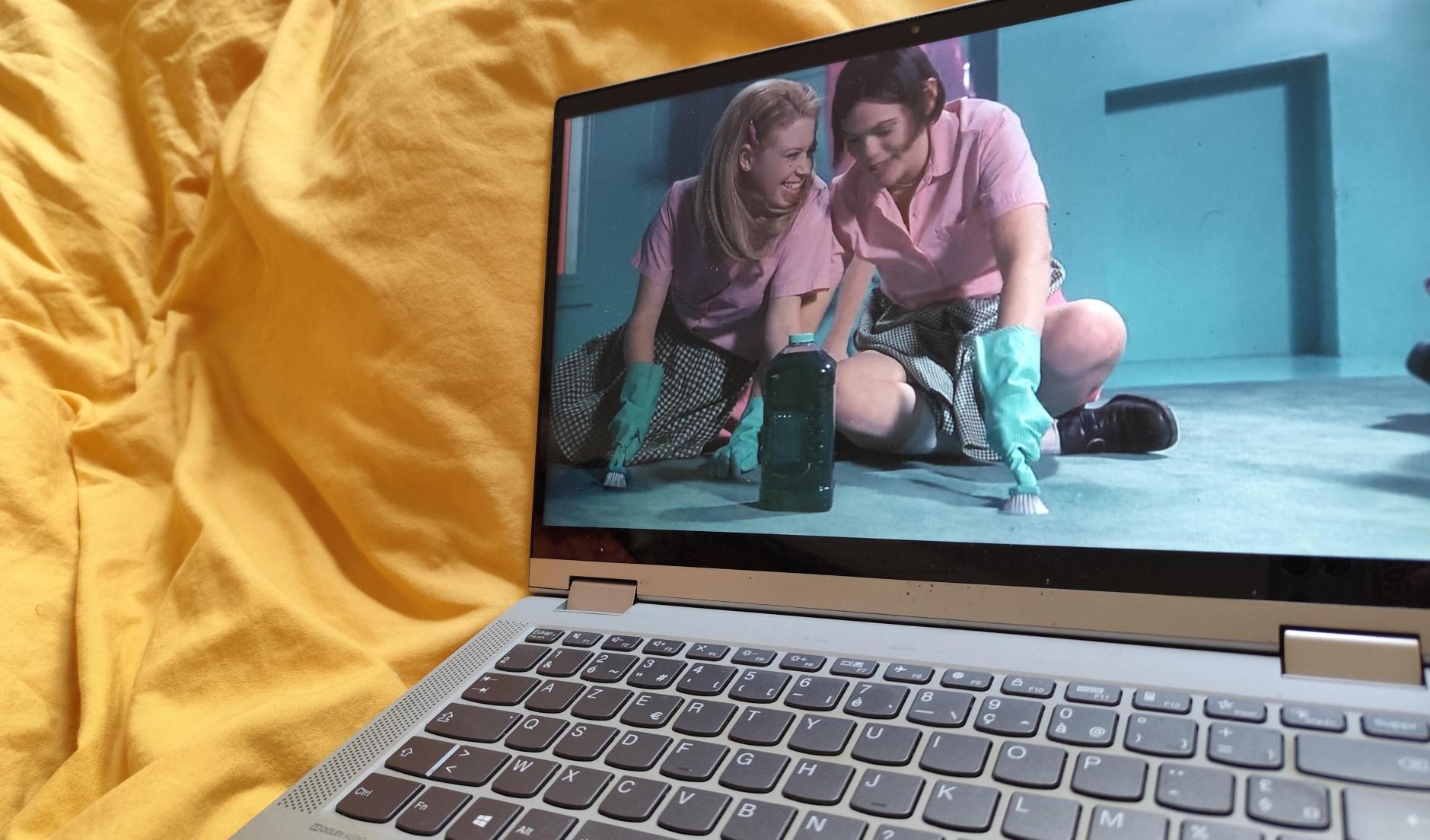
Throughout the film, heterosexual living is repeatedly mocked and bastardized as gender is turned into a performance. The girls are forced to perform wifely duties such as cleaning and changing diapers, though they are tasked with these activities in pairs, which inevitably makes sparks fly between them. Meanwhile, the boys are taught to fix cars by staring at RuPaul’s crotch in tiny shorts and hide behind a hunting target that looks suspiciously like a male soldier performing a sexual act on another. The presumed “root” of the campers’ homosexuality varies from one character’s mother getting married in pants to another being born in France, poking fun at the fact that there is no true “root” of someone’s homosexuality. The most explicit mockery of heterosexuality is the last step of the program, when the campers must wear full body unitards and simulate heterosexual sex, an action that should symbolize their full “rehabilitation.” However, in this scene, the camp director declares that “foreplay is for sissies,” showing a blatant disregard for the mechanics of sex, instead focusing on an abstract idea of heterosexuality and reproduction.
When it was released, But I’m a Cheerleader received mixed reviews, as mainstream reviewers did not connect to the film and its intentions. However, as many other cult and camp classics, the film found a home in the queer and art house film circuit and has often been considered one of the best lesbian films of all time.
In today’s political climate, with religious conservatism on the rise and the emergence of gender essentialist trends and behaviors (for example with the popularization of the trad wife), But I’m a Cheerleader’s satire remains as relevant today as it was 25 years ago, and perhaps even more so. Much like how the character of Jan (Katrina Phillips) is presumed to be a lesbian due to her not-conventionally-attractive appearance and her affinity towards softball, women in the public eye today are repeatedly accused of being transgender for lacking certain “feminine” traits (see Imane Khelif at the 2024 Paris Olympics and Brigitte Macron, First Lady of France.) While the boys at True Directions simulate army training, conservative American politicians complain that men “used to go to war.” As the world appears to be regressing in terms of social movements and the queer experience, it is only logical that a film that aims to poke fun at serious social issues would remain near and dear to our hearts.
3–4 minutes





Leave a Reply