
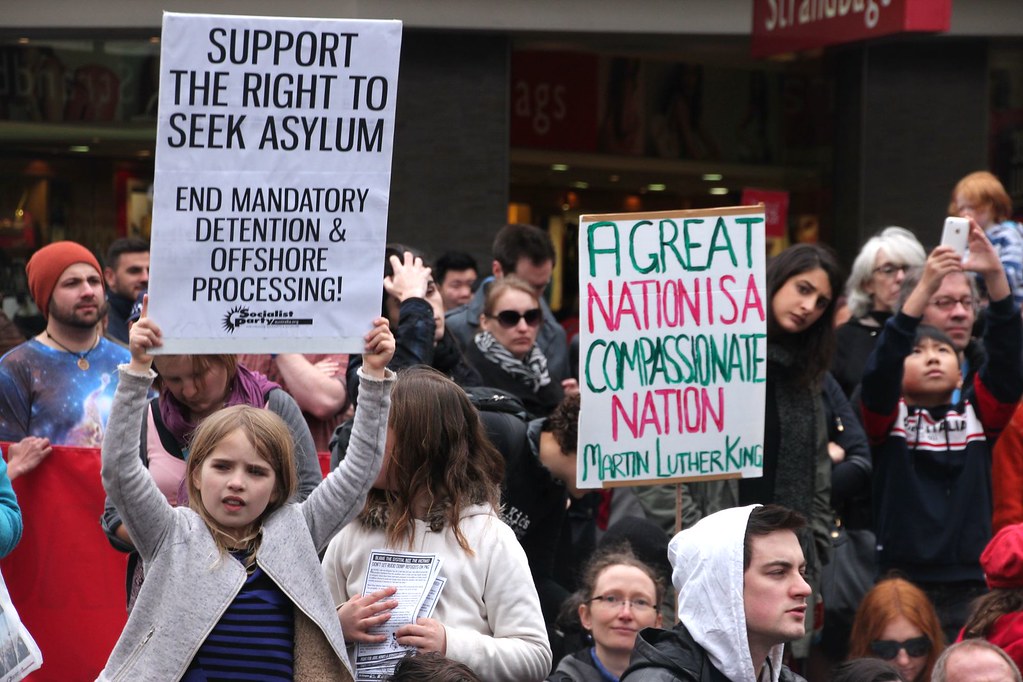
Writer Jack Wilson explores the political narrative of anti-immigration protests and how language fuels a right-wing rhetoric.
Trigger Warning: This article discusses a polorising political topic and protest activity, which some readers may find
distressing.
Armed with Union Jack banners and shouting “stand together; save our children”, protestors gather around a Norwich hotel housing migrants. “This is loving our country,” says one attendee as veterans camp outside the hotel, “not loving the people stealing from the community.”
The gathering called to mind an invasion. Many referenced the inevitable counter-protest Stand Up to Racism. These were broadly dismissed as far-left agitators, with anti-immigration supporters sneering at the attempts of the so-called antifa mob. A stark dividing line was drawn: there are those who love our country, and those who would seek to destroy it — and their accomplices.
Less than two weeks later, Bowthorpe’s Brook Hotel again saw protestors gather in a nationalistic display. Far from being isolated, the protest was part of the countrywide Abolish Asylum Day movement. “The system is unfit for purpose,” posters stated. “Safety of women and children over foreigners,” others read.
Across the country, groups demonstrated their opposition to migrants, condemning those in favour of supporting migrants as being Islamophiles. It’s a sentiment fostered by several political parties, such as the Conservative Party’s Stop the Boats campaign, as well as being a foundation for the Reform Party.
The debate around immigration and multiculturalism is by no means a new phenomenon. It has been a talking point in British culture for decades, long known to be a divisive topic. Right-wing politicians have drawn support for years by preying on common fears of everyday people — fear that you and the people you love, especially children, are under direct threat from immigrants.
Perhaps accelerated by social media, the conversation has become more extreme in nature. In recent years, terms such as woke and antifa have become detached from their original meanings. Originating in the 1930s, to be woke was to be aware of racial discrimination and prejudice, encouraging marginalised peers to tune in to social injustices. After gaining more widespread usage in leftist circles in the 2010s, the term has since devolved through right-wing rhetoric to refer to overly moralistic behaviour and hypersensitive activists.
Antifa — short for anti-fascist — broadly refers to left-wing activist movements that birthed in the wake of World War II. Since then, in right-wing media, it has come to mean simply an irritating opposition to traditional values and patriotism. Used alongside terms like radical, mob and agitator, it strikes a particular tone with people to build a narrow image of leftist politics.
This extends beyond mere name-calling and ignorance; it becomes a tactic to suppress opposition. Any contrasting viewpoint becomes something irrational and irritating, something to be mocked and harassed — or dismissed as snowflake behaviour. Some organisers of the anti-migrant protests have gone so far as to imply that counter-protests are nothing but state actors, paid off by the Labour Party to cause discord.
This intense divisiveness is effective at encouraging people to join the ultra-nationalist cause. It places the very complex history and nature of multiculturalism in England into two distinct, immutable categories. You must stand with the country and your own people, or be against it. To highlight one issue is to discredit the other: you either care about homeless people and veterans who fought for Britain, or you wish to see them suffer.
It turns the debate surrounding immigration into one lacking in any complexity or nuance, and allows little room for actual change or progress. Many perspectives get shrouded by these labels. And no matter how hard they try to reject them, they become very difficult to escape.
With another Norwich-based protest suspected to occur in the coming weeks — a peaceful pink protest for women and girls — the conversation deepens but refuses to progress. The language we use shapes and reflects the political climate, and as time goes on and we go around in circles, one wonders whether we can reclaim political discussion beyond catch-all insults devoid of their original meaning.



Leave a Reply