
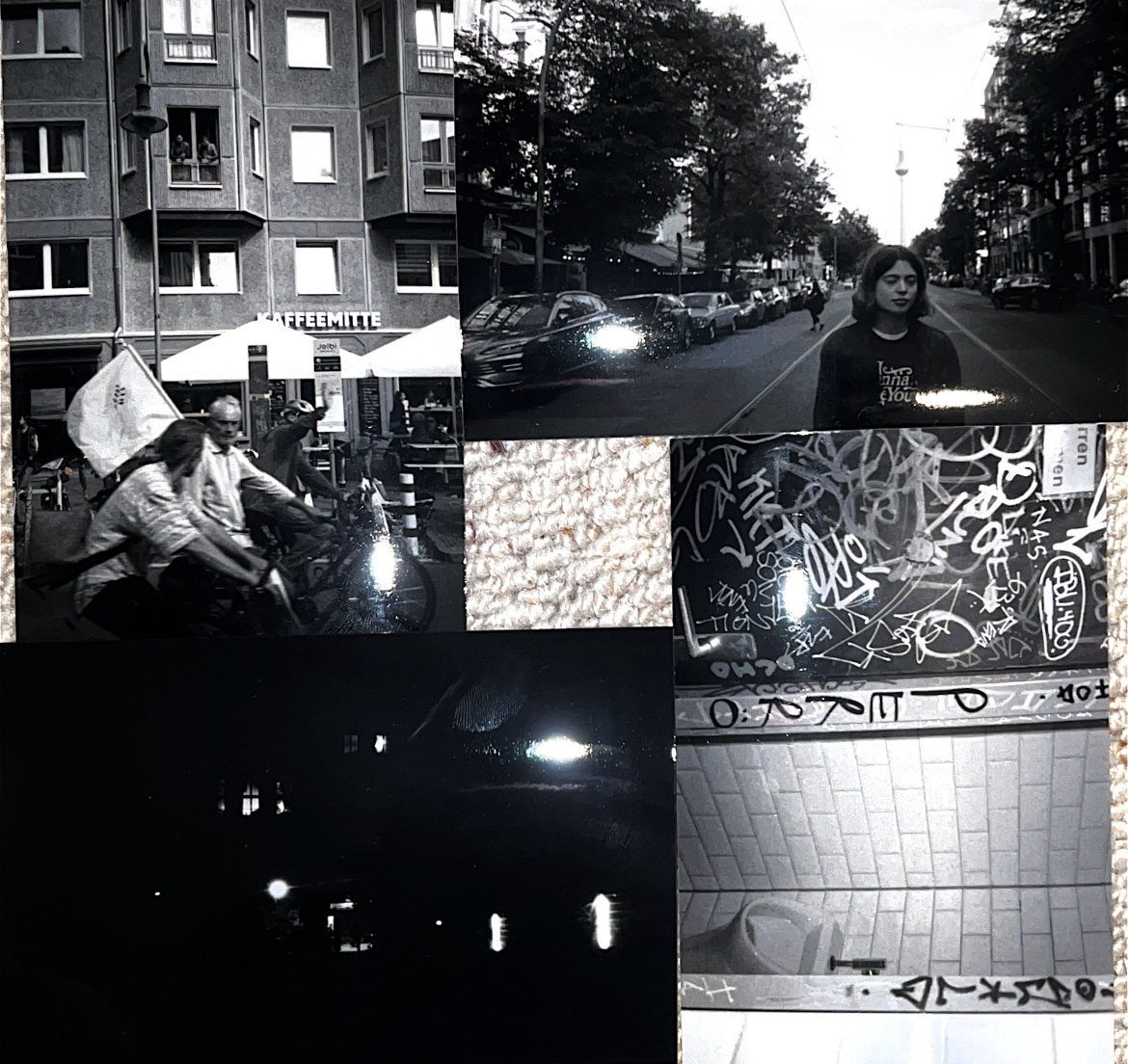
There were eyes between the hammer-horror paraphernalia cast around the wheezing walls of the bar. None of them free of guilt, all of them shaded by the night, and I, holding the torch of a half-British, half-German tourist in Berlin, approached the bar with some loose euros sliding about my palm. Zwei Bier, Bitte.
Under a dusty prop of a bloodied bat, a man stared at me with a suggestive spindle on his face. His skin looked like it was made from the rubble of the Berlin Wall.
The bartender glared through me, awaiting my handout of cash as she funnelled great fumes of golden ale into glasses. She wore eyeliner and mythic tattoos, a Doctorate of punk and post-war liberation, subtly directing the city’s unspoken dress code from the counter of that sticky bar.
I had been in Berlin for two days now, on an end-of-summer getaway with my friend Olson from my hometown in British suburbia. We’d taken the sightseeing bus tour, seen Checkpoint Charlie, all under the direction and prescription of the tourism doctor – a ghostly being that walks the walls of all holiday destinations and draws you in with snow globes and postcards.
That night, we had agreed to ignore the medic and inject ourselves directly into the night’s wired underbelly. I had asked the Circuit Spectre (otherwise known as ChatGPT) where to go, where we would find the hidden secrets of the city. It drained the environment, chucked its plastic organs around a bit and then directed us to a back-alley bar in Kreuzberg.
So, we moved forward, searching for authenticity at the helm of a soulless machine’s puppet strings.
Those beers were soon empty. I fixed my gaze forward so as not to acknowledge the circus of bohemian illicitly taking place around me.
I succeeded in my vacancy for a while; I’ve always been good at being a ghost.
Then, Claus arrived.
He stumbled over, clenching three shot glasses, clad in leather and speaking in an exhilarated concoction of German and English.
“You guys seem cool, I’m Claus!” and thus we tried a shot of peppermint liquor at his recommendation; “It’s Berlin’s classic drink.”
His smile was stained with mischief; he smoked tea-leaf cigarettes, an alternative medication that allowed him to fit into the indoor smoking scene that the city beheld as religion.
Claus recalled, “One time, the government said bars were going to have to make a choice: they could either serve food, or let people smoke inside, not both. The next day, there was no food in Berlin.”
After an hour of lager-strung conversation, we confessed our desire to infiltrate Berlin’s nightlife to Claus.
We mentioned Berghain, Claus was silent, the smoke drifted up in an orange haze, then Claus said, “I’m going to Tresor tonight, you guys should come.”
I sank the last drop of peppermint.
Skinny shadows leaned from the walls as we joined the back of the Tresor queue. Claus was quiet now. I looked to Olson; he looked to the street.
In a sunken daze, I let the bouncers take my ID, their thick silhouettes the same shade of black as the East Berlin sky. A slant of synthetic light shot across Claus’ brow.
He moved toward the bouncer.
Thus came a strange operatic orchestra of German conversation between Claus and the pillars of the night.
The bouncers remained sunk in a draught of emotion, before twisting their inky sleeves and whispering with a haunted gesture towards the door: “Get In.”
Tresor runs on industrial accelerant, a possessed machine winding and churning with lakes of Jäger, bass and sweat. A mechanical tube of steel flowed into the main room.
I was thinking about modern churches and the architecture of aristocratic cults as we descended into the techno-chamber.
With the rhythm of a piston, the crowd moved their heads like cogs to fuel the groove of the drum that penetrated deep from inside the caged DJ. A synthetic hiss, then a magnetic pulse, lights bruised and extracted reservation out of you.
Techno music is highly disciplined, structured and methodical. Yet something in the thrash of the kick drum turns these structural attributes on their head.
This contradictory chemical then dissipates into the crowd, producing a machine of hypnotised liberty. Arms turn like ratchets. Eyeliner soaks the floor.
That night, it wasn’t as though a wild, primal desire had been unleashed from each person. Instead, the crowd moved in mechanical syncopation, not necessarily polite but functioning with a respect for each other’s personal release of feeling.
In some strange way, it was like watching a religious service. Monks in leather, bleeding with sweat, the crowd’s total attention to the music and only the music felt holy.
We had other gods on our mind.
We departed Tresor’s catacombs, headed for the monarch of the Berlin night – Berghain. Like an outpost for coded emancipation or some ironclad crypt, Berghain stands tall and hidden in the night.
We approached its looming windows slowly. There was barely a queue, and within minutes we were standing in the shadow of the sanctum, before two bouncers lit in a hazy yellow light.
A second passed, maybe half a second – before one glanced at us and moved his head with a primal apathy. “Sorry, no.”
So that was that. A duel of unspoken judgment.
I left bloodied by the sword of subcultural authority and moved away from the promised land. I found myself among a strange cluster of people.
At the back of the queue for the club, the rejects sit quietly, withdrawn into a quiet but prepared disappointment.
Among the black-booted crowd, I sat as a knighted leftover, Tresor’s hymns still beating in my blood. It turns out, Berlin’s furnace of rhythm has embers too.
I swallowed my typical tourist desires.
I could still taste peppermint.
Image Credit: Ben Heiss



Leave a Reply