

Born and raised in Gaza, Amjad Daher knew fear before his own name.
Now, he returns to the memories of a war-torn home as he remembers a childhood ripped from his arms and thrown into debris.
This article includes references to death, violence and describes scenes of conflict.
Amjad was only one-year old when he met war.
Born in Gaza, he still recalls the conflict that awoke him at dawn and kept him up at night.
“I still remember the flashing lights that would come to me,” he says.
It’s a chilling statement, further installed as he reminds us that it may have been his first – but was far from last. Reeling off years; 2008, when he was four, 2016 at age 12, he hesitates. “I think there might be too many to count.”
Amjad grew up in an area north of the strip in a big family. He explains that his mother, father and six siblings would often evacuate at night to a second house in central Gaza to escape the bombing.
“Every time, my dad would wake us all up at three, four, five in the morning and say ‘take your passports, take your documents, we have to go,’” he says.
“That’s all we’d take. No time for anything else. And then we’d drive.”
Amjad reminds me that in Palestine, movement does not guarantee safety. Conflict does not care for borders. It cannot be contained.
Like many children, war was incomprehensible for Amjad. Instead, it became a game – the thrill of moving to a different location, the hope that one day he could stay there long enough for it to become a home.

But the memory of his homes are just that. He tells me that they were destroyed amid the conflict that officially began in 2023.
“We still have the keys. We don’t have the houses,” he says.
Before the loss of their properties, Amjad’s parents moved to Turkey, where, at the time in 2019, the country was openly welcoming Palestinians. While his mother stays as a homemaker at the new family house, his father, Dr Mahmoud Daher, works in Yemen.
His six siblings – two brothers and four sisters – remain displaced; spread across the globe – each studying, working or mothering. The eldest girls, who share five children between them, lived in Gaza until the beginning of 2024.
“A couple of weeks after Isreali Forces entered Gaza in 2023, I was in a union meeting.
“I got a call from my sister. She was crying, saying that she was in the streets and her house had been bombed,” he says.
“She had the children with her and didn’t know what to do. She just kept saying that they were in the streets and had nowhere to go.”
Amjad felt powerless.
“You know, when you’re outside and people are suffering inside, and you feel like you’re betraying them in a way?” He asks.
“It’s a feeling of guilt. I felt like I was supposed to be there with them, that I was supposed to protect my sisters and her family. And I couldn’t.”
Entering his second year studying Economics and Finance at the University of East Anglia, Amjad felt as though his life was stuck. Unable to focus on his work, his grades fell.
“If you ask any of my friends, they’ll tell you that they didn’t see me for weeks,” he admits.
“They would text me and check on me, but I was scared to come back. I was so hurt.”
He explains that it was not just the emotional impact of the moment, but that it brought back childhood memories of his own displacement. The pain and suffering of such a young boy is, to many, unimaginable.
The SU Culture and Community Officer lowers his tone.
“If you were to ask me about those childhood memories, or what my childhood looked like, I’d have to be honest. There was no childhood,” he adds.

A once passionate horse-rider, pain now hangs overcast as he tries to remember any sense of youth and freedom. A picture of six-year-old Amjad, smiling in an oversized riding hat and boots, is all that remains. The flag of Palestine, rippling in the background, is a reminder of home.
Amjad says that it is not the aspect of his life frozen in time by a photo. His family house, built from scratch, was destroyed in May of this year.
“I remember holding bricks to help build this home, you know – I was so small that it took both hands to carry each one,” he grins.
“I remember my mum and dad fighting over what colour the paint should be. I remember what every detail looked like.
“But it’s not there anymore. Everything’s gone.”


The 21-year-old has had to learn that home is not a physical structure; home is people. His home is friends, his home is family.
But what happens to home when family dies?
Amjad tells me that his grandfather died after having had no access to food for four days. In death, he left his wife – Amjad’s grandmother – to be cared for by her sons in Gaza.
But now, only one of them remains. Amjad’s uncle was shot as he attempted to rescue his son, who had suffered the same fate.
“My cousin had gone to bring home food to my family. He was the youngest of the kids, and was killed as he walked home,” Amjad explains.
“It was a sniper. My uncle heard the news and went to recover his body.
‘And then, the same thing happened to him.”
The rippling effects of death are not gentle. Amjad’s family have lost three pillars – or “heroes,” as he describes them. Their deaths contribute to the estimated 10% of Palestine’s population that has been killed or injured in the past two years.

It is difficult to understand how Amjad, known for his genuine smile and welcoming aura, has maintained such a notorious presence for himself. One may struggle to lift a frown if they’ve had a bad night’s sleep – many cannot fathom doing so as your family are killed.
Through grinning teeth, he tells me that he’s burning from the inside. “I can only manage by smiling,” he says.
“I live for my land. I don’t want my land to be upset with me for not smiling.
“I know that Palestine wants me to keep going.”
Amjad explains that he sees his suffering as his own. He doesn’t speak to friends, nor to family. He says that it’s the “done thing” – but that there is also a common ground. A metaphorical field of pain where Palestinians gather to listen to one another’s suffering. The only rule? Speak not of your own.
“You have to be strong in order to survive, and I follow my father in that,” he says.
“He’s lost a part of his life, and he keeps on losing. But he speaks about it like fact. Because it is.
“And that’s what we have to do, we have to keep going.”
As an outsider, it’s easy to see Amjad’s courage. But it’s hard to distinguish the line between strength and suffering. He admits that, while keeping his raw emotion inside has helped him continue with day-to-day life, it broke him in his second year of university.
“I wouldn’t come into university because I couldn’t move forward.
“I couldn’t carry on my journey and I wasn’t living.
“I was stuck, in every part of my life and mentality, I was dying.”
It is obvious that, rather than peace, Amjad has found a mental plateau. A state of mind in which he must nurture rays of light that appear in moments of joy, like sunshine through a sheer curtain. One warm beam that enters his mind is the taste of home; a community of generosity and sharing food.
Revisiting this place, he remembers that “every Friday, my dad would go to get fish from a specific place… a local market.
“Then, after prayers, we would all have these plates of fish in front of us. It was a salad that I used to love.
“No one could make it like that. You could smell the fish inside of it, and it was the best taste.”

At this thought, Amjad – grounded by the burden of pain – brightens. His eyes light up as he describes a future, perhaps born of memories that have been buried in years gone by.
“We need to build another house when we get back to our land,” he says – no if, and or but in sight or sound.
“We haven’t sat around the same table as a family for more than eight years, and I haven’t seen my sisters in six.
“There will be all of us sat at that long, brown, strong wooden table with twelve chairs.”
He pauses, before remembering that three seats would now be empty.
“To be able to sit and put my head on my grandmother’s legs, and for her to just touch my head, to stroke my hair and pray,” he whispers.
“To pray for us, to pray to get our place back, to get my friends back that have died.
“That would be my happy place.”
Between strings of memories and few photos of his childhood, Amjad has found comfort. He has no home, yet continues to carve a space for Palestinians in everything he does, says and shares.
He tells us of a poem by Mahmoud Darwish, titled ‘على هذه الارض ما يستحق الحياة’’, or ‘On This Land There Are Reasons to Live’ in English.
While different translations have risen through history, Amjad explains his interpretation.
“There’s a line that says, ‘my lady, you are the reason to live,’ and that’s my ode to home.
“That is why I must live.”
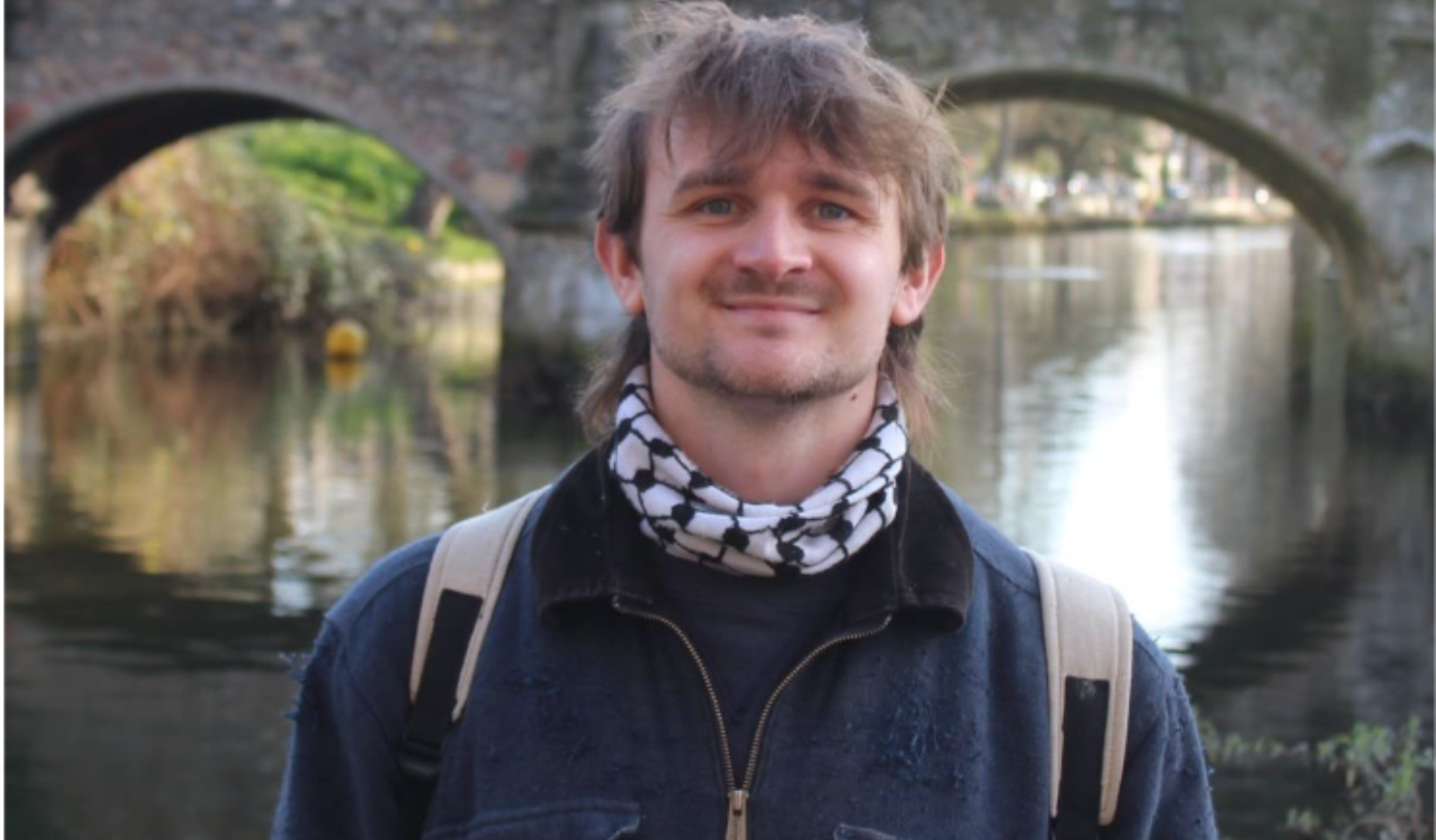
Image credit: Amjad Daher




Leave a Reply