
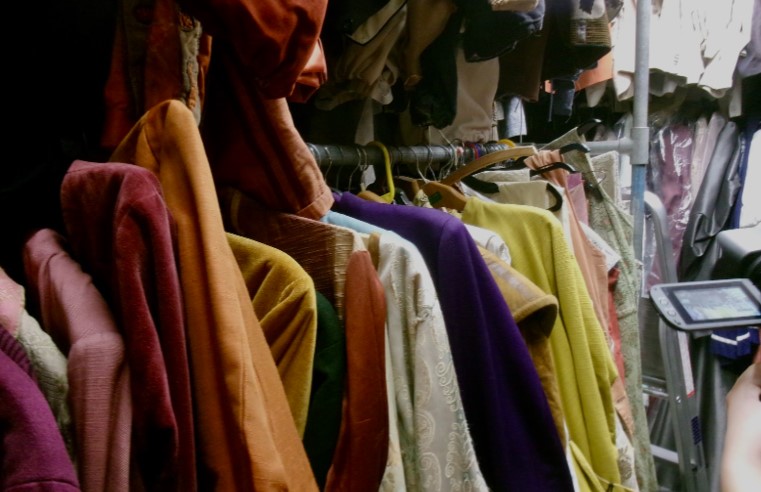
Wooden rafters creak against the outside wind. We’re up in the attic above Maddermarket Theatre, where decades of historical clothing donated by the Norwich community spans rails and vintage trunks, piles high in boxes and grocery crates. It’s an Aladdin’s Cave of costumes, the collection breathtaking in its variety as well as its sheer volume: there are cowgirl boots, clogs, strappy golden heels; ties, cravats, bowler hats; brooches, military pouches, endless swatches of vintage lace.
Amanda Greenway, Head of Costume, is unsheathing a 1930s wedding dress with a trailing train from a garment bag. It’s one of her favourite pieces from the archive. She points us to its embroidered lilies, the buttons up its back.
‘We did Merlin a few years ago,’ she relays, ‘And I really wanted to use this dress for the Lady of the Lake, but it didn’t fit the actor. So I based the costume entirely on this dress… We’ve got things here that we can’t use, but they’re really great to have for inspiration.’
Amanda’s work as a costume designer spans styling and sewing; both are supported by the expansive costume archive collected by the department over Maddermarket’s century of operation. Access to over 30,000 pieces, alongside a hoard of fabric and haberdashery, gives Amanda the freedom to marry fashion history with the expressive art of design: by mixing and matching from real people’s clothing, decades of handmade costumes, and whatever her team have the time and materials to create, she can outfit each character with personality as well as authenticity.
‘It’s rare that we’d do modern shows,’ says Amanda; when they are staged, she finds them particularly difficult. ‘With historical shows, you can use what I call costume shorthand. You get more of a sense of a character from what they’re wearing than you normally would.’ Part of Amanda’s job is to seamlessly convey era, class, personality, story – not just to suspend the audience’s disbelief, but to ground the actors in the dramatic world, too. ‘It’s important for the actors to feel like they’re wearing a costume.’ Wardrobe begins the acting process before the leads have even opened their mouths. Looking the part is an undersung facet of what brings a play to life.
‘We run on a really small budget. If there’s a character wearing Prada, we have to make Primark look like Prada.’ Maddermarket is a community theatre run largely by volunteers, so Amanda’s costuming process must be economical. Reusing and recycling from the archive is central, and dated costumes will often be unpicked and size-adjusted to fit modern measurements. Savvy styling, too, is a major component of “costume shorthand”. ‘Men’s fashion doesn’t really change as quickly as women’s fashion, so if you have a three piece suit, you can make it look like it’s from the 20s or the 70s or 80s, depending on how you style it.’
Downstairs in the main wardrobe workshop, we’re privileged with exploring more of the handmade costumes. The volume and variety here, as well as the intricacy of detail, is again astounding: we move from gilded and pearl-pricked Elizabethan finery to sharp military greatcoats to Gregor Samsa’s verminous antennae. The team are currently assembling eighteenth century gowns out of expressive hot-pinks and modern teals for The School for Scandal, racing to be ready for 11th November, when the play hits Maddermarket’s stage.
‘It’s good to be good with people. Actors come along for their fittings, and it’s quite a vulnerable experience.’ Amanda stresses that costume design is not at all a solitary job. ‘Runners, buyers, breakdown artists, dressers… [There’s more than] drawing a picture and recreating it.’ In fact, the costuming process is a testament to collaboration. The vision of the director is essential – some bring moodboards – and during the stages of construction, Amanda and her team of volunteers all work together on the many moving parts of each garment as they bring that vision to life.

Leave a Reply