
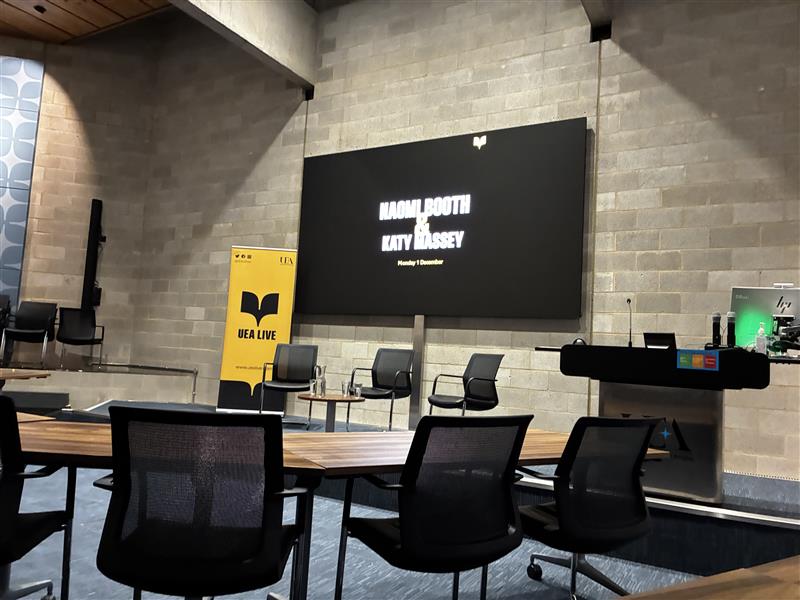
“The main problem is there’s not enough books set in Yorkshire” – Katy Massey
For the last UEA Live event of the season, novelists Naomi Booth and Katy Massey came together to discuss their newest novels, driving engaging conversations about motherhood, nature, crime, and… Yorkshire. Booth draws on her fascination with “weird landscapes” and how they can influence us in Raw Content. Following Grace, a new parent in rural Yorkshire, Booth explores how motherhood can upend one’s entire worldview. This involves dissolving Grace’s distance from threat in her legal profession, while being set against the shadow of the Yorkshire Ripper’s reign of terror.
Massey’s All Us Sinners is also concerned with the infamous Ripper and is set in a brothel in the backstreets and industrial shell of Leeds, a prime target for his crimes. Her novel follows Maureen, the owner of the brothel, who aids the police in investigating the murder of her worker’s son. Exploring community in the face of tragedy, the book is a journey comprised of both fear and self-discovery.
A Yorkshire setting was crucial for both Massey and Booth’s novels, allowing them to draw on childhood memories and cement their heritage as proud Northern women. For Booth, though, the rural Yorkshire landscape in Raw Content is a complex one. Her characters deeply love the place they are situated in, but this adoration is complicated by senses of threat, dereliction and neglect. A playground is full of broken glass. The street is covered in rubbish. Childhood play was not free but bound by the landscape’s threats. The book’s prologue brings these tensions to fruition as Booth’s language characterises the landscape as both beautiful and haunting.
Unlike Booth, Massey’s Yorkshire is an urban one. It’s “where characters are going out to be bad,” she says. Massey’s book is set during a period she couldn’t remember, so she drew on the memories of those around her, like her mother’s, to aid her writing. For authenticity, she also wanted to ensure faithfulness to the contemporary Yorkshire dialect. She recalls she had to fight for this in edits, as her publishers pushed back; they were unable, at times, to understand the dialect at all.
Later, Booth and Massey shared insights into the writing processes of their novels. Booth cited the descriptions of Grace’s baby in Raw Content, where it is described as a “lozenge of flesh.” This grotesque language, Booth notes, shows how parenthood isn’t all “pastels and fluffiness.” Subsequently, this reflects Grace’s shock at the physicality of her child, “it’s rawness, it’s scrappiness,” as well as her inability to comprehend the vulnerable nature of the infant body. A baby’s dependency and reliance goes against the definition of what makes us human, forcing Grace to view her baby as broken and thus confront her preconceived ideas about humanity.
Booth’s reading on environmental contamination, specifically on a study that found noxious chemicals in breast milk, shaped Grace’s conflict with environmental politics during her pregnancy. It is this fear of contamination that causes her postpartum intrusive thoughts, something that Booth said was hard to master during the writing process. To ensure maximum impact, she found a balance between the repetitiveness and terror of Grace’s thoughts so that the novel remained readable and not monotonous.
Similarly to Booth, Massey wanted to explore another side of women that people often don’t notice. All Us Sinners writes against the limited view of sex workers, giving them a voice and an identity. To do this, Massey drew on her mother, who was also a sex worker, and listened to her stories and those of her working girls. Reworking these real-life memories into her book, Massey replicates the strong community of women she was surrounded by, giving them agency. Particularly, Massey said that these women had a “peculiar sense of strength”, being able to wield agency precisely because people thought they could not. Though her novel does explore the sex workers as victims, Massey still “wanted to hear them speak,” upending the one-dimensional view society has about the profession.
Maureen herself is partly based on Massey’s mother. “She went against the grain,” Massey says, situating her mother as a fascinating character within her own right. But Maureen is also based on Massey herself, using her mixed-race identity to explore the politics of race within All Us Sinners. Maureen, then, is an amalgamation of the female experience, embodying the tensions at the heart of the novel.
The conversation then took a sharper turn into gender politics, placing the novels in discussion with female desire. One of Booth’s concerns in Raw Content was exploring how women are supposed to navigate their own lives and desires in the aftermath of the Ripper’s threat. She says female bodies are supposed to be a “safe landscape” – a mother, a nurturer. But she also acknowledges that she doesn’t know what a “safe body” looks like. Thus, in Raw Content, the female body and its desires mimic the novel’s derelict, threat-ridden landscape.
On this topic, Massey notes that Maureen, as a sex worker, is desensitised to her body and has no notion of it as a site of pleasure. She links this to the limited number of identities women get compared to men. Women are either “mother” or “prostitute,” whereas men, she says, “can be anything” and everything all at once.
Further seeking to unpack the role of crime in their novels, Booth and Massey turned to society’s obsession with the brutalisation of the female body in fiction and reality. Booth argues that our culture “has an attachment to the visceral” because “we are distanced from the fact that we are physical animals,” suggesting that true crime and horror are outlets for processing this discomfort. Massey adds that the appeal of crime fiction is partly caused by the fact that “no one reads the news anymore,” sealing us within our own bubble of ‘safe’ crime. She describes modern life as a “sanitised society;” everything is clean on the surface, but still people return to the unavoidable grit of crime fiction.
Booth and Massey’s talk is part of the UEA Live programme. To hear more engaging discussions like this first-hand, UEA Live will return in 2026 with new panels of writers and more events.
Student tickets cost £6, offering an accessible way to hear from writers right on your doorstep. To find out more, head to https://www.uealive.com. In the coming weeks, we will release an article covering UEA Live’s programme for next semester. We’d love for you to take a read!
Photo credit: Polly Dye


Leave a Reply