
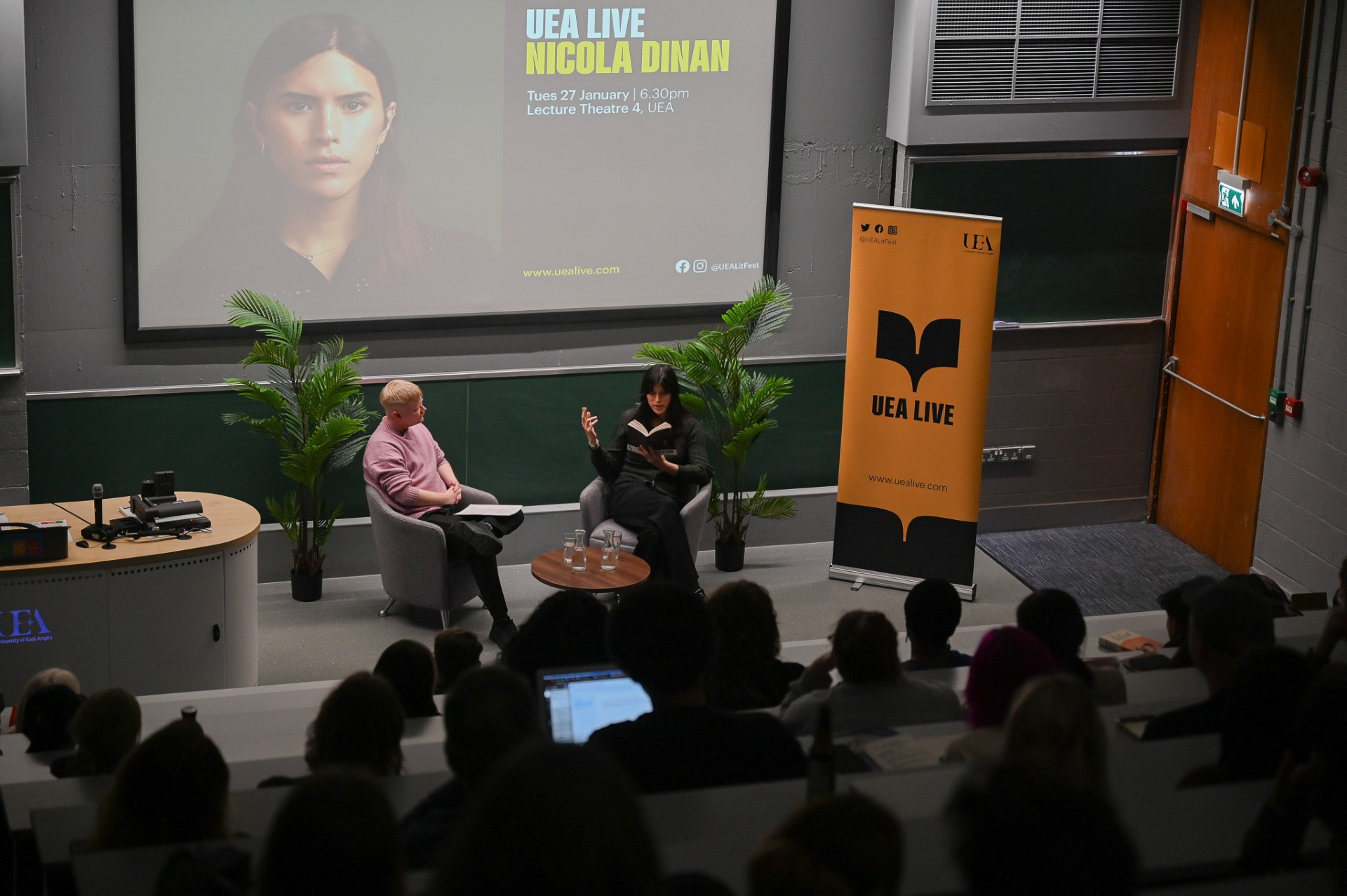
On 27th January, Nicola Dinan, author of the best-selling Bellies, came to talk to us about her new novel: Disappoint Me. Following Max, navigating dating as a transgender woman, and Vincent, a cisgender man, who is suffering his own identity issues, Dinan expertly explores the complexities of modern romance.
Dinan started by delving into her unique writing process. For Disappoint Me, she had three word documents on the go. One contained the present day, told through Max. This was the “genesis,” Dinan says. Disappoint Me was born out of Max, but Dinan felt that this point-of-view (POV) made Vincent fall flat. It didn’t allow her to explore him any deeper than how Max perceives him.
Hence, Vincent’s 2012 Thailand POV came into existence. This allowed Dinan to explore Vincent’s own complexities and troubles with identity. The final word document was what became the final draft – a mashing of these two POVs.
Next, she went into more detail about how she actually writes – how do these scenes come to her?
She says that she is a “vibes-based” writer. She isn’t one for strenuous planning; she finds this restrictive. Instead, she writes a scene when the idea comes to her. It isn’t chronological and she doesn’t always know what its relevance will be to the story, but she writes it and sees where it fits.
“There is joy in not knowing where things will go,” Dinan says. In fact, most of this drafting process is defined by her “not knowing.” She says that she can only really begin to grasp what her work is about, what it is really trying to say, after it is finished. She often has a feeling, perhaps a sense of extreme trepidation, at the start, but nothing concrete.
But why does Dinan write?
Just like Max, Dinan talks about how she is trying to “reconnect with creativity.” Dinan took a very roundabout way of becoming an author. First going to Cambridge to study Natural Sciences, to then taking a law conversion course and practising as a tax lawyer, Dinan only became an author at 27.
Writing her debut novel alongside her time in law, Dinan says that writing filled the void that her professional career had created. Writing was the only thing that she liked beyond the idea – she liked the thought of lab coats and law, but not the actuality. With writing, this was different. The process made her excited, just as much as the end result.
“I love to write,” she says, “so writing is easy.”
Dramatically, Dinan quit her job when she finished her first draft of Bellies. This was a testament to her confidence in her work, as well as her ability to recognise what works for her and what doesn’t. Dinan, then, set about looking for a place to publish her debut.
“I wouldn’t recommend this path,” she says. “I’m shocked at my past self-belief. I wouldn’t have that kind of confidence now.”

Dinan also talked about how she can’t understand when authors say writing is a slog – if you love it, how can you find it so laborious?
This isn’t to say that she always finds writing joy-inducing. With the success of her debut Bellies, one might be tempted to assume it was only happiness she felt at the time of publication.
However, Dinan dispelled this myth. She said it was the most stressful time of her life, where she felt extremely low. This isn’t to say that Bellies didn’t cause her immense happiness too, but it proves that writing doesn’t always have to cause one feeling. Success isn’t hand-in-hand with happiness, it is part of a larger emotional storm.
Writing, for her, is partly about figuring out her own problems and questions, which is why she says many of her characters share a likeness to her in some way. Namely, when she was turning thirty as a woman, there were suddenly lots of expectations placed upon her that she didn’t have in her 20s.
Part of writing Bellies and Disappoint Me was to try and figure these questions out and see where she fits into them. But also, her writing doesn’t intend to answer these questions clear-cut: it is mediation.
“There is contentment in the not knowing,” she says. While at times she feels like “a dog chasing its own tail,” rumination is what she enjoys, rather than concrete answers.
As a transgender author, Dinan was inevitably asked questions about how she approaches representing and writing transgender characters. She says there is no point “coddling transgender characters” as it is redundant. They shouldn’t have to be perfect to protect how the transgender community is viewed.
Instead, she says that they should be written with integrity and true to something within the writer, as well as in the community. A writer is never going to be able to write every transgender person’s experience, but what they can do is a really good job of writing about one person’s journey. This will hopefully resonate with readers, especially transgender ones.
Dinan’s talk is part of a series held by UEA Live. In February, talks include Sanam Mahloudji speaking about her novel The Persians on Monday 9th and Francis Spufford talking about Nonesuch, a literary fantasy, on Tuesday 24th. In March, Tash Aw, a Malaysian writer, speaks about his novel The South on Tuesday 10th and Yann Martel, author of the renowned Life of Pi, is talking about his new book Son of Nobody, where the lives of Troy are brought into the walls of contemporary Oxford, on Friday 27th. To wrap up, Celine Pin will be talking about her novel Celestial Lights, following the journey of an astronaut embarking on a ten-year mission, on Tuesday 21st April.
Student tickets are £6, and the events are a great chance to see authors right on your doorstep! To book, go to https://www.uealive.com/
Image Credit: Abigail Sexton and UEA Live team



Leave a Reply