
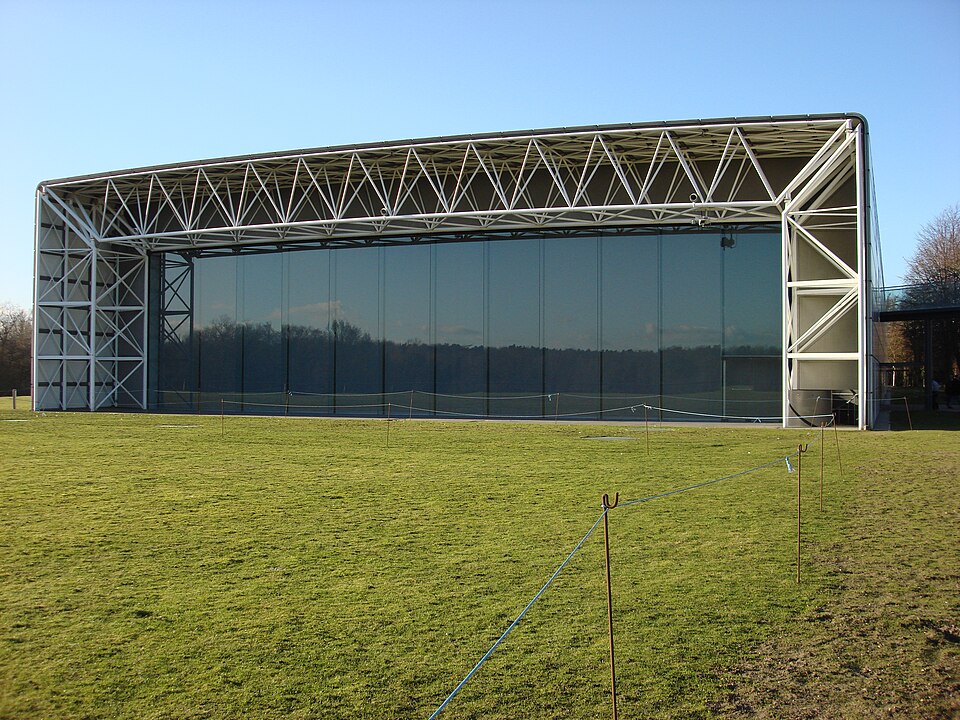
Ebi Fegha’s time at UEA began when, after having completed a bachelor’s degree in English and communications back home in Nigeria, she moved to Norwich for a master’s degree in international development.
“I’d worked in marketing across different industries,” she says. “Fashion, real estate, healthcare… At my core, what I was interested in was media development.”
Ebi’s interest in media and marketing is what first pushed her to apply for a position at the Sainsbury Centre for the Visual Arts, where she currently works in marketing and communications.
“I’ve always been interested in the arts from a personal point of view, but not from a professional one. There was always the notion that you had to be a certain way to work in the arts, you had to be very knowledgeable, basically a specialist.
“Because of that, prior to landing my role, I never would’ve envisaged that I would be working in the arts.”
Even though she was not an art specialist herself, Ebi describes herself as a “museum gallery buff.”
“I’ve always loved art, and I think art expresses itself in different ways. One of my favourite things to do is wear colourful prints. I love art in the form of fashion. I love things that are really colourful and vibrant because I’m Nigerian and a lot of the work that we, well, a lot of the works I grew up seeing at works I grew up seeing are very vibrant, very colourful and things like that.”
As Ebi quickly learned, the Sainsbury Centre team is made up of a myriad of backgrounds, both artistic and non-artistic alike, and she was quick to adapt to the industry, where she has now been working since 2023.
“I think the Sainsbury Centre is fabulous. It’s a fabulous building, it’s a fabulous collection, the fabulous space, but the people make a difference. The culture here is really, really lovely. The work culture is really lovely.
“We’re all a very collaborative, creative bunch, and that makes it joyous to come to work. It’s a safe space; no idea is off the table.
“There are people with an art history background, and there are people like me, from a different academic background. The people there are from all different walks of life, and I think that is very important for the museums of today, because we’re not only creating for people with art backgrounds.
“The people who come in every day are not just art specialists; they love art for art’s sake. They love to engage with it, they love to be in this space, they just love beauty and creativity.”
One of the Sainsbury Centre’s core values is its dedication to making art accessible for the average enjoyer, and Ebi credits these values for having changed her perception of museums overall.
“[The Centre believes] there is no right or wrong way to behave in a museum. You don’t have to just pose and look up. We believe that art is for everyone. We’re trying to break down the barriers that people have with going to museums. We believe that people should form a connection with us. They should engage with us in their own way.
“And some of the ways in which we’ve done that is to encourage people to hug the Henry Moore sculpture, you know, step into the glass box and become work, lie under the Giacometti and tell it your secrets… These experiences are very different, they’re not what you’d expect from a museum.
“And I guess what’s different for me now [after working at the Sainsbury Centre] is that, when I travel and go to other museums, I’m more appreciative of what goes on behind the scenes. And since I work in marketing, I’m always like eager to see what other people are doing, in other museums.”
Having lived away from Nigeria since doing her master’s, Ebi notes finding traces of home in art galleries, even when she is not looking for it.
“I don’t go around searching for Nigerian art, but since I work in the arts, I get exposed to so much different work. One of my favourite pieces in our collection is Yinka Shonibare’s mask, it’s very colourful and vibrant. I love it so much, it’s so energetic. It’s just a mask, but it’s made with an African print that I find really, really beautiful.
“Things like that catch my eye because that’s my lived experience. That’s what I grew up seeing. I’m not restricted to African art, I love all art forms, but based on my background, I’ll have an affinity for it.
“It feels like when you’re on holiday, and you eat something that tastes like your mum cooked it. That’s the only way I can explain it, it just feels so familiar. I see art that isn’t African or Nigerian and still resonate with them, but the only difference is that sense of familiarity.”
As a closing question, I ask Ebi about the importance of art and museums in today’s age, when the arts grow increasingly undervalued by the government.
“Museums have to evolve and understand what’s happening today,” she replies. “We [at the Sainsbury Centre] are very aware that the world as we know it is changing. As a museum, we’re constantly reinventing what it means to be a museum in the 21st century. In 2023, we shifted our approach to programming from artist-led exhibitions to doing exhibitions that respond to fundamental societal challenges.
“The big ones explore what are the biggest questions people have in their lives, and we use arts to explore these. We get [the questions] directly from our audiences, so it’s very topical, it’s very now, it’s very much about what’s going on in the world today.
“I think that the museum can be a space to have those conversations, you know, not to answer, but to explore the questions through art, because art is a reflection of the experiences of the artist. We’ve been looking at what’s happening in the world, with questions like ‘Can we stop killing each other?’ or our next exhibition, in May, on the meaning of life.
“Museums are typically known for the past—ancient things—not really reflecting what’s happening. And so, with what we’ve done, we’re challenging museums as we know it.”
In the age of AI, Ebi highlights people’s craving for authenticity and how museums contribute to this human-ness.
“People just want to escape the AI world. You get that authentic experience in the museum; genuine human connection that technology cannot replace.
“You can put your phone away in the museum and have a fantastic time. We typically get a lot of people who want that, they want that in-person experience, a space where they can come in and have a workshop, they want to paint something away from their screens, away from their phones. We get a lot of parents who come to our mini studio sessions who just want to do something with their kids, make something with their hands…
“I think museums play a very critical role, but they have to evolve and get with the programme. I feel very lucky to be doing what we [at the Sainsbury Centre] are doing now.”
Visit the Sainsbury Centre Tuesdays – Fridays



Leave a Reply