
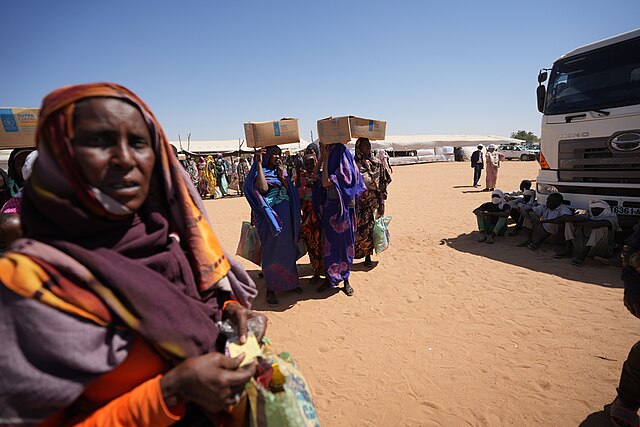
Sudan has initiated legal action against the United Arab Emirates at the International Court of Justice (ICJ), accusing the Gulf state of abetting genocide in Sudan’s war-torn Darfur region. In a formal case filed in The Hague. Sudan alleges that the UAE has been arming and funding the Rapid Support Forces (RSF), a paramilitary group battling Sudan’s national army, and in doing so has violated the 1948 Genocide Convention.
The complaint centres on atrocities committed in West Darfur, where the RSF and allied Arab militias stand accused of targeting the Masalit, an African ethnic minority, in what Sudan’s government calls a campaign of genocide. According to evidence cited by Sudan, RSF fighters carried out “gruesome violations, including killings, torture and even the rape of women,” often documenting these crimes themselves on video.
By allegedly supplying weapons and financial support to the RSF during this period, Sudan argues, the UAE directly enabled the perpetration of genocidal acts. In its ICJ application, Sudan asserts that Abu Dhabi’s material support was indispensable to the RSF’s brutal campaign and that the UAE therefore breached its obligation under the Genocide Convention to prevent and punish genocide. The United Arab Emirates has forcefully rejected Sudan’s accusations, dismissing the ICJ case as baseless and politically motivated. An Emirati official, speaking on behalf of the government, characterised Sudan’s lawsuit as “nothing more than a cynical publicity stunt” aimed at diverting attention from atrocities committed by Sudan’s army itself
The conflict between the RSF (led by Mohamed Hamdan “Hemedti” Dagalo) and Sudan’s regular army (led by General Abdel Fattah al-Burhan) – erupted in April 2023 and has since engulfed multiple regions, causing mass civilian suffering. According to United Nations estimates, more than 24,000 people have been killed in the fighting to date. The violence has driven an estimated 14 million Sudanese from their homes, roughly 30% of the country’s population, in what has rapidly become one of the world’s largest displacement crises. Human rights monitors warn that ongoing ethnic violence in West Darfur could spiral into full-fledged genocide if no protective action is taken. The Masalit minority, in particular, has been “hunted down” in and around the city of El Geneina, which was virtually obliterated by RSF-allied fighters in mid-2023.
By bringing its grievance to the ICJ, Sudan is leveraging one of the few legal avenues available to hold another state accountable for genocide. The case – Sudan v. United Arab Emirates – invokes the Genocide Convention, to which both countries are parties, as the basis for the Court’s jurisdiction. Sudan’s petition asks the ICJ to declare that the UAE has breached its obligation to prevent genocide and to order “provisional measures”, essentially emergency injunctions, to stop any further support that could facilitate genocidal acts. Such provisional measures, if granted, could come within weeks or months, given the urgency of alleged ongoing atrocities. They would be legally binding and put Abu Dhabi under international pressure to comply. However, the road to a final judgment will likely be long and arduous. Cases at the ICJ typically take years to reach a conclusion, especially when they involve complex questions of state responsibility and genocide – as seen in a similar genocide case Gambia brought against Myanmar that has dragged on since 2019. Even if the Court ultimately rules in Sudan’s favour, enforcement of any judgment would rely on diplomatic pressure, as the ICJ has no direct means to compel state action.
That said, the filing of this case is significant in its own right. It marks the first time a government has been hauled before the ICJ over the Darfur carnage, and it turns a spotlight on the alleged role of foreign actors in Sudan’s conflict. The outcome could establish an important precedent on whether states can be held liable for indirectly fueling genocidal violence in another country. In the immediate term, the proceedings keep international attention on Sudan’s humanitarian crisis. Legally, the ICJ’s rulings are binding on the parties by the UN Charter, so a judgment against the UAE (even years from now) would carry substantial moral and political weight.
Ultimately, Sudan’s move highlights the gravity of the Darfur situation. Whether the ICJ can meaningfully address a crisis unfolding amid an active war is uncertain. Nonetheless, the legal proceedings will document atrocities and could prod the involved parties toward restraint. In the best case, the mere threat of an ICJ order might discourage any external support that enables mass violence. In the worst case, if fighting and massacres continue unabated, the ICJ’s eventual judgment will stand as an authoritative record that genocide was attempted and that those who aided it – directly or indirectly – were called to account. For the millions of Sudanese civilians whose lives hang in the balance, that is at least a step toward justice, however delayed.
Photo Credit: Wikimedia Commons





Leave a Reply