
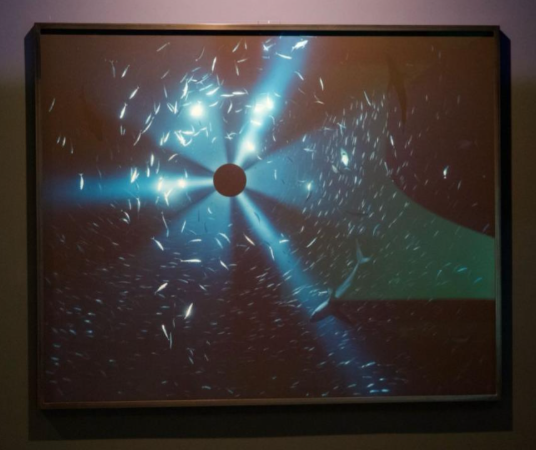
Can the Sea Survive Us? A Dive into the Depths of Crisis and Connection is the Sainsbury Centre’s latest exhibition.
Changing visitors like the reshaping of the shoreline, the Sainsbury Centre’s new exhibition, Can the Sea Survive Us, offers a compelling exploration into humanity’s complex relationship with the ocean. Rather than offering easy hope or didactic answers, Can the Sea Survive Us opens up the space between grief and action using art not just as pure spectatcle but also as a tool for ecological imagination.
Following you out of the gallery, the title lingers not as a rhetorical flourish but as a challenge, perhaps becoming the most impactful aspect of the exhibition as it focuses on a “collective action for change” as Kate Dunton expressed. Presented through a trio of thought-provoking galleries running until October 26th, these exhibitions bring together works from British and international artists over the years, offering unique perspectives on evolving marine ecosystems and oceanic habitats. The first exhibition, World of Water, begins as a sensory encounter with sound, illustrating the shifting relationship between human and marine environments. From ancient atlases to 17th century Dutch maps and local contemporary landscapes, the exhibition is overflowing with an aesthetic awe that is underlined with a quiet warning through the evident changing of the sea through the years, as the beach becomes “our frontline”(Kate Dunton). Huge canvasses of wild rolling waves effectively juxtaposed the dry images of a world without water, presenting a warning of environmental degradation caused by our own hands. However, by not acknowledging the impact of our actions on the world we live in and is a part of, the exhibition highlights how important it is to adapt to rising tides. Jan Eric Visser’s sculptures featured in the ‘Mud Plume’ section exemplifies Visser’s commitment in transforming waste into thought-provoking art, highlighting the pervasive issue of plastic pollution in our oceans, with his work created out of plastics collected from waterways.
As the exhibition brings out once unknown and distant future issues to the present reality, John Kenneth Paranad, curator of Art and Climate Change at the Sainsbury Centre, expressed that “what makes this exhibition urgent is its innovative and pioneering curatorial approach — one that amplifies lived experiences of climate realities, not as a distant future but as a crisis already unfolding.” One of many integral pieces in the exhibition is Dutch artist Boris Maas’ “The Urge to Sit Dry.” This provocative piece features an ordinary oak chair elevated on tall legs composed of stacked wooden blocks, symbolising the anticipated rise of sea levels in the Netherlands by the year 2100. The design evokes a sense of urgency, prompting viewers to reflect on the environmental challenges posed by climate change. A twin of this sculpture is displayed in the office of the Dutch environment minister in The Hague, serving as a constant reminder of the real and immediate threat posed by rising sea levels. However, what undersets this piece as a whole is the sense of fragility and unbalance. You can’t help but wonder what would happen if the chair was ever so slightly pushed. Would the whole thing come tumbling down on our heads much like the current climate of the world? As we all seem focused on the building up of our own chairs to race the rising water, we seem to have lost sight of the reason of this rising tide and therefore the need not to just adapt to environmental results of our action but to fix and prevent further destruction from occurring.
Flowing through the dark blues and purples of the ‘A World of Water,’ through the ‘hanging gallery lane you will find yourselves in the colourful inviting exuberances of the second exhibition: Darwin in Paradise Camp. Perhaps the most confrontational section of the exhibitions, Yuki Kihara’s installations and rendering of Paul Gauguin’s Polynesian portraits, subverts the colonial gaze to a new and beautifully impactful extent. As a critique of the manipulated and tailored erotism, gender boundaries and the impact of the West on island ecologies, ‘Darwin Drag’ theatrically inhabits Charles Darwin himself, putting the old dusty theory into a new, bubbly life as she confronts and interrogates the scientific observations of the Victorian era and how thy have shaped and continued to shape racial and gender hierarchies. Here the sea is not just a site of ecological collapse but a cultural and social space for an evolutionary thought and action to emerge form.
What’s more, still to come this June is the third and final exhibition: Sea Inside. The final section promises a more intimate turn, exploring the internal and subconscious connections we hold with the ocean. Living in dreams, myths and bodies, artist like Shuviani Ashioona and Hirosho Sugimoto take a physical look into the ecological crisis we are presently facing today through a personal meditation.
In contrast, the structure titled ‘The Space of Dialogue’ emerges as one of the most integral and defining elements of the exhibition. Following the quiet, often intimate progression through the preceding works, this space invites open conversation and reflection, transforming the viewer’s experience from solitary contemplation to collective engagement. By forming a circular arrangement of tiered seating, ‘The Space of Dialogue’ establishes a setting in which all participants are positioned on an equal plane—symbolically distributing both the shared responsibility for environmental degradation and the collective potential for meaningful discourse and “trusting the power of your own voice,” as Dunton puts it.
In conclusion, the Sainsbury Centre’s latest exhibition: Can the Sea Survive Us, which is free for all students, takes us on a deep dive through the traumatic and beautiful ocean which we share this planet with. This is surly an unmissable exhibition to see this this summer which emphases deep refection and leaves the visitors rolling with the waves. While this exhibition emphasises the adaptive measures we must undertake to cope with the environmental consequences of our actions, perhaps the focus should instead shift toward prevention — halting further destruction and mitigating the escalating threats, rather than merely learning to live within them. After all, humanity is an intrinsic part of the natural world; what affects the environment ultimately affects us. Therefore, urgent and decisive action is imperative.
Photo Credit: Thomas Lewis



Leave a Reply