
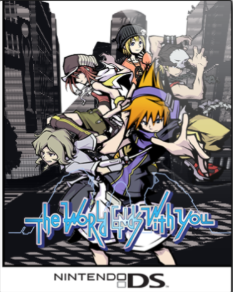
In the summer of 2012, I was playing the brand-new Kingdom Hearts game for the 3DS. The first world, Traverse Town, featured characters that I assumed were from Final Fantasy. I soon discovered that they were from a different series entirely, one called The World Ends With You (TWEWY). Curiosity got the better of me, and I started researching this game I had never heard of, not knowing just how important and influential it would become to me.
What initially drew me to TWEWY was its 00s urban vibes and its unique Tetsuya Nomura art style with jagged splashes of greys and blacks and imagery reminiscent of graffiti. Once I started playing, I realised just how special it was. It felt completely new, and completely unsanitised. The characters did not filter their dialogue; they swore and had conflict with each other. It was raw and edgy. It was a glimpse into an exciting, more mature world.
The game follows Neku, an antisocial teenager, who is thrust into the Reaper’s Game and forced to fight against the monstrous Noise and the humanoid Reapers for his right to existence. Over the course of the game, he must learn to open himself up to other people to survive. Neku is the perfect protagonist to tell this story. Two core tenants of his early character are resisting change and an intense dislike of other people. Through having to both mechanically and narratively build relationships, both he and the player come to appreciate the importance of trusting other people and that your world is only as small as you make it. Through interacting and clashing with other people, Neku experiences real character growth and he ends up as a completely different character by the end of the game.
TWEWY is the best example of narrative and mechanical harmony I can think of. Every facet of the DS console is pushed to its limit. Combat takes place over both screens as you control Neku with the touch screen and his partner with the directional pad at the same time, which ties into the story’s themes of connecting with other people. Attacks can involve slashing, tapping, and drawing shapes with the stylus, and even blowing into the microphone to create noise. One fight requires the player to close the DS itself. The game also features Mingle mode, a sort of precursor to Nintendo’s Streetpass service. Here, you could connect with other players and DS users you would pass in the real world with the intention of gaining in-game experience.
The game is very much a modern RPG. It takes place entirely in the geographically accurate city of Shibuya Tokyo, populated by a diverse range of people (whose thoughts can be read at any time with the tap of a button). Armour is replaced by clothing, with each piece belonging to its own unique fashion brand that is trending in the city. These brands have their own rankings in different districts that influence their effectiveness, and repping a brand in a fight will make it move up the charts, thus making you stronger. The billboards in the backgrounds of the overworld and combat encounters will also change to advertise whatever is number one at the time.
The soundtrack covers every genre you could conceivably think of. J-pop, rock, metal, hip-hop, thrash, dance and trance all come together to create the sound of Shibuya. The range of genres never clash with each other; rather it feels like flipping between radio stations, making the city feel alive and populated by people who all have different tastes. One minute you’ll be roaming the city listening to pop, and then a battle will start, and you’ll be hearing trance or rock.
As a major theme of the game is embracing a melting pot of diverse ideas, it makes sense that TWEWY draws inspirations from many different styles and cultures just like a real city would. Social media was in its infancy when the game was released (although impressively the mobile device remaster Solo Remix featured Twitter integration, allowing real tweets to show up as scannable thoughts). Today the clashing of ideals is stronger than ever, to the point where the constant bombardment of influencing and messaging through our devices can feel overwhelming, making it feel harder to grasp onto a solid identity. But TWEWY posits that if we can filter out the noise and learn to meaningfully clash and change, we can all end up the better for it. We can become more connected to each other and the world, whilst still retaining our individuality.
TWEWY is truly a once in a generation game. I do not believe that there will ever be another game that manages to take full advantage of its hardware in quite the same way, mainly because console development now focuses on power rather than innovation. For 14 years it was a joke in the community that we would never get a sequel – I used to dream about a sequel as a kid. But a trailer in 2020 broke the drought, and in 2021 NEO: The World Ends With You (NEO) was released.
NEO is a great game, and one that feels like a worthy successor to the original. The art style that drew me to the first game is unchanged, the soundtrack is just as varied and the world feels just as alive as, whilst the newly added features like the social network and the fully 3D environment complement the game well. It lacks the same level of character growth and individuality as the original, but for a sequel that seemed impossible (and one that was only really made because of Tetsuya Nomura’s personal passion for it), it’s more than enough. What it doesn’t try to do is half-heartedly copy the original, instead opting for a completely different battle system and (mostly) new characters whose flaws and insecurities stem from the modern world (such as NEO’s main character Rindo not rejecting others as Neku initially did, instead struggling to be decisive and project his voice in a world where everyone is trying to do the same). It feels like a sequel that expands upon ideas that the original raised rather than a straight-up rehash, and it’s clear that it wasn’t just made to cash in on nostalgia.
Ultimately, TWEWY as a series is a reminder about opening yourself up to the world and discovering your individuality in the process. It’s a reminder that life is what you make of it, and that the world really does begin, and end, with you.
Photo Credit: DeviantArt



Leave a Reply