
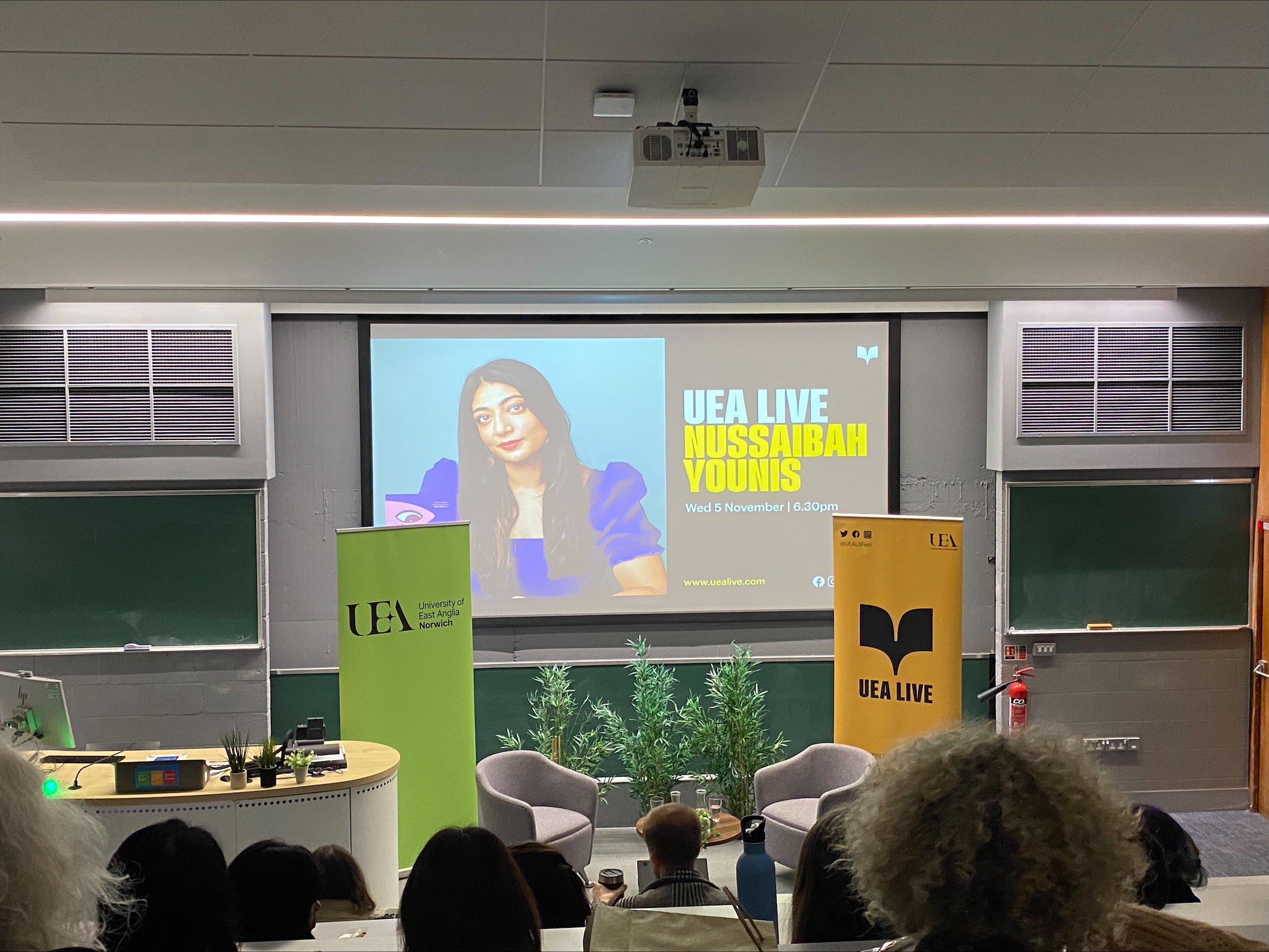
Nussaibah Younis, writer, academic and former humanitarian worker, visited the University of East Anglia to discuss her debut novel, Fundamentally. The novel, soaked in satire that leaves no party unscathed, made for a refreshingly honest read.
Younis detailed how the novel was, in part, a reflection on her time working in international relations. She discussed the realities of those attracted to humanitarian work, with many going into it to be seen as heroic.
She expressed her disbelief at people’s ability to treat working in the United Nations as a day job, especially when the stakes are so high, and shed light on this by illustrating the reality of international relations work: living on a compound.
For Younis specifically, this was in Baghdad, Iraq. Compound life entailed an intensity that was, perhaps, unexpected. It blurred professional and social time, having people work together in the day and then mingle at night.
Younis spoke of how this often led to unexpected behaviour, with people unable to distinguish between the professional and causal.
Much of the conversation centred around the relationship between Nadia, the book’s protagonist, and Sara, an ISIS bride, and their very stark differences but also surplus similarities.
Younis found it important to demonstrate that while it can seem that there are two clear sides, especially in the instance of a deradicalisation programme, this isn’t always the case.
Nadia and Sara form a friendship that develops across the novel, which asks questions about how far you will go to break the rules for people you care about.
Becoming invested in someone impacts the objectivity that is essential to humanitarian work.
This toeing of lines is also seen in this ability to be both victim and perpetrator, with Younis once again getting us to question the clear-cut ideas we might have about who, and what, is right and wrong.
Younis wants Fundamentally to provide a different presentation of ISIS brides, one that is contrary to what is seen in the media. She wants to dispel the image of them being monstrous and bloodthirsty, or silent, and show that they can be outspoken and caring just like anyone else.
She spoke about the purpose of her novel, saying that she initially set out for it to be a funny and accessible book, but was surprised by the amount of sadness that came through.
This fed into her journey with politics and international relations, even though she is not working explicitly with it anymore. She said it was important to focus on public opinion, by having people read her novel and doing talks to encourage those unfamiliar with the topic to engage with it empathetically.
She stated that “we shouldn’t try to change people’s beliefs, that isn’t the answer.” Instead, she said we should provide them with community, as it will be far more successful at getting people to engage and learn.
Younis’ talk is part of a series held by UEA Live. Other talks include Joelle Taylor and James McDermott on Wednesday 26th November for a poetry special, and Naomi Booth and Katy Massey on Monday 1st December, discussing themes of motherhood, violence and… Yorkshire.
Student tickets are £6, and the events are a great chance to see authors and poets right on your doorstep!
To book, go to https://www.uealive.com/
Image Credit: Lilia Colledge



Leave a Reply