
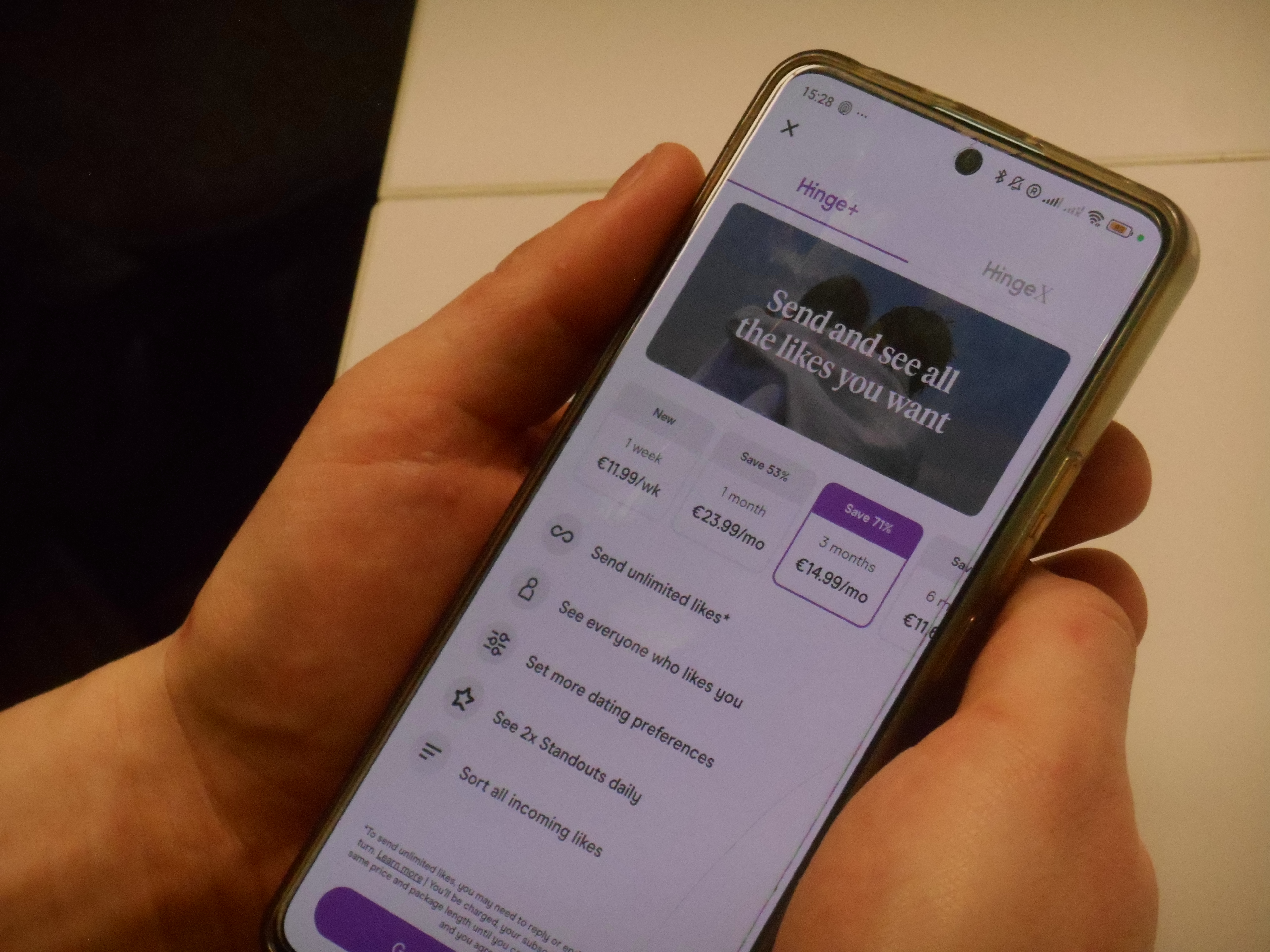
At first glance, dating apps appear to be a cheat code for the dating game. By immediately being presented with potential dates’ looks, interests, and intentions, you bypass initial questions of attraction and compatibility, which should, theoretically, bring you to your perfect match.
However, all of Hinge’s features, with its polls, voice notes, videos, and other prompts, have created another game out of dating entirely, one that seems impossible to win.
Your dating app profile has never been about showing the real you, but rather about presenting the best, most interesting or exciting version of yourself, to attract likes or swipes. Recently, though, Hinge profiles have become a stage for bits and performances, as if competing for who can come up with the most creative punchline, rather than truly showing who you are.
This may be (at least partly) due to Gen Z’s apparent inability to be earnest or sincere. Having come of age in the heyday of ‘cringe culture,’ with every move at risk of being mocked or criticized, it is no surprise that many young adults fear putting themselves out there when social media has created a virtual panopticon.
Entire TikTok accounts are dedicated to rating Hinge profiles, leaking weird or uninspired replies, or judging people based on the photos they choose, with many of their videos reaching tens (if not hundreds) of thousands of likes.
Though internet humiliation might be a worse-case scenario, users, particularly those in university, have a major risk being seen by a classmate or a friend, which feels just as embarrassing. Thus, instead of throwing their ‘best selves’ to the wolves and risking being seen at their most vulnerable (i.e. admitting that they might be a person desiring sex or romance), they hide behind wittyjokes, pop culture references, and memes in lieu of profile images.
Sure, many complain about how repetitive prompt answers have become, as if there is a designated number of interests deemed ‘socially acceptable,’ but is yet another “My typical Sunday: F1” not more honest than “Together we could: do the ganzfeld experiment” and “my simple pleasures: bleep bloop” (both of which being real replies that I have come across.) At least, in the former’s case, you learn one thing about them.
To take it one step further, videos of people projecting Hinge profiles on their TV at parties or talking about their friends “taking over” their accounts for the night contribute to the blatant dehumanisation of those on the other side of the screen. This dehumanisation gives people the confidence to talk about their likes or matches as if they were simply video game NPCs, with many taking to social media to complain that they keep getting likes from ‘ugly’ people, going so far as to act insulted by Hinge’s algorithm.
Every dating app has its own audience and reputation. Grindr is the app for gay sex, Feeld is for kink and nonmonogamy, Tinder is for straight hookups, but where does that leave Hinge?
With Fortune stating that over three-quarters of Gen Z feel burnt out using dating apps and Novuna finding that two-thirds of them use apps merely out of boredom, it is safe to say that most Hinge users of this demographic are not there to find the One. Instead, they are there for the thrill of the chase, a noncommittal way of achieving validation, not only for their looks, but for as much of a personality as they are willing to display.
You see someone you like, you swipe, you engage in a flirty conversation, you ghost (or get ghosted), and you move on. If you’re not going to find love, you might as well present yourself as the funniest person in the room.
Image credit: Micah Petyt





Leave a Reply