
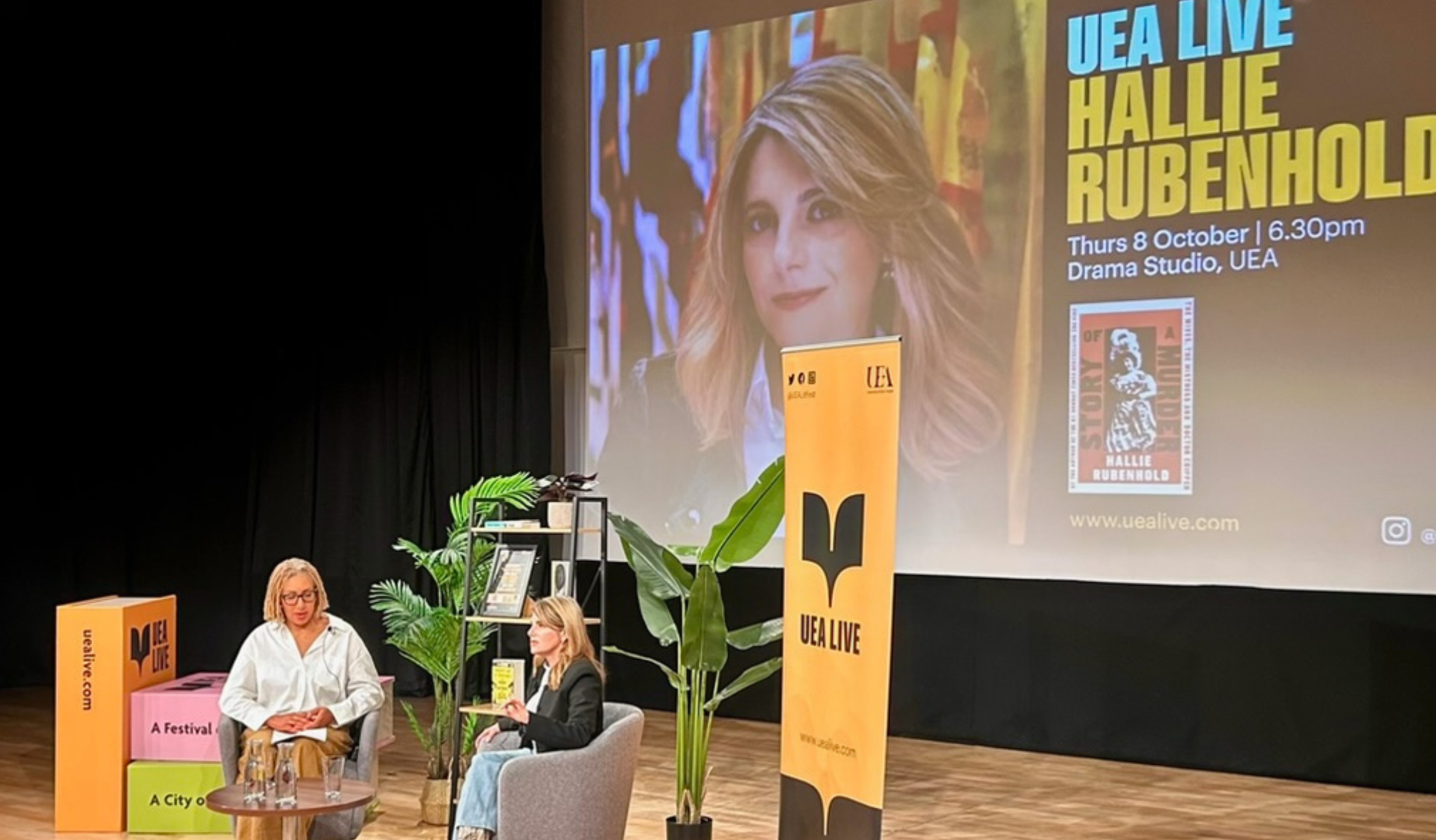
Hallie Rubenhold detailed how ‘we get this sameness of history, like bedtime stories, again and again; we fixate on certain times and monarchs’, but Rubenhold kept asking herself the same question: ‘What about everyone else?’
The UEA literary festival, UEA Live, continued last week with social historian and best-selling author Hallie Rubenhold. Hallie is known for challenging the traditional true-crime narrative by shifting the focus to victims, particularly women who would otherwise go unheard.
Dr Claire Hynes, Associate Professor in Creative Writing at UEA, chaired the event on Thursday October 9 in the UEA Drama Studio.
Rubenhold’s latest novel, The Story of a Murder: The Wives, The Mistress and Dr Crippen, re-examines the notorious case of Dr Hawley Crippen, who killed his wife before fleeing the country with his mistress, Ethel. She reclaims the narrative for Belle Elmore, Crippen’s often-maligned victim whose story has long been overlooked.

This isn’t her first best-seller either. Hallie received widespread acclaim in 2019 with her book The Five, unveiling the lives of Jack the Ripper’s victims. The Covent Garden Ladies inspired the three-season TV series Harlots (2017-19), and The Scandalous Lady W was dramatised by the BBC into a film starring Natalie Dormer in 2015.
This event was a full-circle moment for Hallie, having spent a year at UEA as an exchange student in 1991/92 studying both history and creative writing. In fact, she detailed how it was actually at UEA that she was introduced to social history and before that, she ‘didn’t know a type of history like that existed’.
She immediately knew it was something she could do and wanted to do. It’s a type of history that looks at the lived experience of the past, much like the life of Belle Elmore. Rubenhold told us that she ‘had to pull her out of this ridiculous mythological telling of being this ‘monstrous Belle’; she was never that’.
She explained that society at that time called any woman who didn’t adhere to the norms a prostitute and that Elmore’s character was completely tarnished, quite deliberately because it suited the era.
She expressed her disdain for stories about women that only contribute to the ‘campfire tellings’ and topically brought up Ryan Murphy’s new ‘Monster’ Netflix series, The Lizzie Borden Story. Rubenhold said we still don’t learn who the real Lizzie was and ‘[Murphy’s] done what everyone else has done, which is wrapped it, even re-wrapped it in misogyny’.
Rubenhold shared that similarly, many people who have previously told the Dr Crippen case have utilised Belle as the villain.
Much like Alexander Bell Filson Young in 1920, who treated the Crippen case as a love story. He framed Crippen and his mistress Ethel as star-crossed lovers, but he needed an obstacle, a monster. ‘That monster was Belle Elmore, so he turned her into this aberration of womanhood – and that stuck’.
‘What strikes me is that you’re a bit of a rebel, Hallie’. – Dr Claire Hynes
Rubenhold is rewriting history, serving as a mouthpiece for so many victims who have been denied justice; she fills gaps that many other historians won’t, constantly digging for the truth. Hallie detailed why she was impassioned to write these stories. She expressed that ‘history is told from the top down’ and that the lives of ordinary people are just as interesting as those of leaders and monarchs.
While she was at university, she often sat in classes about kings and queens and wondered what everyone else was doing at that time, and who was going to tell their stories? She described it as ‘an itch’ that she had to keep scratching.
Ironically, Rubenhold has publicly vocalised her dismay for the true crime genre, even though this newest book won her a Clue Award for True Crime Book of the Year. She acknowledged the humour in that but said the book is first and foremost an historical novel that also happens to fit into the true crime genre.
She often sees the true crime genre as being ‘entangled with prejudices of the era’ and noted that people often only like it because it’s a sensationalist story. Rubenhold articulately phrased that the traditional true crime narrative is ‘frozen in aspic; it’s a time capsule of ideology and beliefs from another period’; she specialises in peeling away those layers in order to get to the truth.
The talk finished with Hallie detailing some parts of her process when writing a novel. ‘It’s usually about a year of intense research, then a year of intense writing’, and little bits of research are often going on throughout the entire process as new questions emerge.
Rubenhold admitted that it’s hard work and sometimes frustrating when you can’t find the information that you want, declaring that it’s often heartbreaking and sometimes haunting. She even confessed that she often has nightmares, but sees it as completely worth it.
And with that, I’ll leave you with what she left us:
‘It’s an amazing thing to reach into the darkness and pull out a human being who lived hundreds of years ago and pull them to the light and say you’re alive again because people know who you are!’ – Hallie Rubenhold.
Photo credits: Megan Kempster




Leave a Reply