
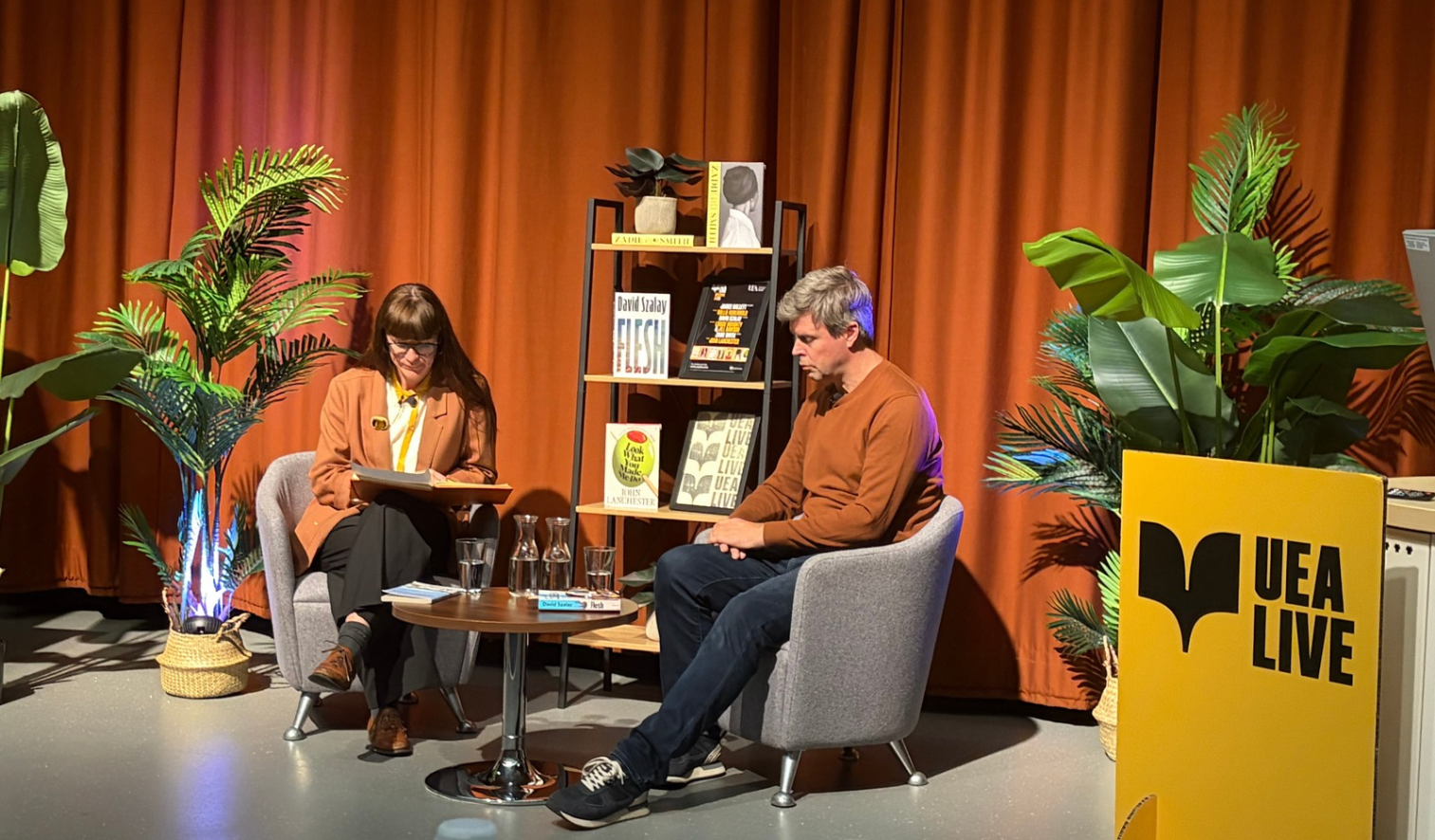
What does it mean to be masculine in the modern world? In David Szalay’s 2025 Booker Prize-winning novel Flesh, this question emerges through the life of István, a man whose emotional restraint and apparent passivity complicate traditional understandings of masculinity.
Over 200 were in attendance on 14 October at Lecture Theatre 1 to hear David discuss Flesh, with the conversation hosted by Associate Professor in Creative Writing at UEA, Dr. Naomi Wood.
Flesh is a rags-to-riches story which follows István’s ascension from post-communist Hungary to military service in the Iraq War to the aristocracy of London’s elite. The novel interrogates lust, wealth and what it means to truly love another person.
Szalay’s sparse prose gives the novel a directness but why was it the optimal approach? Szalay explained that Turbulence was originally written for radio, requiring each scene to adhere to a similarly brief length. He also cited Katherine Faw’s Ultraluminous as an influence on the minimalist style he subsequently adopted in Flesh.
Szalay’s ability to create a compelling protagonist in István, despite minimal insight into his inward emotions, is part of the text’s intrigue. Szalay said this approach was ‘about keeping the emphasis on the physical’ and that ‘we assemble a coherent idea of who a person is instinctively. There was an idea of wanting to present István in that way.’
Although István rarely articulates his feelings, Szalay resisted the suggestion that he had deliberately created a recognisable masculine archetype. Instead, he explained that his approach was rooted in physical experience: ‘Physicality is the foundational experience of our lives, our physical being and everything that follows is associated with that.’

Flesh has a fragmented structure throughout, typical of Szalay’s previous work, often skipping forward to different moments in István’s life. Although, Szalay touched on how he didn’t immediately know the story would develop into a novel: ‘The first chapter was the first part to be written which isn’t always the case. I didn’t know when writing this part it would be a novel, maybe a short story. Then I thought about what type of novel this chapter could be of and that is when I thought about physicality’.
István’s time spent serving during the Iraq war and his experiences with PTSD impacts him throughout the rest of his life.
Whilst other writers could have resorted to clichés around trauma, Szalay differentiates between the standardisation of language in reality for such trauma which he says ‘is useful since there’s a reason for it to be standardised’, whilst contrasting this with a novel which ‘can get away from that standardisation, so I was looking for it to get away from that type of narrative in the conventional sense.’
This emphasis on language, despite the novel’s stripped prose and István’s minimal utterances, was at the centre of Szalay’s approach: ‘I could have written a more conventional trauma narrative; it’s not like I said those narratives are false since it’s within this story, I just tried to avoid standard ways of talking about them.’
But what does the title ‘Flesh’ truly mean? The title can have different associations for different readers, with Szalay noting: ‘[it has] different emotional contexts, different meanings.’
On the depiction of sex in the novel, Szalay encouraged readers to interpret such interactions between characters without moralising: ‘the book as a whole does refrain from judgement generally in all kinds of ways. The book depicts what happens without by and large explaining to the reader what they should think and feel, unless it’s in an implicit way’
Rather than categorising characters as victims or perpetrators, Szalay appears more interested in the uncertainty surrounding their relationships.
His reluctance to impose moral judgements invites readers to confront the uncomfortable possibility that manipulation and affection are not always mutually exclusive: ‘I find stories in which it’s very easy to identity moral and immoral are boring. It’s interesting when things are ambiguous and that was one of the things that drew me to this story. Who’s the victim and perpetrator and whose taking advantage of whom? It’s quite deliberate to create situations around that.’
Alongside masculinity, discovering what love means for István, in the sense of platonic love and romantic love in relation to a man, is key. On István’s connections with other men, Szalay says: ‘Male friendship isn’t as nearly present in the book as his sexual relationships with various women. That gives him a sense of being a lone wolf.’
Szalay went on to say ‘the whole book is an exploration’ of what love is to István: ‘For me love is at the centre of the book in a way, what it is. The question of love is repeatedly broached in various different contexts.’
As Szalay turns his attention towards a potential film adaptation of Flesh, the novel’s distinctive exploration of physicality, emotional restraint and moral ambiguity offers an intriguing challenge for the screen. Whether István’s inner life can remain as elusive on film as it does on the page, whilst replicating Szalay’s fragmented structure, is perhaps the most compelling question of all: ‘It’s almost more of a film’s grammar than it is a novel in terms of jumping years forward.’ Szalay says. ‘Those jumps are very much present in it, but fewer since they’ve been simplified.’
UEA Live’s Autumn programme continues with two events featuring authors Zadie Smith and John Lanchester.
Student tickets are £6 and bookable at www.uealive.com
Image credit: Samuel Haines




Leave a Reply