
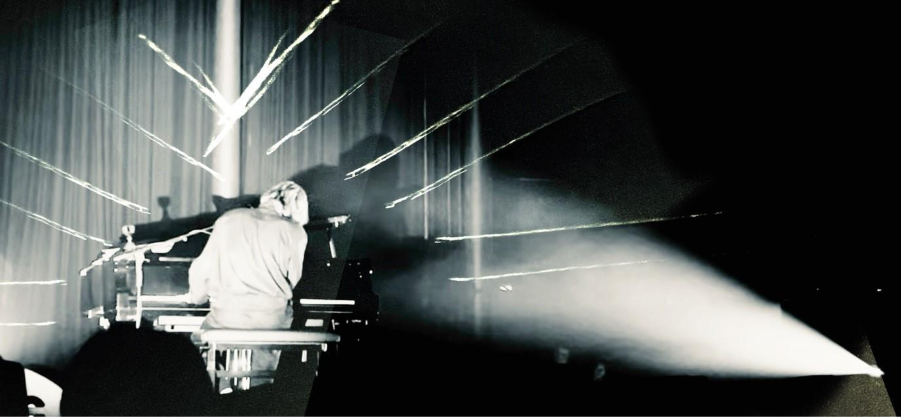
Boney fingers plucked the piano keys with a graceful vigour, weaving the silent crowd into stained glass. The boy, hunched over and turned away from his own kind, drawled with cold ache into the December evening, crazed by visions of wild horses, domestic grace, tumours, ukuleles and The Rolling Stones.
I was leaning against the railing, physically metres away from Mr. Cameron Winter, but my head was sunk within the magnetic strings of the Steinway, beaten blue and warm with a croon of:
“Lonely as hell, walking around/
Without moving, I’m not here.”
The crowd was unmoved, frozen, but still somehow thawed for that moment with saltwater entering eyelids. There was no opportunity to sing along, no movement, no undercurrent of sardonic conversation. Cameron plucked the notes slowly, leaving empty space between the words and the music. Every person in the roundhouse was stood completely silent.
Cameron Winter’s lyricism speaks to an absurdity in my generation. His strange lyrics cut past the obvious and capture a (dare I say) brain-rotted nihilism but doing so with the melancholic chic of a Leonard Cohen.
“Oh, I painted over the perfect nose/
That touches something you learned in 2011”
Lyrics such as these sound as though they were taken from the contents of an evening doomscroll and then filtered through a Francis Bacon painting. But more than any analytical notion can offer, Cameron Winter’s importance in culture is very apparent. This is mainly because of how his work has seep into all my friends’ lives.
The reverence doesn’t feel disembodied, as though we are looking up to an unreachable northern star. It feels like, maybe for the first time in my life, there is someone accustomed to my collective generational experience of: disconnection, isolation, paranoia and apathy. It’s not a higher-up with wrinkled fingers and an ignorant brow commenting on the misgivings and misdirection of Gen-Z, nor is it someone trying to voice pushback and provide a response. Instead, it’s someone capturing, rather than commenting, on the emotive undercurrent of the current youth, through impressionistic rambles and post-rock irony.
The detached inclusion of Brian Jones’ death in the opening track of Heavy Metal, showcases how the Rock N Roll myth has died, and that we are perhaps all too aware of the conventions of rock stardom for any new Patti Smith or Bowie to exist again. Titling the opening track “The Rolling Stones,” is an intentional misstep to both induce confusion in the listener and perhaps comment on how The Stones as a band are symbolic of a wider bygone moment in culture. So here comes the new Rolling Stones, via Heavy Metal, in which rock mythos is deconstructed through blunt humour and Cameron’s typically off-kilter ramblings. Strangely, through this irony, Cameron is creating a mythic status for himself. By deconstructing myth, he inserts himself into it.
Not long after the applause faded, Cameron re-entered the stage for the encore. In a Bob Dylan-esque contrariness, he sat down again and performed with his back turned away from the audience. The final song was perhaps the one that best defines his approach to songwriting: Cancer of the Skull.
I looked back towards the thousands of people standing behind me. They all watched on, as though there was a ghost upon the stage. Across the seated section, the stage lights casted a silhouette of Cameron and his piano, looming like a cathedral spire. The silhouette of his face wavered with intent, over the top of the hypnotised crowd, and then up, towards the ceiling.
Photo credit: Ben Heiss





Leave a Reply